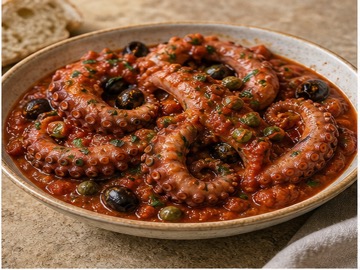
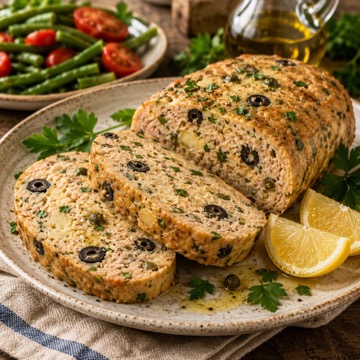
Spigola all'Acqua Pazza
Branzino al vino bianco — due versioni, una tradizione
The acqua pazza exists in two legitimate and distinct versions in Naples: with cherry tomatoes and without. My mother made it without tomatoes. Just the fish, olive oil, garlic, white wine, water, and fresh parsley. The cooking liquid was light, clear, and tasted of the sea. Both versions are on this page. A Napule, o sapore è 'na cosa seria.
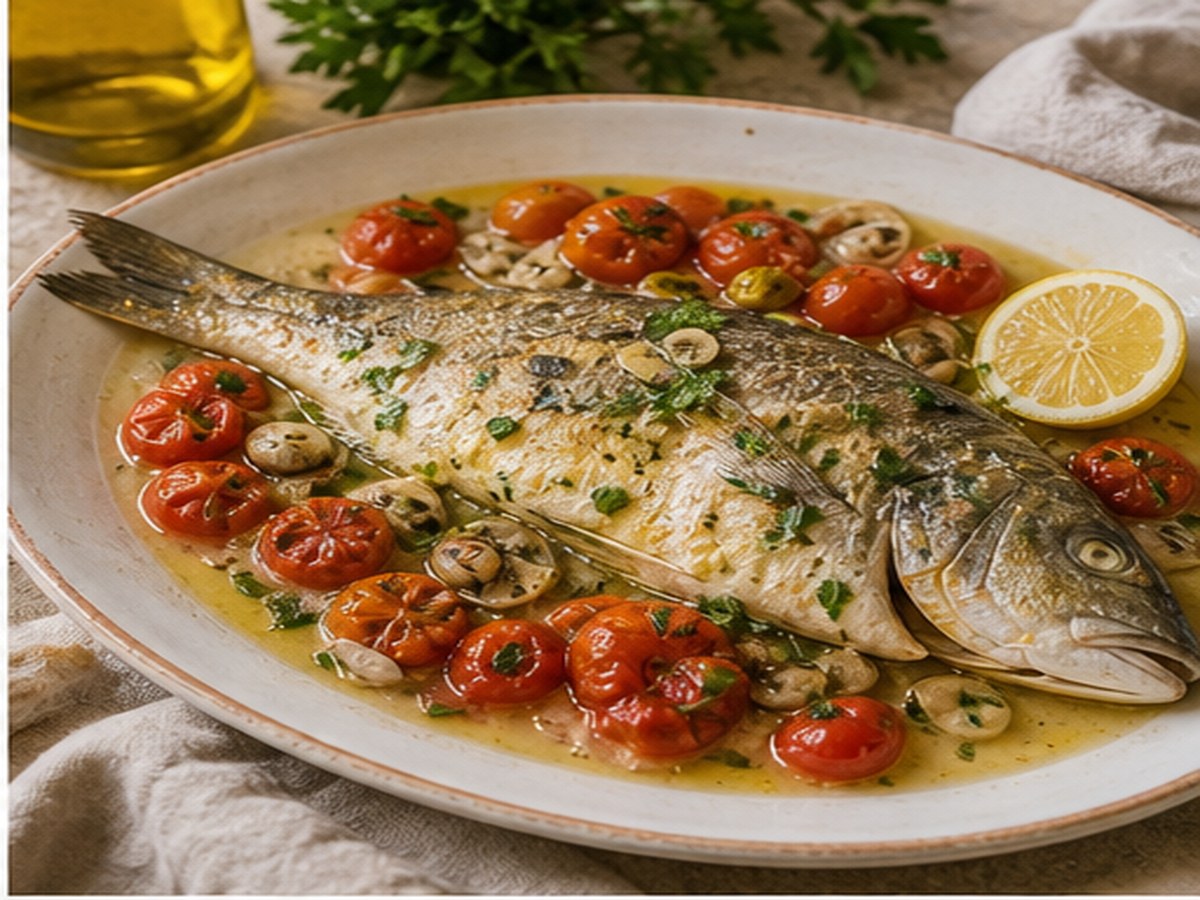
The name acqua pazza — crazy water — refers to the cooking liquid, and there are different theories about where it comes from. The most likely is that it describes the way the liquid behaves in the pan: the combination of olive oil and water or wine produces a turbulent, slightly foamy surface during cooking, which someone at some point decided looked crazy. The name stuck and the preparation became one of the defining fish dishes of the Neapolitan tradition — simple, fast, and entirely dependent on the quality of the fish for its success.
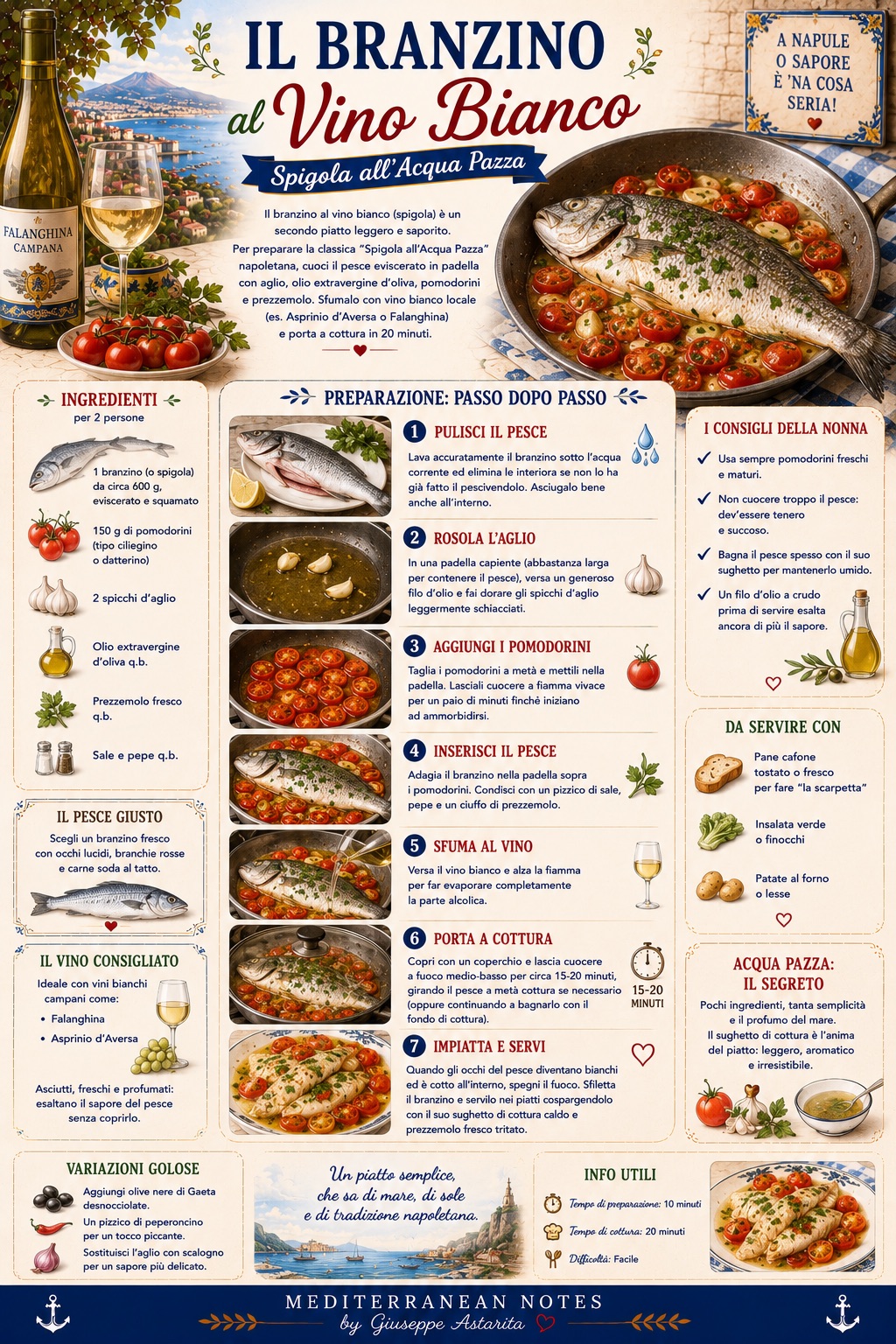
My mother's version had no tomatoes. This is worth stating clearly because the version most commonly described as acqua pazza in contemporary recipes, in restaurants, and in the infographic I am working from includes cherry tomatoes as a central element. The tomato version is authentic and good — the tomatoes give the cooking liquid color and acidity and a richer flavor. But it is not the only version, and it was not my mother's version. Hers was cleaner and lighter: olive oil, two cloves of garlic, a good glass of Falanghina or whatever white wine was open, a splash of water, fresh parsley at the end. The fish cooked in this liquid for fifteen to twenty minutes and came out with the flesh tender, the skin intact, and a cooking liquid around it that was pale, slightly cloudy with the fish's own proteins, and very good spooned over the fish or used for the scarpetta with pane cafone. It is the version I grew up eating and the one I make most often.
The fish is everything in both versions. The branzino — called spigola in Campania and branzino in most of the rest of Italy — is a sea bass with white, firm flesh and a mild, clean flavor that responds well to the wine-and-oil cooking environment. Fresh branzino has specific and reliable signs: bright, clear eyes (never cloudy or sunken), bright red gills under the operculum, firm flesh that springs back when pressed. A fish that fails any of these tests is not fresh and should not be used for acqua pazza, which has nothing to hide it behind.
My mother had a simple way of describing what a good fresh fish does when it is cooked correctly: si scioglie in bocca — it melts in your mouth. Not flaking, not chewing, just dissolving against the palate. That was her standard and her verdict. When she said it about a fish she had just served, it meant everything had gone right — the fish, the cooking, the timing. My aunt Zia Ada used to repeat something her husband, my uncle Dodò, always said: that you have to eat fish with your palate, not chewing, being careful of the bones. He meant that a truly fresh, well-cooked fish should not require the kind of attention that chewing implies. You hold it in your mouth and it gives itself up. The bones become an afterthought rather than a project. Both of them were right, and between those two sayings they described the standard that acqua pazza either meets or does not.
The wine is the other key ingredient. In Campania the traditional white wines for this preparation are the Falanghina — aromatic, fresh, with citrus and floral notes that amplify the delicacy of the fish — and the Asprinio d'Aversa, a bone-dry, slightly acidic white from the province of Caserta that is one of the most underknown wines of the region. Outside Italy, a crisp dry white — unoaked Pinot Grigio, dry Vermentino, Muscadet — works well. The wine should be one you would drink, not a cooking wine. Whatever ethanol-based astringency is in a poor wine will concentrate into the cooking liquid and the result will taste of it.
The infographic's nonna tip — bagna il pesce spesso con il suo sughetto — baste the fish frequently with its own cooking liquid — has a specific scientific basis. Fish flesh dries out much faster than meat during pan cooking because it has less connective tissue and a higher water content relative to protein. As the fish cooks, the myosin proteins in the outer layer of flesh denature and contract, squeezing water out of the muscle toward the surface. If this expelled water is not replenished from outside, the outer flesh dries before the interior is cooked. Basting replaces this moisture continuously, keeping the surface hydrated while the heat penetrates through to the center. The oil in the basting liquid also forms a thin barrier that slows further evaporation. The doneness indicator — the eyes turning completely white and opaque — is a reliable surface-level marker: the proteins in the ocular fluid denature at around 63–65°C, turning the previously clear vitreous humor opaque white. When the eyes are fully white, the pan temperature has been sufficient to cook the flesh adjacent to the eye cavity, which is one of the deepest points of the fish. Testing with a fork at the thickest part of the back remains the most reliable confirmation. The flesh should separate cleanly into flakes and look opaque white throughout, with no translucency at the center.
La ricetta — versione di mia madre (in bianco)
La variante con pomodorini
For the classic Neapolitan version with tomatoes, add 150 g of cherry tomatoes (Vesuvian type, halved) after the garlic has colored at step 2. Cook them over a lively flame for 2 minutes until they just begin to soften. Then lay the fish on top of the tomatoes and proceed from step 4. The tomatoes collapse during the covered cooking, releasing their juice into the wine and creating the characteristic pink, slightly acidic cooking liquid. Add Gaeta olives and a pinch of chili if you want — both are legitimate additions in the classic version. The result is richer, more complex, and more robust than the white version. Both are correct. My mother preferred the white version. Both deserve pane cafone for the scarpetta at the end.
Il vino giusto
Falanghina from Campania is the first choice — aromatic, fresh, with enough structure to hold its character in the pan without disappearing into the cooking liquid. Asprinio d'Aversa, from the province of Caserta, is the other great local option: bone-dry, high acid, very clean, and unfortunately almost impossible to find outside the region. Outside Italy, an unoaked Vermentino, a dry Pinot Grigio, or a Muscadet all work well. Use the same wine in the glass alongside the fish.
My mother served the spigola with pane cafone and nothing else when it was the main event of the meal. Sometimes a green salad or fennel alongside. Sometimes potatoes boiled separately. The fish was always the point and the cooking liquid in the pan was always the second point, and the bread was the instrument for addressing both. Some meals are structured this simply and are exactly right for it.
Buon appetito — e non dimenticare la scarpetta nel fondo della padella.