Italian Food Hand Gestures
The language of Naples at the table — eight gestures that run a Sunday lunch, why a port city needed them, and the one that grandmothers always ignore.
Few cultures speak with their hands as fluently as Italians, and in Naples the dialect is at its richest precisely where it matters most: at the table. A single movement of the fingers can express delight, suspicion, hunger, surrender, or pure culinary ecstasy — often faster and more precisely than the sentence it replaces. Growing up, you did not learn these gestures; you absorbed them, the way you absorbed the smell of ragù on Sunday morning. By the time I noticed I was using them, I had been using them for years — and I still use them in Massachusetts, where they occasionally require subtitles.
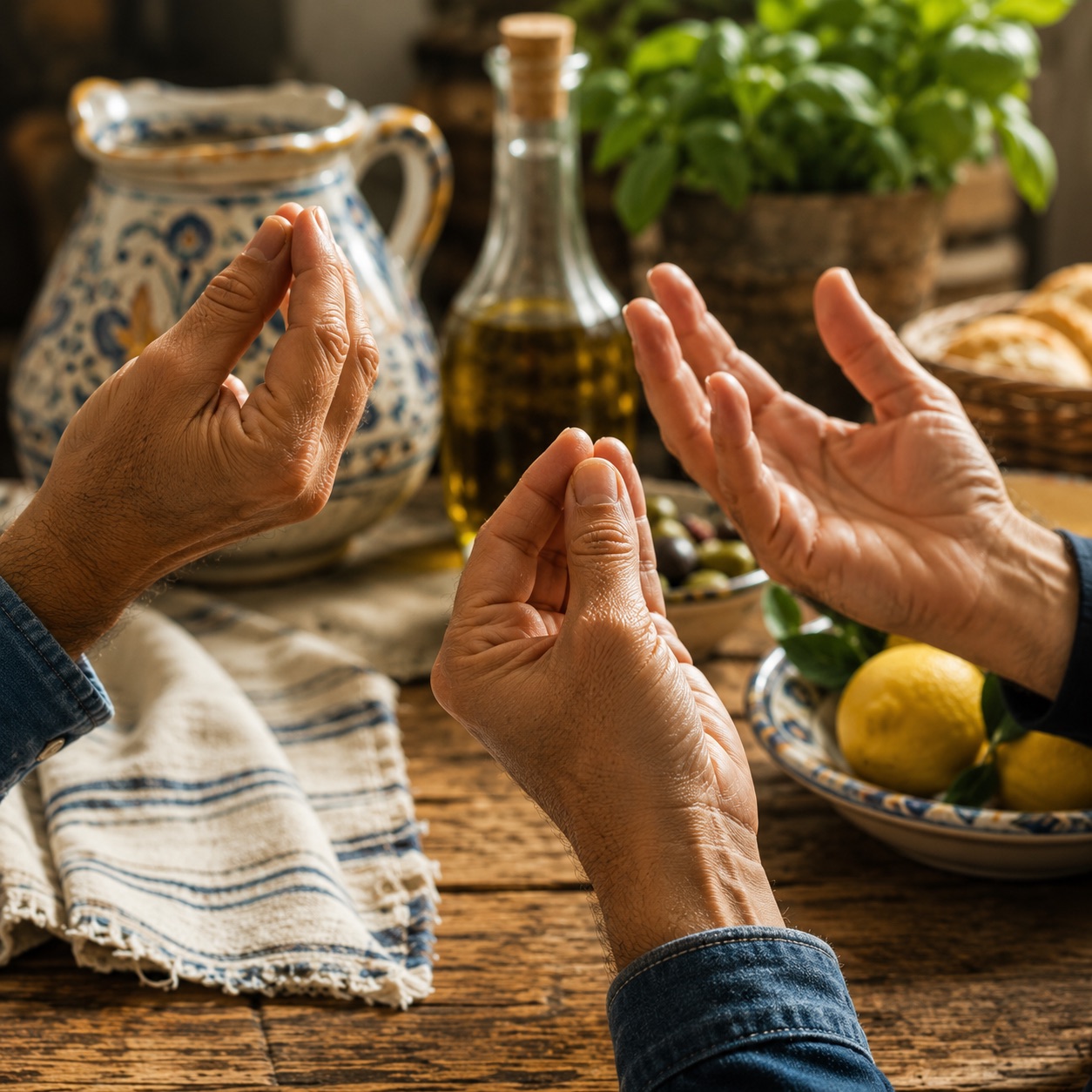
The vocabulary is real and surprisingly standardized. The pinched fingers swung at the wrist — ma che vuò? — is perhaps the most famous Italian gesture on earth, deployed at the table for everything from "when is the food ready?" to sincere doubts about someone's pizza opinions. The same pinch held still and kissed becomes che buono! — the verdict after the first bite of something serious. The thumb-and-index ring is technical approval: the pasta is cooked exactly right. The slow upright palm is basta, "stop serving me" — a gesture, it must be said, with a long history of being completely ignored by Neapolitan grandmothers.
Why so many? The infographic's anthropology is sound: Naples was for centuries crowded, cosmopolitan, full of sailors and traders, layered with dialects that did not always understand each other. The hands became the lingua franca — a channel that worked across languages, across the noise of the vicoli, across a table of twelve people all talking at once. A full Neapolitan Sunday lunch can be transcribed almost entirely in gestures: the open arms at arrival (where is everyone?), the kissed fingertips at the antipasto, both hands to heaven at the pasta (mamma mia), the ring of perfection at the secondo, the pinch requesting just a little more at dessert, the upright palm at the coffee — and then, when another dessert appears anyway, no gesture at all, because there is no escape.
The science here is genuinely good: gesture researchers estimate Italians command hundreds of recognizable hand signs — among the densest gesture vocabularies documented — and Neapolitan usage is the dialect's high register. Co-speech gesture is not decoration for language; neuroscience shows it engages the same brain networks as speech itself, and speakers gesture even on the telephone, where nobody can see them. The leading historical account matches the infographic: in a crowded, multilingual port city, a visual channel that cuts across dialects has real communicative value, and once established it propagates culturally like vocabulary. The hands are not commentary on the conversation. They are the conversation.
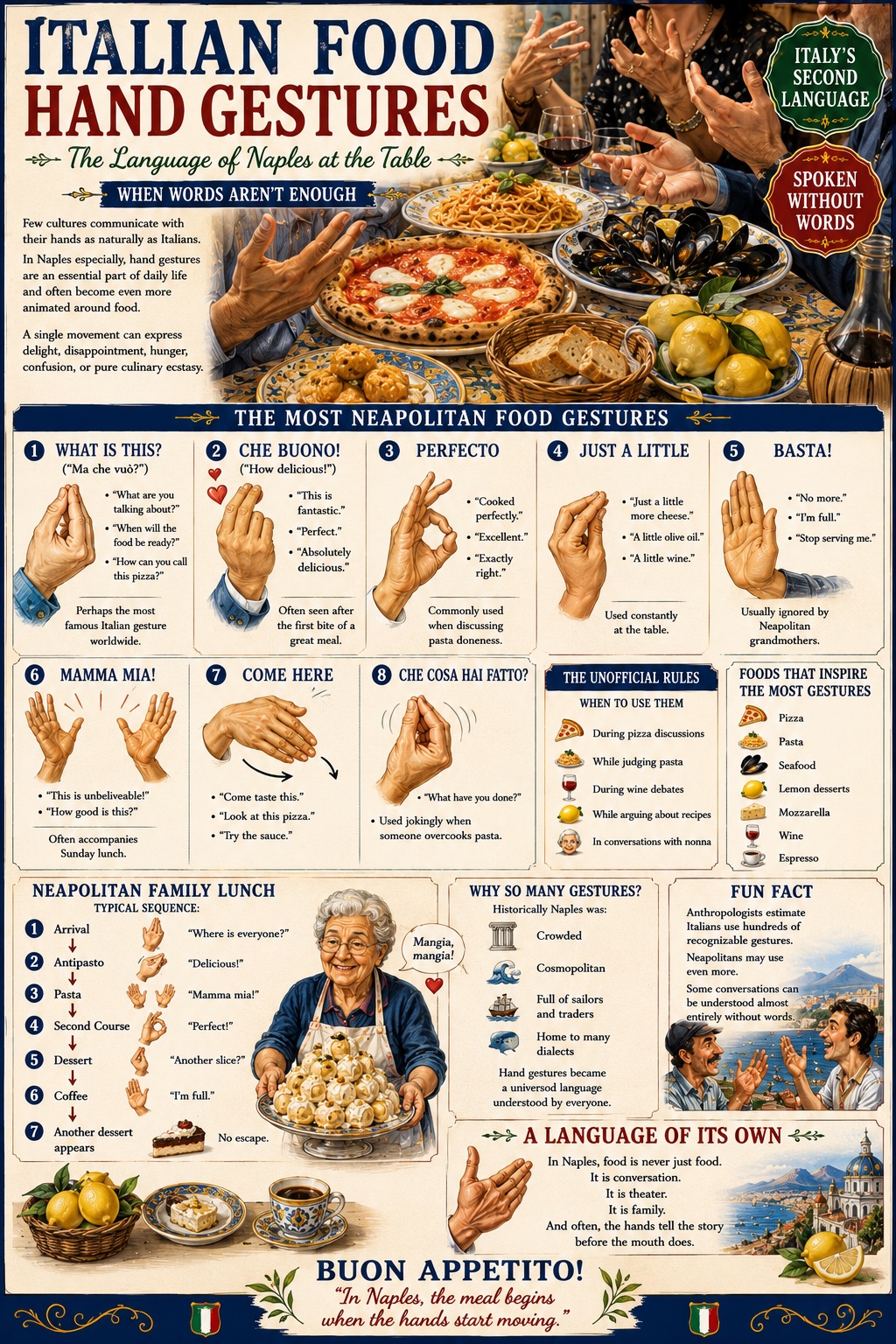
Italian Food Hand Gestures — the most Neapolitan gestures of the table, decoded one by one.
The Gestures, One by One
Eight gestures that run a Neapolitan table
- Ma che vuò? — fingers pinched, wrist swinging: disbelief, impatience, "how can you call this a pizza?"
- Che buono! — the pinch kissed: the verdict after the first bite
- Perfetto — thumb-index ring: the pasta is cooked exactly right
- Just a little — the pinch held out: more cheese, more oil, more wine (a little)
- Basta! — upright palm: "I am full" (routinely overruled)
- Mamma mia! — both hands raised: disbelief, delight, Sunday lunch
- Come here — the scooping hand: "come taste this"
- Che cosa hai fatto? — the slow shake of the pinch: used jokingly on whoever overcooked the pasta