Frittura di Calamari
The Neapolitan Way — Crispy Outside, Tender Inside
Fried calamari was one of the few seafood things my father would eat. We loved to order it at the restaurant, and for a period my parents owned a small electric fryer that went on the balcony next to the kitchen — outside, because of the smell. We made various fritture: calamari, mixed fish, arancini, patatine fritte, crocchè di patate. The balcony did everything.
The small electric fryer on the balcony — this is the same balcony as the charcoal grill, which makes it the most actively used outdoor cooking space in the collection. The fryer went outside because frying produces a smell that fills an apartment and lingers, and putting it on the balcony kept the smell in the open air rather than in the kitchen and the curtains. This was a practical decision that also turned the preparation into an outdoor activity — the fryer on the floor of the balcony, someone monitoring the temperature, the calamari going in in small batches, the sound of the sizzle, the steam rising. It was its own kind of occasion, different from the grill but sharing the same space.
The fritture that came from that balcony fryer over the years: calamari and mixed seafood (frittura di pesce mista), arancini made from leftover risotto, potato croquettes (crocchè di patate), plain fried potatoes. Each one requiring the oil at the right temperature, the right amount per batch, the patience to drain on paper before salting. My father ate the calamari — the one seafood preparation that made it through his specific reservations about fish — and the arancini and the crocchè, which are not seafood at all and which are a story of their own.
Fried calamari is one of those preparations that looks simple and is, in the technique, genuinely not complicated — but that depends entirely on a few things being right: the calamari completely dry before breading, the flour the correct type, the oil at the correct temperature, the batches small enough not to drop the temperature. When all of these are right the result is golden, dry, crisp on the outside and tender inside, and it does not taste oily because the moisture barrier created by the crust prevented the oil from entering the interior. When any of them are wrong the calamari is pale and soft or greasy and overcooked. The margin between right and wrong is narrower than it appears.
The secret is simple: dry the calamari and use the right flour. The moisture is the enemy of crispiness — water in contact with hot oil steams rather than fries, and steamed calamari is pale and soft. Completely dry, dredged in semolina flour (which forms a crisper crust than all-purpose), fried in small batches at exactly 175–180°C. Salted only just before serving. Never before, which draws moisture. This is the whole technique.
The recipe — serves 4
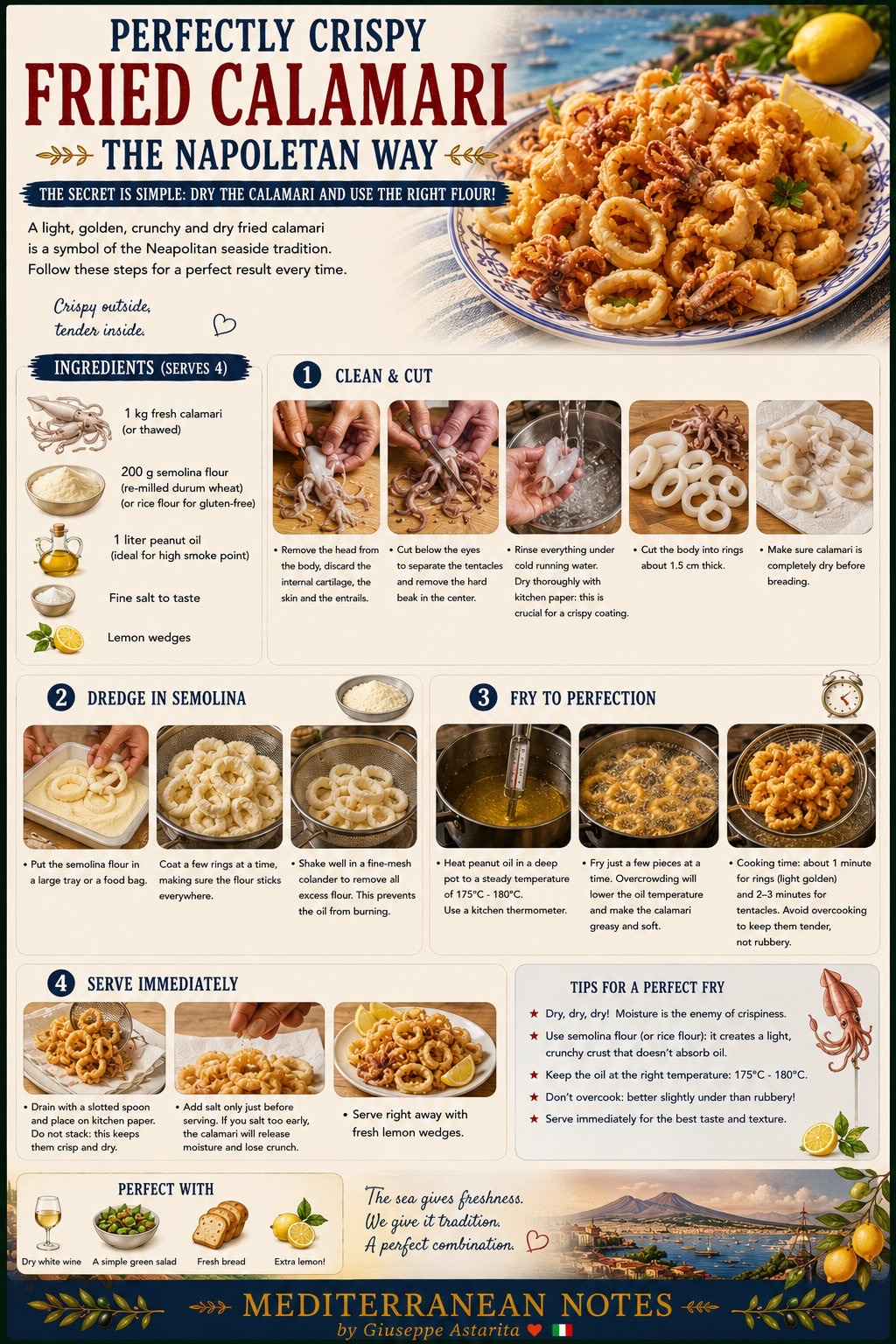
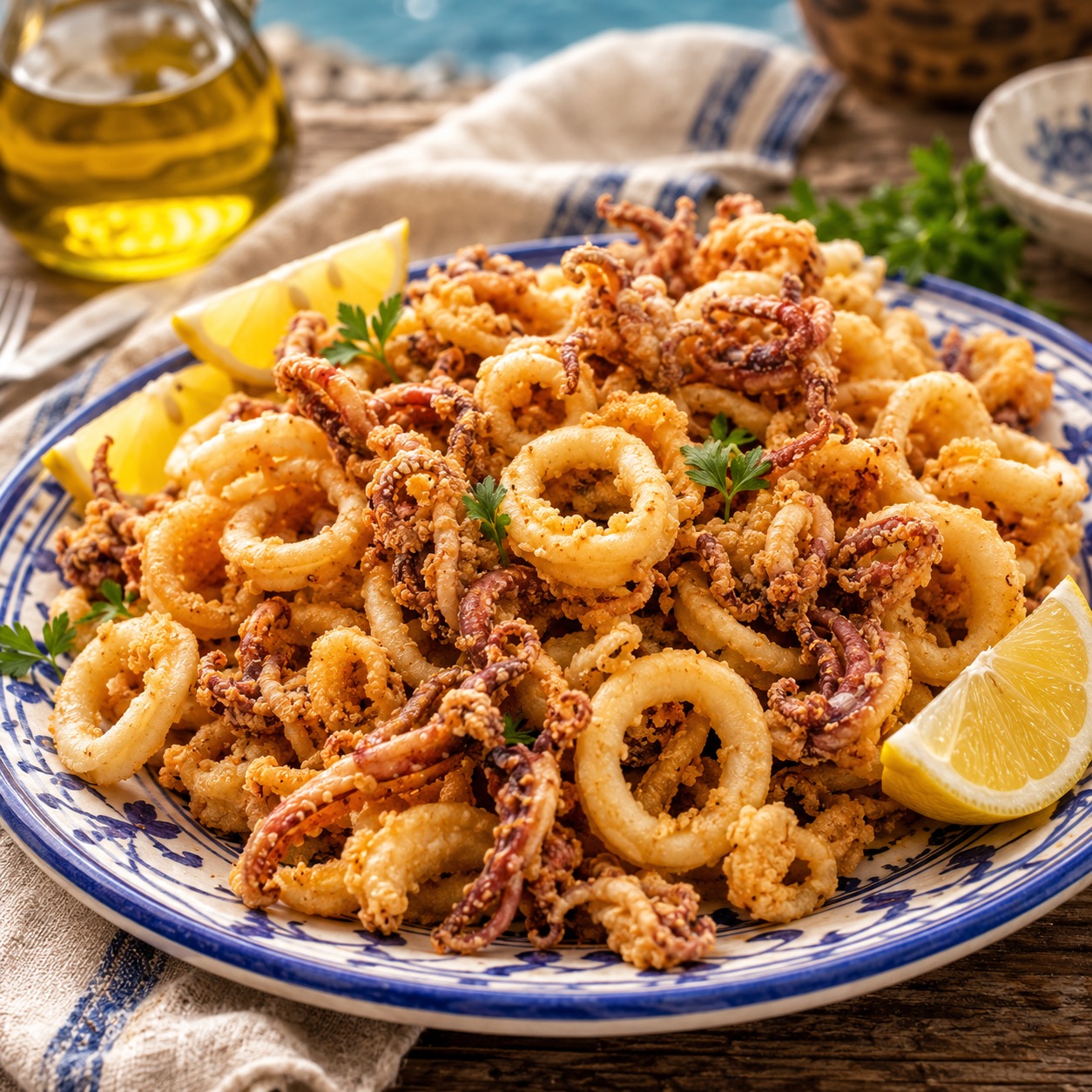
Frittura di calamari — croccanti fuori, teneri dentro. Click to enlarge.
1 kg, fresh or thawedCalamari — cleaned and cut into 1.5 cm rings
200 gSemolina flour (re-milled durum wheat) — the correct flour
1 litrePeanut or sunflower oil — any neutral vegetable oil with a high smoke point
to taste — at the end onlyFine salt
to serveLemon wedges — generous
1
Clean the calamari: pull the head from the body, remove the internal cartilage (the transparent quill), the skin, and the entrails. Cut below the eyes to separate the tentacles; remove the hard beak at the center. Rinse everything thoroughly under cold water. Then dry completely — pat with kitchen paper, press firmly, let them sit on a clean cloth.
Completely dry is not a suggestion.
This is the most important step. Five minutes of careful drying produces calamari that fry correctly. Calamari with surface moisture produces steam in the oil, pale coating, and greasiness. Spend the time.
2
Put the semolina flour in a large tray or food bag. Add the calamari rings in batches, tossing to coat all surfaces. Shake in a fine-mesh colander to remove all excess flour — flour that falls into the oil burns and makes the oil turn dark and bitter quickly.
3
Heat the olive oil in a deep, heavy pot to a steady 175–180°C. Use a thermometer — without it you are guessing and the temperature is too important to guess. Fry a few rings at a time — never crowd the pot. Crowding drops the temperature and produces pale, greasy, soft calamari. Small batches only.
About 1 minute for rings (light golden), 2–3 minutes for tentacles. Remove when golden, not dark. Dark means the interior is already overcooked and rubbery.
4
Drain with a slotted spoon and place on kitchen paper. Do not stack — this traps steam and softens the crust. Salt only just before serving — salt applied earlier draws moisture from the coating and destroys the crispness. Serve immediately with lemon wedges. Fried calamari waits for nobody.
Everything else that came from the balcony fryer
Frittura di pesce mista
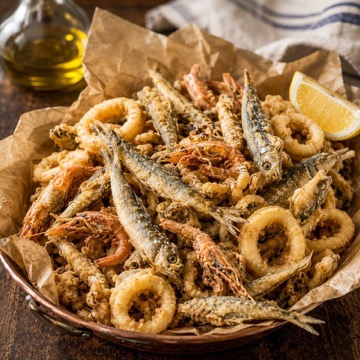
The mixed fish fry — calamari, small shrimp, whitebait, whatever was fresh and small. All dredged in semolina, all fried quickly. The Neapolitan seaside tradition.
Arancini
Rice balls made from leftover risotto, filled with ragù or mozzarella, breaded and fried. Sicilian in origin but deeply embedded in Neapolitan street food culture. Substantial and satisfying.
Crocchè di patate
Potato croquettes — mashed potato with Parmigiano, egg, and parsley, shaped into cylinders and fried. A staple of Neapolitan street food and the rosticceria. My father ate these without any reservation about their seafood-free contents.
Patatine fritte
Plain fried potatoes. The simplest use of the fryer and the one that needed no occasion or preparation. Cut, dry, fry, salt immediately. Always welcome.
Small fried pizza dough — the Christmas Eve tradition already described in the
pizza di scarola post. Fried and topped with tomato and cheese, or plain. The balcony fryer at its most festive.
The rule
Whatever goes in the fryer: completely dry before dredging, the right flour for the right thing, oil at temperature, small batches, drain on paper, salt at the end. The rules are the same for calamari, crocchè, or anything else. The technique does not change.
Why semolina flour — and why temperature matters more than anything else
Semolina flour (re-milled durum wheat) produces a crispier, drier crust than all-purpose flour for two reasons. First, its larger particle size creates a more open, porous coating that allows steam to escape more efficiently during frying — if steam cannot escape, it condenses inside the crust and makes it soggy. Second, durum wheat has a higher protein content (12–14% compared to 9–11% for all-purpose) which forms a stiffer, more rigid gluten network when hydrated and fried, producing a crust that holds its crunch longer after coming out of the oil. Rice flour, mentioned in the infographic as a gluten-free alternative, works similarly: its lack of gluten means the coating doesn't become chewy, and its starch gelatinizes into an exceptionally light, crisp layer.
The oil temperature is the single most critical variable. At 175–180°C, the surface moisture of the calamari vaporizes instantly on contact, creating a steam barrier that prevents the oil from penetrating the coating while the Maillard reaction browns the exterior. Below 165°C, the oil penetrates the coating before the crust has set — producing greasy, oil-saturated calamari. Above 190°C, the exterior burns before the interior is cooked. The narrow window of 175–180°C is not arbitrary: it is the temperature at which the surface seals fast enough to protect the interior while the browning reactions proceed at the correct rate. Crowding the pan drops the oil temperature by 10–20°C immediately, which is why small batches are not optional.
On the outdoor fryer — and why it was on the balcony
Deep frying in a closed kitchen produces a specific smell that permeates fabrics, hair, and surfaces for hours after the cooking is done. This is not a problem in itself — the smell of frying is pleasant while the food is being made — but it is a reason why families who fried regularly found ways to move the operation outdoors. The electric fryer on the balcony was a practical solution: the smell dispersed into the open air, the oil splatter stayed outside, and the preparation became an outdoor activity rather than a kitchen one.
This also explains why frying was, in our house, an occasion rather than a routine. Setting up the fryer on the balcony, monitoring the temperature, working in batches — this required commitment and attention that indoor, stovetop frying would also require but that was amplified by the outdoor setup. The occasions when the balcony fryer appeared were specific: the family gathering where a large quantity was needed, the holiday preparation, the Sunday when the crocchè or the calamari were going to be worth the effort. The same logic as the charcoal grill in the same space: occasion cooking, not weekday cooking.
The balcony of that apartment in Caserta contained, across different occasions: the charcoal grill for the artichokes and the meat, the electric fryer for the calamari and the crocchè and the arancini, and the drying rack for the laundry. It was a working balcony, a cooking extension of the kitchen, a space that got used rather than merely occupied. These details matter because they describe a way of living in an apartment — making the available space work for whatever was needed, moving the cooking outside when the inside was not suited for it. The balcony as kitchen annex. Both the smell of charcoal and the smell of frying drifted toward the street. The street knew what was being made upstairs.
Croccanti fuori, teneri dentro — e sempre il limone a lato.