Alici 'ndurate e fritte
'Ndurate means gilded — coated in beaten egg until they look gold before they even hit the oil. Pan-fried in hot olive oil until the egg crust sets and the fish inside is just cooked. No batter, no flour, no breadcrumbs. The simplest fried anchovy and the one that disappears fastest. Eat with lemon while they are still hot.
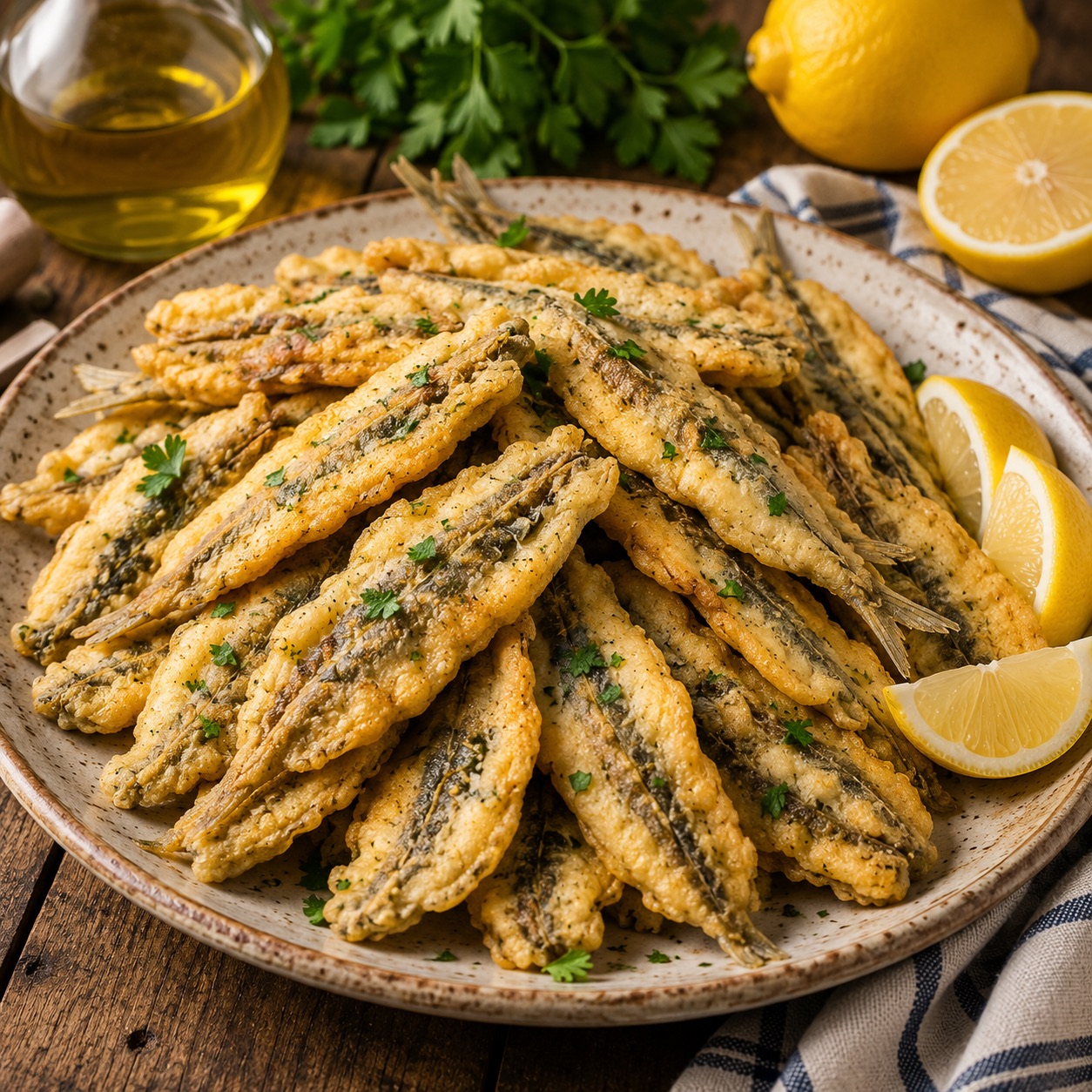
The word 'ndurate comes from indorato — gilded, turned gold. It describes what happens to the anchovy when it is dipped in beaten egg: the egg coat gives the small fish a warm, pale yellow sheen before it touches the oil, and the finished fish emerges a deeper gold from the pan. This is the Neapolitan name and the Neapolitan method, distinct from the battered version and the breadcrumbed version in both technique and result. The egg coat is thin and direct; it clings to every contour of the butterflied fish and fries to a delicate, slightly creamy crust rather than the more substantial shell of a batter or the crunch of a breadcrumb.
My mother made these on the evenings when she wanted something quick and the anchovies were good. The preparation is essentially nothing: clean the fish, beat the eggs with a pinch of salt, dip, fry, drain, eat. The entire process from cleaned fish to plate takes less than fifteen minutes if you move efficiently. The only requirement is hot oil — consistently hot, not fluctuating — and the discipline not to crowd the pan. Crowded anchovies steam rather than fry; the egg coat turns pale and soft rather than golden and set. Work in small batches. The pan should sizzle immediately when each fish goes in.
The distinction from the other fried alici page — alici fritte — is the coating. That version uses a light flour coat or a sparkling-water batter; the crust is thicker and crispier, the fish more enclosed. The 'ndurate version uses only egg; the result is lighter and more immediate, the flavor of the anchovy more present through the thinner coat. Both are right. They are different dishes with different characters. On evenings when my mother wanted something between the completely uncoated and the fully battered, this was the answer.
Why egg alone makes a different crust from batter — protein coagulation vs starch gelatinization
A flour or batter coating works primarily through starch gelatinization and subsequent Maillard browning: the starch granules absorb oil and water during frying, swell and set into a rigid matrix, and the proteins and reducing sugars at the surface undergo Maillard reactions producing the characteristic deep golden color and toasted aroma. The result is a self-contained shell that separates physically from the fish beneath. An egg coating works differently: the egg proteins — primarily ovalbumin, conalbumin, and ovomucin — coagulate directly at around 65–70°C and bond to the surface proteins of the anchovy flesh as they set, creating a coating that is chemically bonded to the fish rather than mechanically surrounding it. The crust is thinner, more delicate, and does not have the crunch of a starch-based coating; it has instead a soft exterior that gives way immediately, with the anchovy flavor coming through without the insulation of a thick batter. The oil temperature matters more with egg than with batter: below 170°C the egg coagulates slowly and absorbs oil rather than setting; above 180°C it sets fast and clean. A consistent 175–180°C is the target.
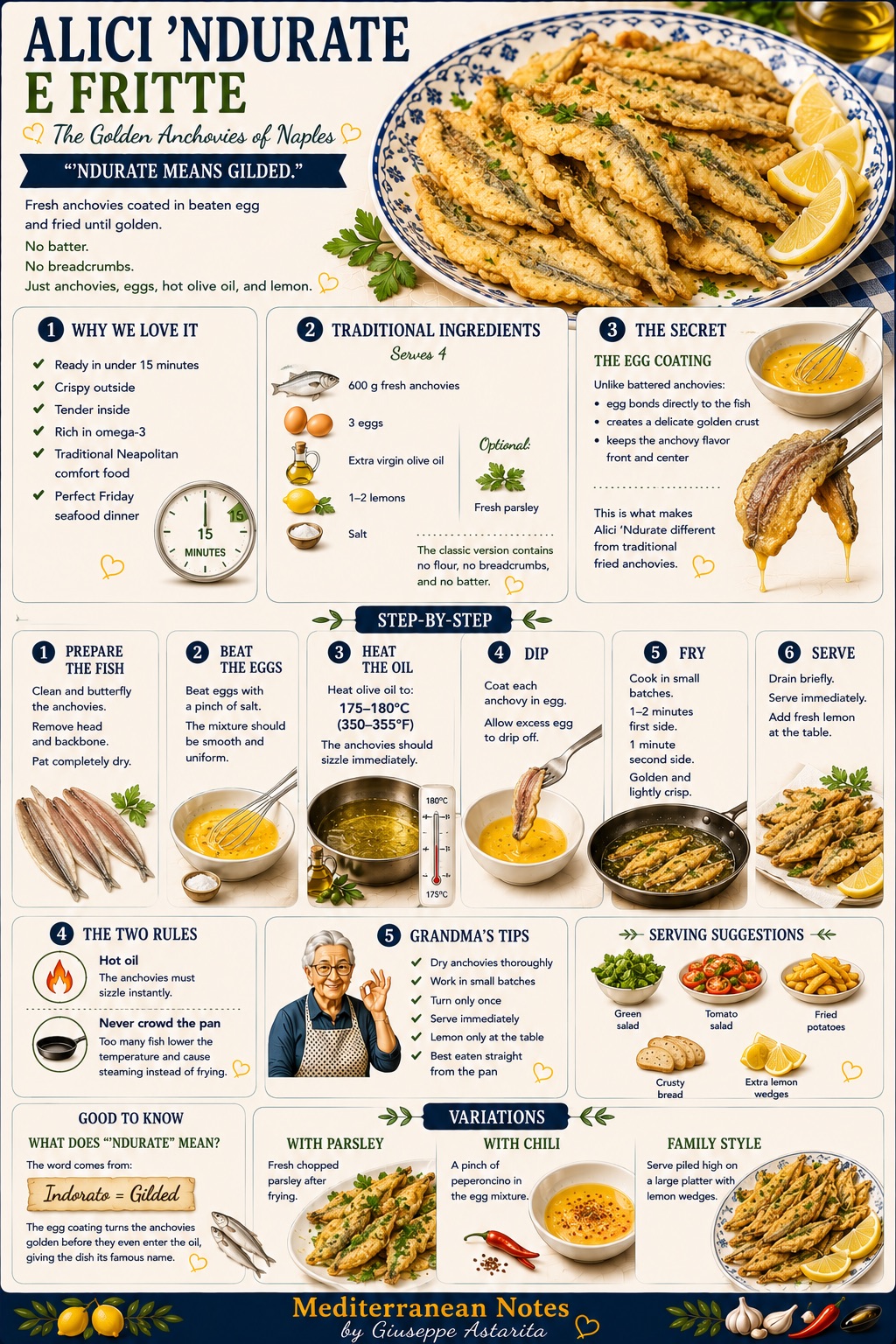
Recipe — serves 4
Ingredients
Method
Prepare the anchovies. Clean, butterfly, remove head and central spine. Pat dry thoroughly with kitchen paper. Dry fish means the egg adheres evenly; wet fish means the egg slides off in the oil.
Beat the eggs. In a shallow bowl, beat 3 eggs with a pinch of salt until completely uniform — no streaks of white. The bowl should be wide enough to dip the butterflied fish flat.
Heat the oil. Pour olive oil into a wide skillet to a depth of about 1 cm. Heat over medium-high until it reaches 175–180°C. If you don't have a thermometer: drop a small piece of bread into the oil — it should turn golden in about 30 seconds. If it browns immediately, the oil is too hot; if it sizzles weakly, not hot enough.
The oil temperature is the most important variable. Get it right before you start frying and maintain it throughout by adjusting the heat between batches.
Dip and fry in small batches. Dip each butterflied anchovy in the beaten egg, let the excess drip off for a moment, and lay it gently in the hot oil. Fry 4–5 anchovies at a time — never more. Cook 1–2 minutes on the first side until the egg sets and turns golden on the underside. Turn once carefully with tongs or a fork and cook 1 minute on the second side.
Do not move them while the first side is cooking. Let the egg set undisturbed before you attempt to turn. An anchovy that sticks is one that is not ready to be turned yet.
Drain and serve immediately. Lift the anchovies with a slotted spoon and drain briefly on kitchen paper. Season with a pinch of salt if needed. Serve immediately with lemon wedges. Do not cover, do not hold in the oven. These are at their best in the two minutes after they come out of the oil.
My mother brought them to the table directly from the pan, still crackling. No ceremony — just the plate, the lemon, and the instruction to eat now.
There is nothing difficult about this dish. What it requires is presence — you need to be at the pan, paying attention, moving efficiently between the egg bowl and the oil. The anchovies cook in minutes and are best eaten in minutes. It is not a dish you make and then do other things. My mother made it on evenings when she was already in the kitchen and the fish was already cleaned and the oil was already hot from something else. The sequence mattered: the setup was casual; the frying was fully attentive.
Dorate, calde, con il limone — mangiatele subito.