Broad Bean Soup
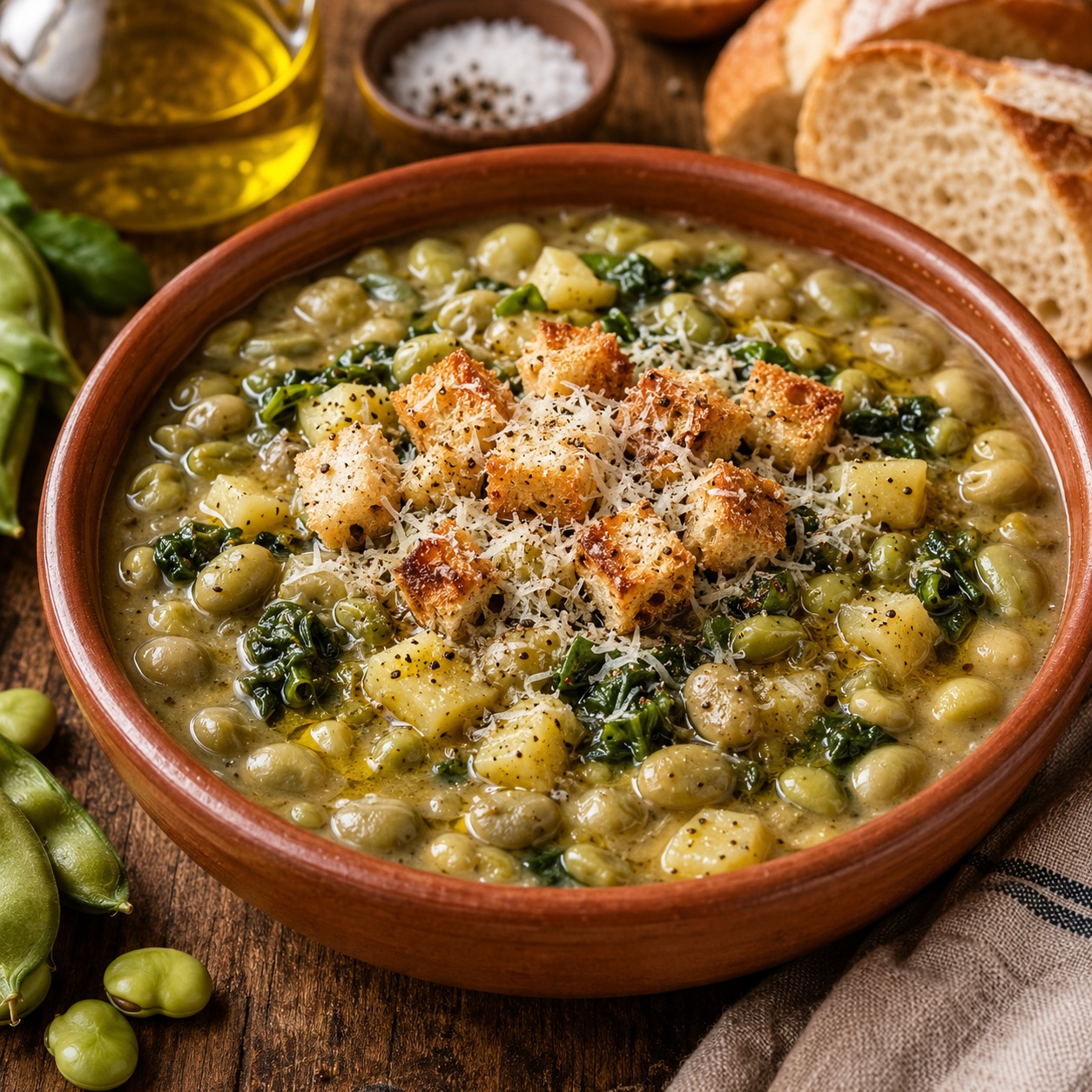
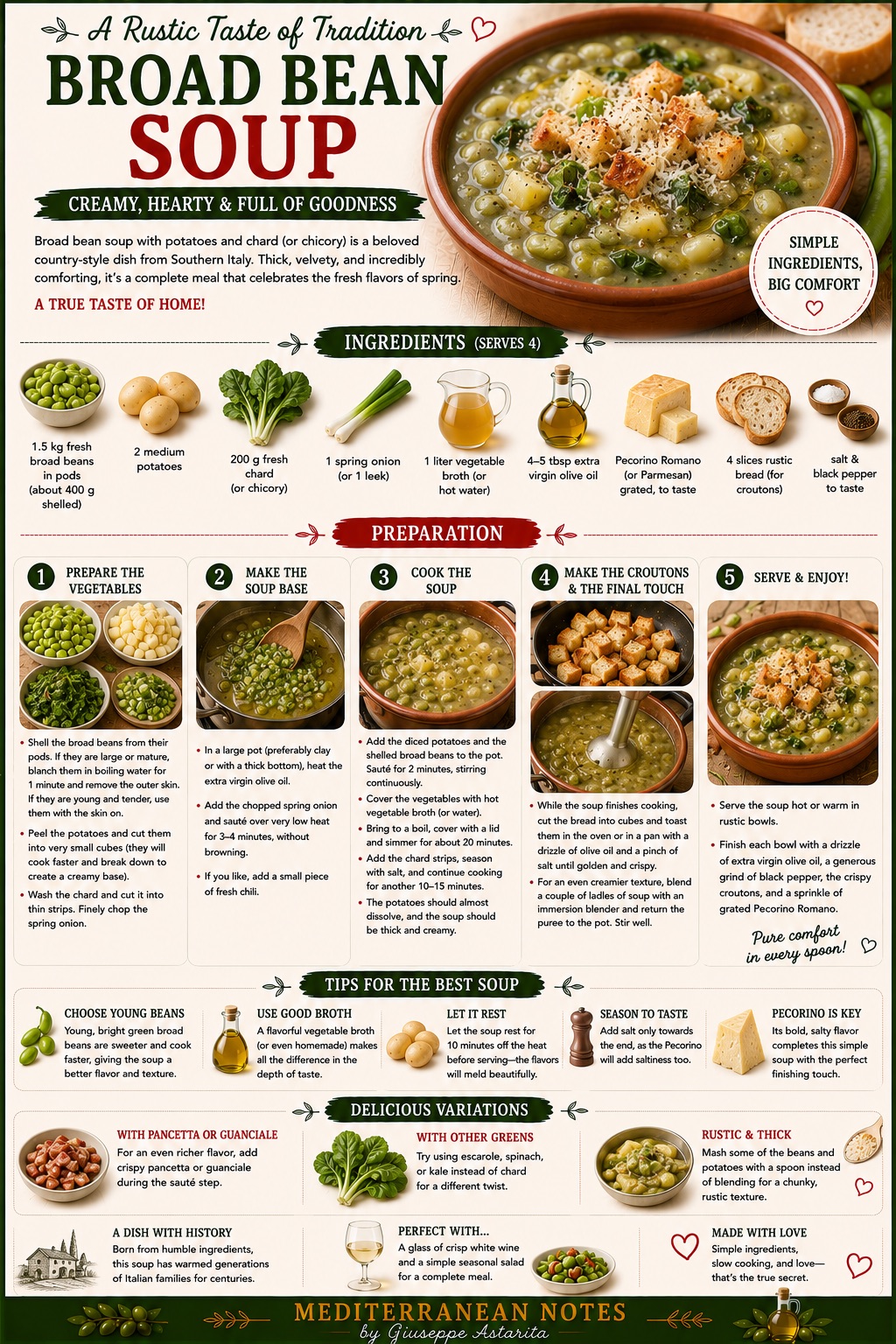
A rustic broad bean soup with potatoes, greens, spring onion, olive oil, broth, bread, and Pecorino.
Ingredients · serves 4
Method
1. Prepare the vegetables. Shell the beans; if large, blanch 1 minute and slip off the skins, if young use them as they are. Cut the potatoes into small cubes (they cook fast and break down to a creamy base). Cut the chard into thin strips and finely chop the spring onion.
2. Make the base. Gently sweat the spring onion in a little olive oil over low heat 3–4 minutes, without browning.
3. Cook the soup. Add the potatoes and beans, sauté 2 minutes, then the chard and a little salt for another 3–4 minutes. Cover with hot broth, bring to a boil, and simmer 25–30 minutes until the potatoes dissolve and the soup is thick.
4. Croutons & the final touch. Cube the bread and toast it golden with a drizzle of oil. For extra creaminess, blend a couple of ladles of soup and stir back in.
5. Serve. Hot in rustic bowls, finished with olive oil, black pepper, the croutons and a sprinkle of Pecorino.
My mother made this in March when fresh fava beans appeared at the market. She shelled them herself — sometimes my sister and I helped, sitting at the kitchen table with a bowl between us, splitting the pods and running a thumb along the inside to pop the beans out. It took most of a Sunday morning for a quantity large enough to make a proper soup. We ate it for lunch and it tasted unmistakably of the season: light, slightly sweet, with the chard still holding its shape, the Pecorino dissolving in ribbons when you stirred it in at the table.
Fresh fava beans are brief in Campania — a few weeks in spring, then gone until the following year. The dried version is a different ingredient entirely: dense, starchy, the basis of the Pugliese fave e cicorie that belongs to a different season and a different sensibility. This soup is the fresh version, and it only makes sense in spring. The beans are still young enough to be slightly sweet, the outer skin thin enough to leave on if you prefer. The greens — chard or chicory, whatever the market had — balance the sweetness and give the soup its backbone.
The olive oil goes in at the end, off the heat, in a quantity that might look excessive. This is not a mistake. That final oil is what rounds the soup and carries the flavors. Do not reduce it.
Fava beans contain vicine and convicine, two glycosides that, when metabolized, produce compounds that generate oxidative stress in red blood cells. In people with G6PD deficiency — a genetic condition affecting glucose-6-phosphate dehydrogenase, an enzyme critical for protecting red blood cells from oxidative damage — eating fava beans can trigger hemolytic anemia, sometimes severely. G6PD deficiency is significantly more common in populations from the Mediterranean, sub-Saharan Africa, and the Middle East than in northern European populations, likely because it confers partial protection against malaria. The condition is X-linked, so it affects males more often and more severely. In southern Italy, where fava beans have been a staple for millennia, the coexistence of this genetic trait and this ingredient in the same population is one of the more striking examples of a food-gene interaction with deep historical roots. Cooking does not fully inactivate vicine and convicine. People who know they carry the variant avoid the beans entirely, and many southern Italian families know this without knowing the biochemistry behind it.