Spaghetti alla puttanesca: my father's fish-night pasta — without the fish
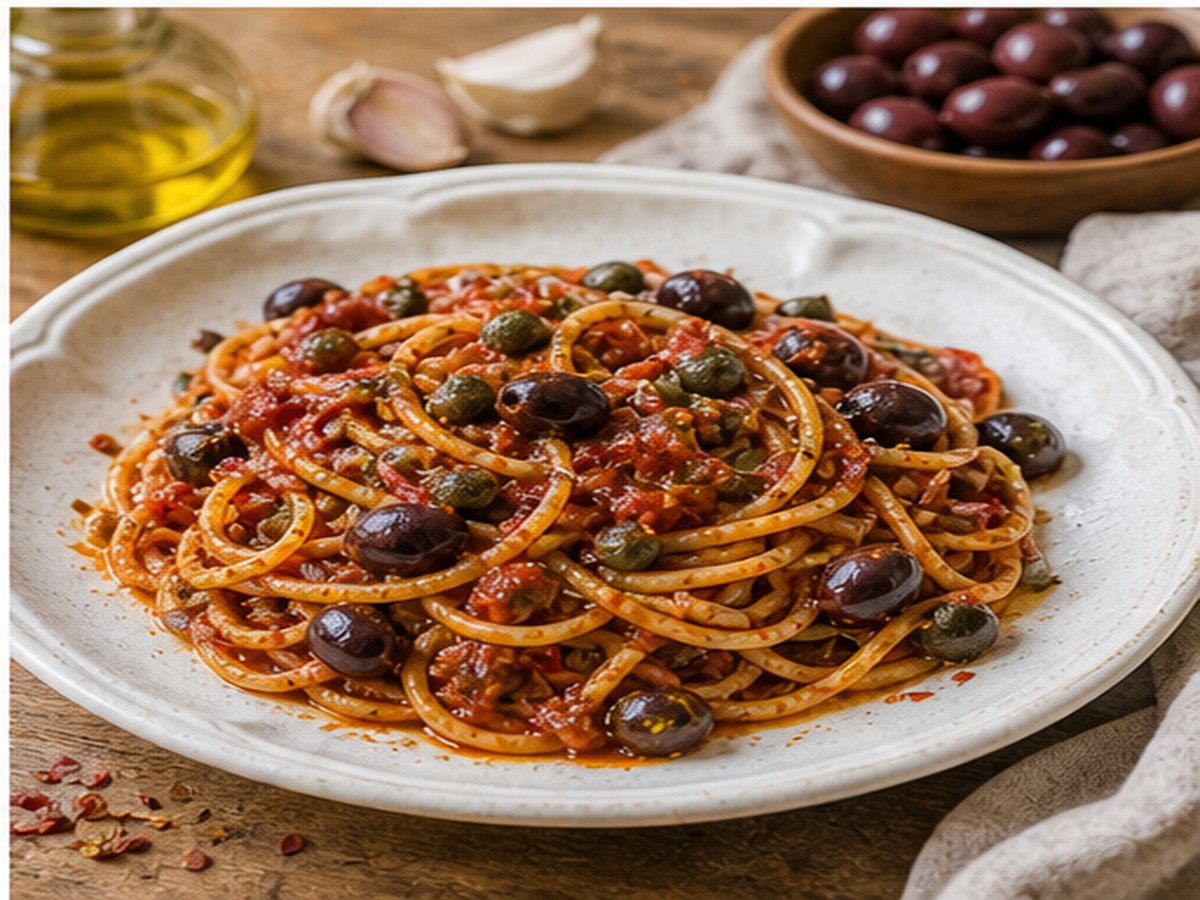
On Christmas Eve, on New Year's Eve, on any night when the table was organized around fish — my father didn't eat fish. The puttanesca was his. Tomatoes, Gaeta olives, capers, garlic, chili. No anchovies in the authentic Neapolitan original. A dish I grew to love properly only later in life.
The structure of Christmas Eve dinner in a Campanian Catholic household — la Vigilia di Natale — is built around fish and seafood: the tradition of the seven fishes, or some version of it, with vongole and scampi and baccalà and whatever else the kitchen chose. It is one of the great Italian feast tables. My father, who did not eat fish in any form, navigated it reliably with the puttanesca. It was the pasta before the fish courses, made without anchovies in the Neapolitan style, and it was bold enough to be a complete satisfaction on its own rather than a concession to his preference. He was not eating a diminished version of the meal. He was eating a different and very good one.
The name puttanesca has generated more folklore than almost any other pasta dish in Italy — the competing origin stories involve brothels, chaotic late-night kitchens, and a Neapolitan painter named Sandro Petti who supposedly told hungry guests at his Ischia restaurant in the 1950s that he would make them una puttanata qualsiasi, something from whatever was at hand, and produced this sauce from the pantry. In Neapolitan dialect the dish is still sometimes called 'A Forasacchi — Sandro's version — or simply pasta with olives and capers, which is the honest description. The name is what it is. The dish is excellent.
The debate between the Neapolitan original (no anchovies) and the Roman variation (with anchovies, with Pecorino) is one of those Italian culinary disagreements that is firmly held on both sides. The Neapolitan version relies entirely on the combination of tomatoes, olives, capers, garlic, and chili — the sauce achieves its complexity and depth without any fish, through the interaction of the briny olives, the sharp capers, and the sweet-sharp tomato. This is the version appropriate for a fish dinner night when someone at the table does not eat fish. And it is also, in its own right, the better version for understanding what the individual components contribute — because without the anchovies providing a background umami note, each ingredient has to do its full work.
The dish is also the natural companion to fish pasta when fish is involved. The puttanesca base — tomatoes, olives, capers — is the foundation for the pasta con le vongole in rosso, for the pasta all'amatriciana di mare, for the pasta con i polpi, for the pasta with tuna already on this blog. The combination of Gaeta olives and capers with tomato is one of those flavor relationships in Neapolitan cooking that appears across dozens of preparations, always doing the same work: salt, brine, sharpness, complexity, achieved without additional effort from the cook. My father arrived at this conclusion without the fish version. The rest of us arrived at it through both routes.
Anchovy umami, caper acidity, and flavor complexity from very few ingredients
The puttanesca is a case study in flavor complexity achieved through ingredient selection rather than technique. The sauce takes approximately 12–15 minutes to cook and produces something that tastes as though it cooked considerably longer — the reason is the pre-existing complexity of its pantry ingredients. Gaeta olives contribute oleic acid, hydroxytyrosol, oleuropein, and a concentration of volatile aromatic compounds developed during the curing process — including lactic acid esters, phenolic aldehydes, and γ-decalactone — that a fresh olive does not possess. Capers are the richest dietary source of quercetin and kaempferol of any commonly used food (more concentrated than onions, apples, or tea), and they also contain rutin, a glycoside of quercetin with documented bioavailability that contributes to the antioxidant and anti-inflammatory activity attributed to Mediterranean diet patterns. The rinsing of salt-packed capers is essential: it removes the excess sodium chloride (which would make the sauce inedibly salty) while retaining the volatile aromatic compounds responsible for the characteristic caper flavor — primarily methyl isothiocyanate and 2-methylbutyl isothiocyanate, compounds in the same chemical family as the glucosinolates in broccoli and kale. San Marzano tomatoes, with their lower acidity, higher sugar content, and thicker flesh than round tomatoes, provide lycopene, vitamin C, and potassium, and their lower water content produces a more concentrated sauce in the same cooking time. Garlic, briefly sautéed in olive oil before the other ingredients are added, undergoes partial allicin conversion to diallyl disulfide and other organosulfur compounds with cardiovascular and antimicrobial activity. The chili flakes contribute capsaicin — a TRPV1 receptor agonist that produces the familiar heat sensation and that at culinary concentrations has mild anti-inflammatory and circulation-stimulating effects. No anchovies in this version: the sauce achieves its complexity through the stacking of distinct flavor profiles rather than through the background umami elevation that anchovies provide. It is a nutritionally rich sauce that happens to be ready in twenty minutes from entirely shelf-stable ingredients.
The recipe
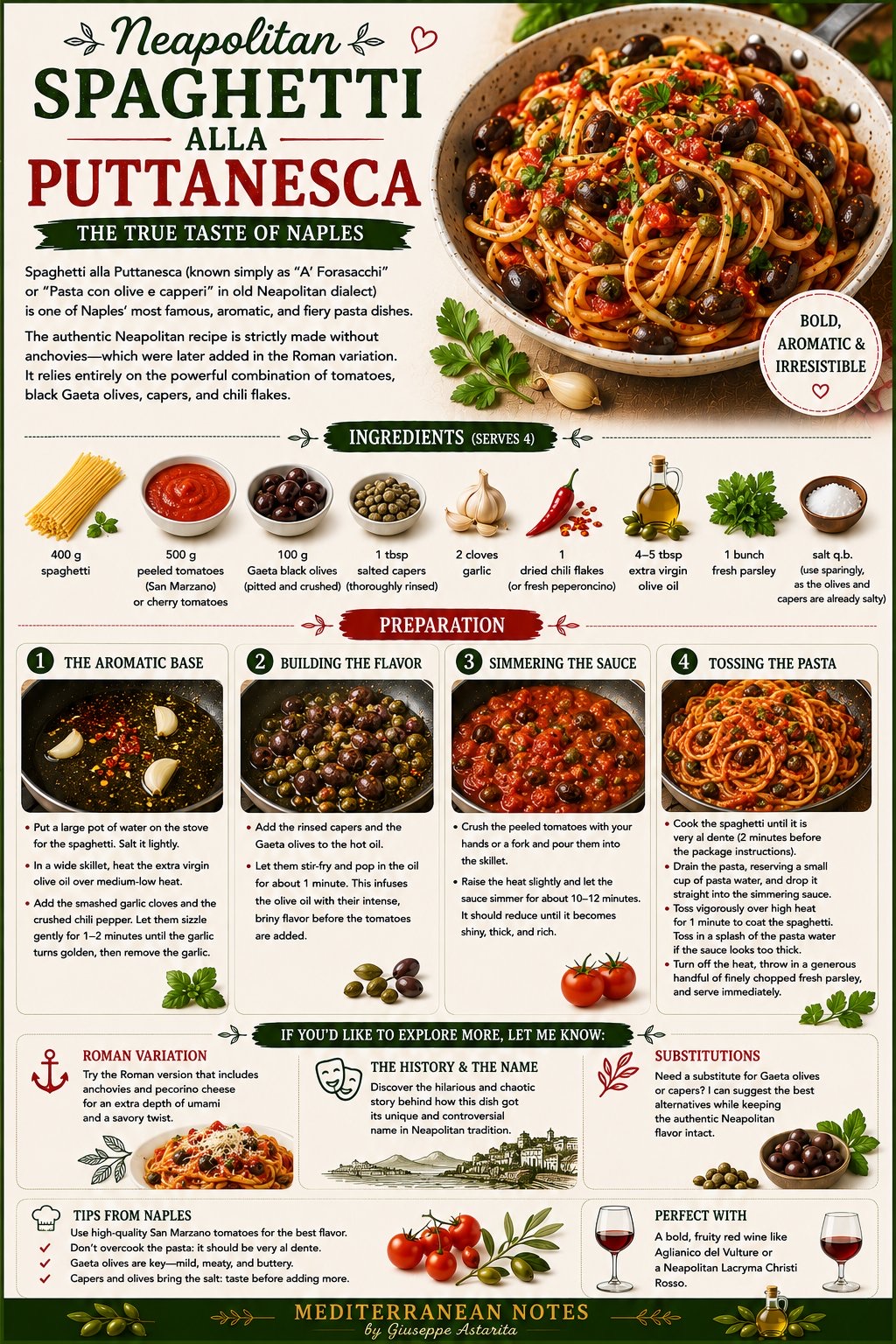
Ingredients · serves 4
Method
Build the aromatic base. In a large, wide skillet, heat the olive oil over medium-low heat. Add the smashed garlic cloves and the chili. Sauté gently for 1–2 minutes until the garlic is golden and fragrant. Remove the garlic. Add the rinsed capers and the Gaeta olives. Let them sizzle and pop in the oil for about 1 minute — they release their brine into the oil and infuse it with their flavor. This step takes the sauce from oil with olives to something with actual depth before the tomatoes arrive.
Add the tomatoes. Crush the peeled tomatoes by hand directly into the pan, or pour in the passata. Raise the heat slightly and let the sauce simmer for 10–12 minutes, stirring occasionally, until it thickens and becomes glossy and concentrated. Do not add salt yet — taste at the end, because the olives and capers have already contributed significant salt and the sauce often needs none.
Cook and finish the pasta. Meanwhile, cook the spaghetti in well-salted boiling water until very al dente — 2 minutes before the package time. Reserve a small cup of pasta water. Drain and add directly to the sauce. Toss over high heat for 1 minute to coat the spaghetti completely, adding a splash of pasta water if the sauce is too thick. Turn off the heat. Finish with the finely chopped fresh parsley — generously. Serve immediately.
No Parmigiano. No Pecorino. This is a fish-adjacent sauce — even without the fish, the convention holds. The parsley is the finish. More olive oil if you like. That is all.
The fish dinner table — where puttanesca belongs
The puttanesca sauce is the foundation of several fish pasta dishes that appear on the Campanian Christmas Eve table. Understanding it as a base — rather than only as a standalone pasta — shows how versatile and useful it is as a flavor structure.
On its own — my father's version
No fish, no additions. Tomatoes, Gaeta olives, capers, garlic, chili, parsley, spaghetti. The version for Christmas Eve when someone at the table does not eat fish. Bold enough to need nothing added. The original Neapolitan version without anchovies.
Con le vongole — with clams
Add clams steamed open in white wine to the puttanesca base. The clam liquid enriches the tomato sauce; the olives and capers provide the brine that clam pasta in bianco lacks. A richer, more complex version of the Christmas Eve standard.
Con i polpi — with small octopus
Baby octopus braised slowly in the puttanesca base until tender — the tomato, olive, and caper combination is one of the natural homes of small octopus in Neapolitan cooking. A longer preparation, but the sauce does most of the work and the result is exceptional.
Con il tonno — with tuna
Add good oil-packed tuna in the last 2–3 minutes, as in the spaghetti al tonno post. The puttanesca base — olives, capers, tomato — is the Neapolitan version of the tonno sauce, and the two approaches share the same pantry and the same logic.
Later in life the puttanesca became something I returned to repeatedly — not as the fish-night alternative but as the pasta in its own right, the one that produces maximum satisfaction from a pantry with no fresh ingredients beyond tomatoes. It is one of the most complete pasta dishes available from shelf-stable ingredients, and it is ready in the time it takes to boil the pasta. My father discovered this before the rest of us did, through the specific circumstance of not eating fish. He was right.
Buon appetito — e buona Vigilia.