Salame di Cioccolato
Il Salame di Cioccolato — The Iconic No-Bake Dessert from Naples
A strange one. Very popular in the 1980s, especially at kids' parties — but I haven't seen it in a very long time, and certainly not in the United States. We used to love it as kids, also for the afternoon merenda. Comfort, nostalgia, and Neapolitan creativity all rolled into one log of chocolate and biscuits, shaped like a salami, sliced into rounds that show the biscuit pieces inside like fat through meat.
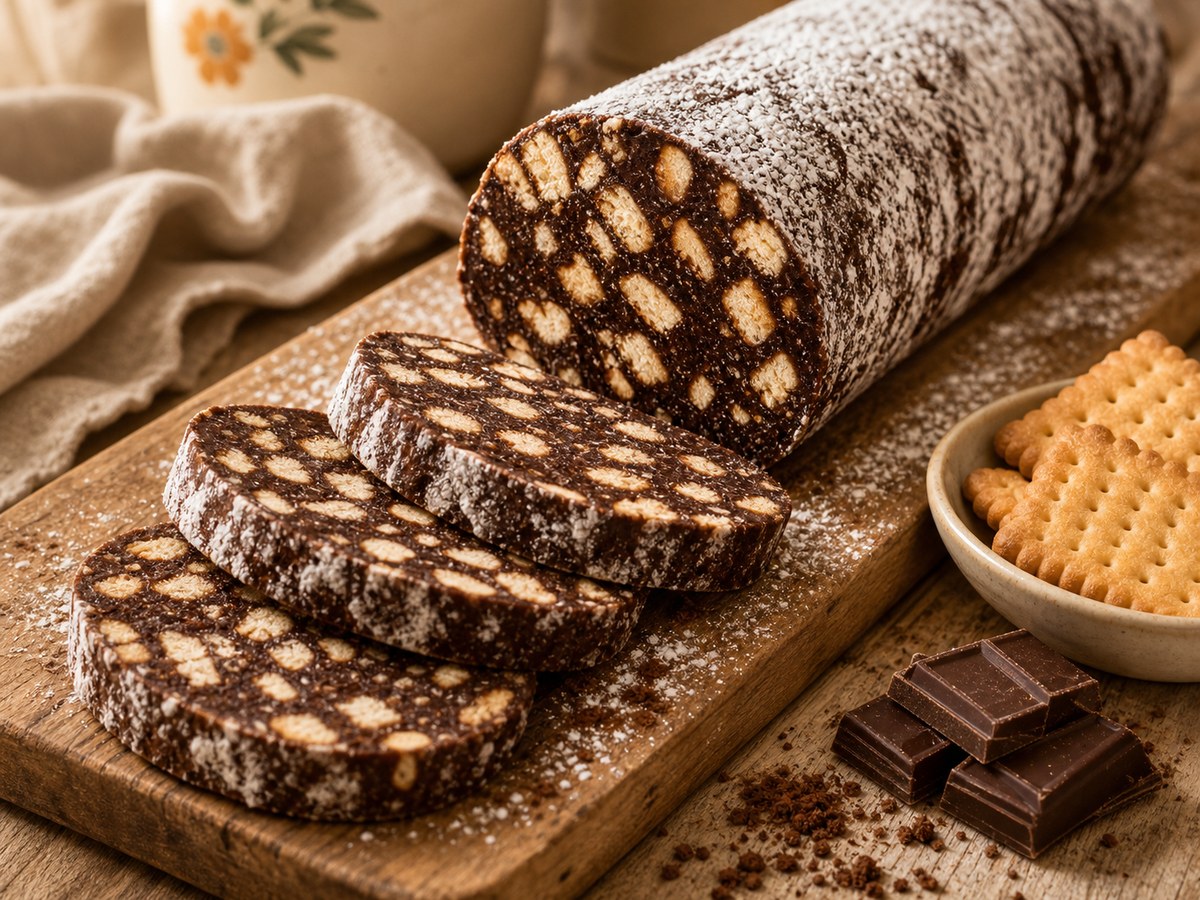
The chocolate salami occupied a specific position in the 1980s Italian childhood food landscape. It appeared at kids' birthday parties alongside the torta della nonna and the crostata, it appeared as a merenda in the afternoon cut into thick rounds, and it appeared as a make-ahead dessert that could be prepared the day before and kept in the refrigerator wrapped in its parchment paper. It was simple enough to make without professional equipment and impressive enough in presentation — the dark log dusted in powdered sugar, sliced to reveal the biscuit pieces inside mimicking the fat of a salami — to feel like a real dessert rather than a quick fix. The concept is one of those moments of Italian home culinary wit: a dessert that looks exactly like a cured meat product and is made from things the opposite of meat.
I have not seen it in a very long time. It seems to have faded from the party circuit sometime in the 1990s as the repertoire of available commercial desserts expanded and homemade no-bake preparations became less necessary. In the United States it does not exist in any context I have encountered. This makes it specifically worth recording here — a dessert that was ubiquitous for one generation of Italian children and then simply stopped appearing. If my daughters ever encounter it, they will need to know where it came from.
The preparation requires no oven, no special equipment, and no technique beyond melting chocolate and mixing. This was part of its appeal in the 1980s home kitchen: it could be made by a child with adult supervision, it required no timing or temperature monitoring, and it produced a visually arresting result from ingredients that were always available — dark chocolate, butter, eggs, sugar, and the dry biscuits (Oro Saiwa or Petit Beurre) that were a permanent presence in Italian kitchen cupboards. The biscuits go in broken by hand into rough chunks — not crushed to powder, which would produce a uniform texture — so that the cut surface shows the pale biscuit pieces suspended in the dark chocolate matrix, exactly like the fat in a slice of salami. The name is not a metaphor; it is a description.
The powdered sugar dusted on the outside before serving creates the "moldy" surface of an aged salami — the white bloom that appears on the casing of a properly aged cured meat. This is the final touch of the visual joke, and it is entirely intentional. A chocolate salami without the powdered sugar coating is simply a chocolate log. With it, it becomes something that requires explanation when you bring it to the table, which is the whole point.
The recipe — no oven required
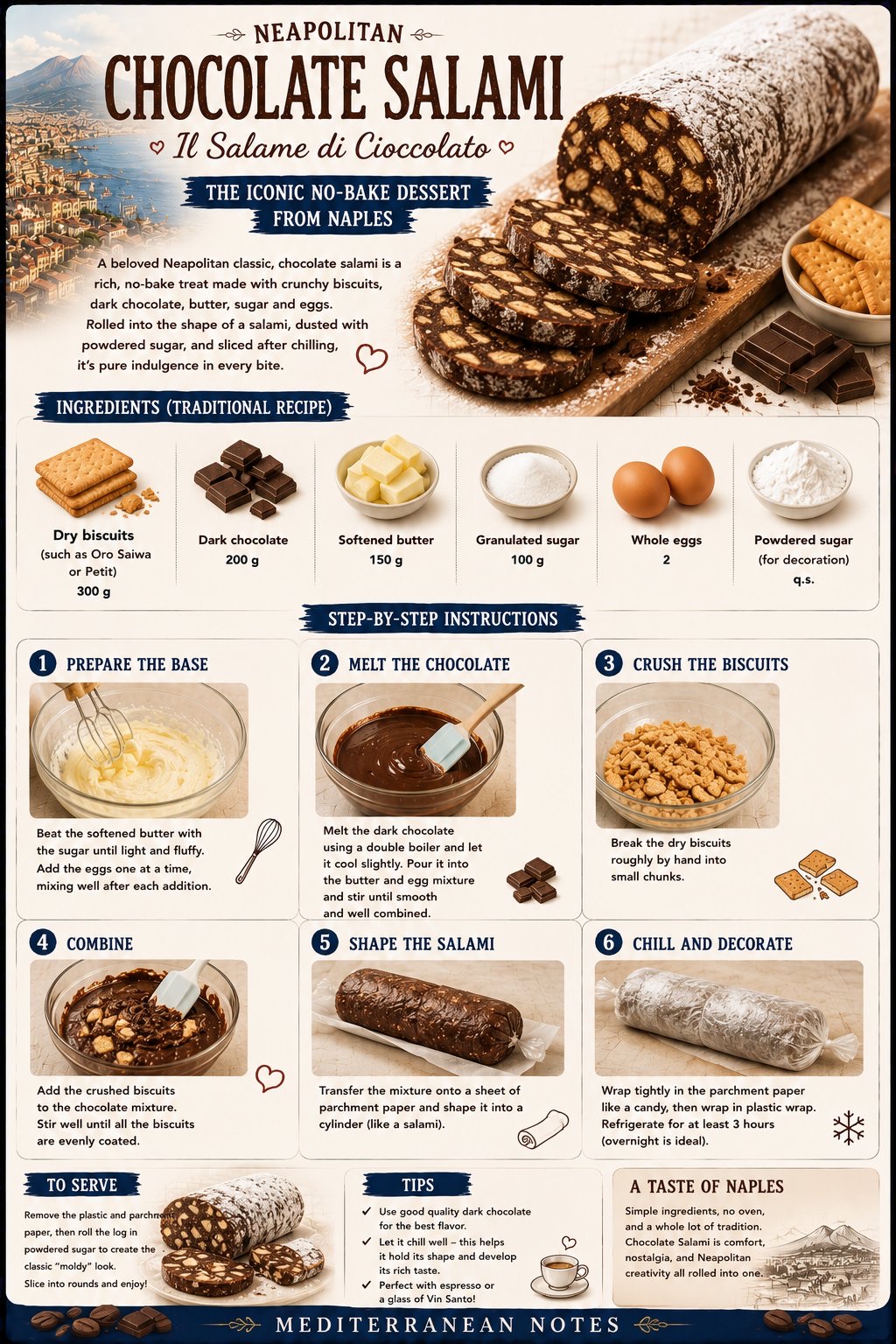
Il salame di cioccolato — il dolce senza cottura iconico di Napoli. Click to enlarge.
300 g, broken by hand into rough chunksDry biscuits — Oro Saiwa, Petit Beurre, or digestives
200 g, good qualityDark chocolate (60–70% cocoa), melted
150 g, softenedButter, at room temperature
100 gGranulated sugar
2 wholeEggs
to coat generously before servingPowdered sugar — the "mold" of the salami
1
Beat the softened butter with the sugar until light and fluffy. Add the eggs one at a time, mixing well after each addition. The mixture should be smooth and pale.
2
Melt the dark chocolate in a double boiler (a heatproof bowl over simmering water, not touching the water). Let it cool slightly — it should be fluid but not hot. Pour the cooled chocolate into the butter and egg mixture and stir until smooth and well combined.
3
Break the biscuits by hand into rough chunks — some small, some larger. This is important: the irregular size produces the visual contrast of the cut surface. Add the biscuit chunks to the chocolate mixture and stir until all pieces are evenly coated.
Do not crush the biscuits to crumbs. The point of the preparation is the cross-section showing large pale biscuit pieces suspended in dark chocolate — like fat in salami. Uniform fine crumbs produce a homogeneous texture with no visual interest.
4
Transfer the mixture onto a sheet of parchment paper. Shape into a cylinder approximately 6–7 cm in diameter and 25–30 cm long — like a salami. Roll the parchment tightly around it, twisting the ends closed. Wrap in plastic wrap over the parchment. Refrigerate for at least 3 hours — overnight is ideal. The log needs to firm fully before slicing.
5
To serve: remove the plastic wrap and parchment. Roll the log generously in powdered sugar — coating the entire surface to create the white "moldy" effect. Place on a cutting board and slice into rounds of about 1 cm thickness using a sharp knife. Arrange on a plate. Serve cold.
The cross-section of each slice should show the biscuit pieces clearly against the dark chocolate. Slice with a decisive single motion rather than a sawing action, which keeps the slices clean. Perfect with espresso or a small glass of Vin Santo.
The salame di cioccolato is comfort and nostalgia and Neapolitan creativity all in the same preparation — the infographic's summary is completely accurate. It is also a recipe that belongs specifically to a decade and a childhood: the 1980s Italian kids' party table, the afternoon merenda at the kitchen counter, the delight of a dessert that looked like something it was not. It has largely disappeared from that context. It exists here now, before it disappears entirely from memory as well.
Per i bambini degli anni '80 —
and for the children who should know what they missed.