Pasta e cocozza: broken bucatini, pumpkin, and the whistling sound at the table
The only way I ate squash until my thirties. Broken bucatini, cooked directly in the pumpkin until everything became thick and golden and dense. I didn't know squash soup existed. This was squash, and this was enough — and more than enough.
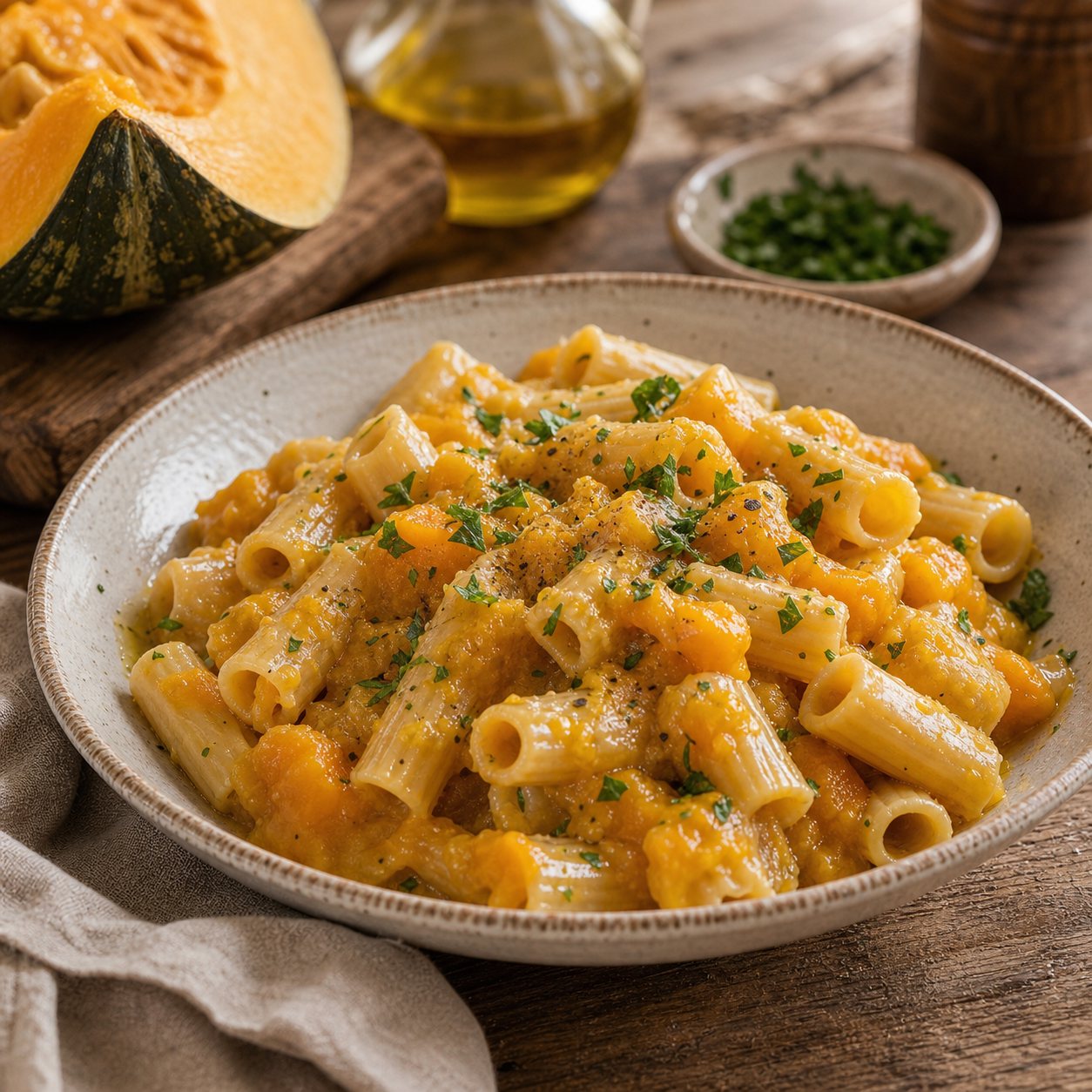
In Naples, the pumpkin dish is called pasta e cocozza — cocozza being the Neapolitan word for the long local pumpkin, the zucca lunga napoletana, whose flesh is golden-orange and intensely sweet and breaks down beautifully under the slow heat that this recipe requires. It is a cucina povera dish in the most direct sense: one vegetable, a little olive oil, garlic, chili, pasta. Nothing else producing something that is sweet and savory and deeply comforting in a way that is genuinely difficult to account for from the ingredient list alone.
The pasta of choice in this house was broken bucatini — bucatini being the thick, hollow spaghetti with a hole running through the middle, snapped by hand into irregular shorter lengths before going into the pot. This detail matters beyond nostalgia: broken bucatini produces uneven pieces that cook at slightly different rates, and the hollow center of each piece traps the dense pumpkin sauce inside it. When you ate it — specifically, when you sucked up a piece from the spoon — the hollow bucatini made a small whistling sound. This is the detail I remember most clearly from childhood, the sound of eating this dish, which was distinctive enough that it was part of the experience of the meal itself. Nobody commented on it. It was just how the dish sounded.
Squash soup — the northern European and American version, blended smooth, served with cream and bread on the side — did not exist in this frame of reference. Squash was pasta e cocozza, and that was the complete category. It was not until my thirties, living in the United States, that I encountered squash prepared any other way and realized there were other interpretations. They are valid. But they are not the ones that come to mind first when someone says zucca.
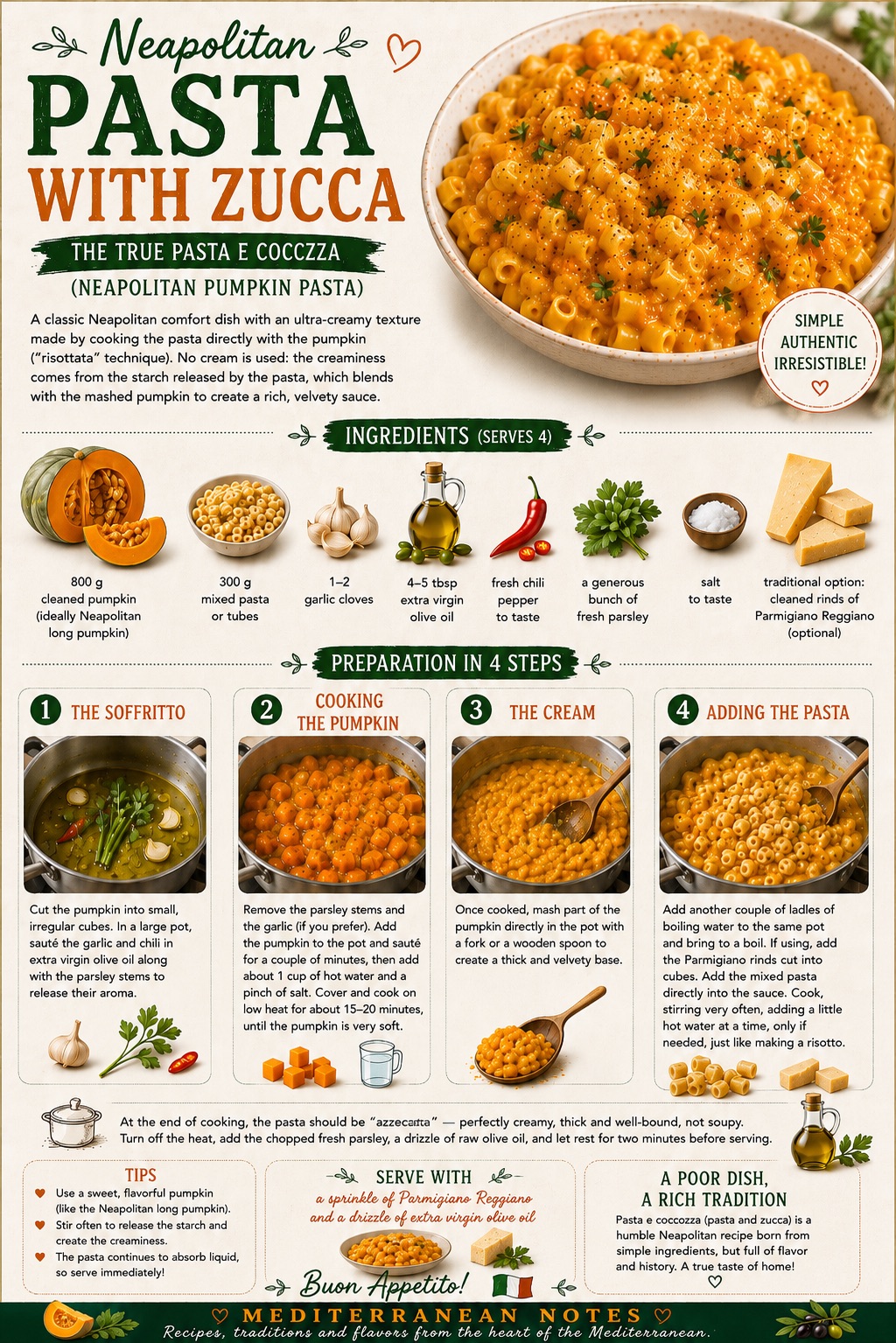
The technique is the same azzeccata method used in the pasta e cavolfiore: the vegetable cooks in a small amount of water until very soft, is partially mashed to create a creamy base, and the pasta is cooked directly in the same pot, stirred like a risotto, adding water in small quantities as needed until the pasta is al dente and the dish is thick and unified. No cream. No blender. The creaminess comes from the starch of the pasta releasing into the mashed pumpkin — the same principle that makes a risotto creamy without dairy. The color of the finished dish is a deep, saturated orange-gold, visually one of the most striking in this collection.
Beta-carotene, fat-soluble absorption, and why pumpkin with olive oil makes sense
Pumpkin and winter squash are among the richest dietary sources of beta-carotene of any vegetable — the orange pigment that is converted to vitamin A in the body and that gives the Neapolitan long pumpkin its characteristic color. A single serving of this dish provides well above the adult daily requirement for vitamin A as beta-carotene, with bioavailability significantly enhanced by the olive oil in which the pumpkin is sautéed at the start. Fat is essential for absorption of all fat-soluble carotenoids; the sauté step in olive oil — rather than starting in water — is nutritionally the correct approach, and it also develops the flavor compounds of the pumpkin through the Maillard reaction at the cut surfaces. Pumpkin also provides potassium, vitamin C, vitamin E, and the carotenoids lutein and zeaxanthin, which accumulate in the retinal macular pigment and are associated with reduced age-related macular degeneration risk. The azzeccata technique — pasta cooked directly in the pumpkin liquid — retains the water-soluble nutrients (potassium, B vitamins) leached from the pumpkin during cooking, which would be discarded in conventional separate-boiling approaches. The broken bucatini contributes more starch surface area than intact bucatini of the same weight, because the broken ends are exposed and release starch more readily — meaning the hollow-pasta-in-pumpkin combination produces a particularly efficient thickening, even faster than tubetti or ditalini of similar bore diameter. The final raw olive oil drizzle adds oleic acid and phenolic antioxidants and serves as the additional fat medium for maximal carotenoid absorption from each bowl. This is, per ingredient and per unit of effort, one of the most nutrient-dense dishes in the collection — disguised as one of the simplest.
The recipe
Ingredients · serves 4
Method
The soffritto. Cut the pumpkin into small, irregular cubes about 2 cm — remove the skin and seeds first. In a large, deep pot, heat the olive oil over medium heat. Add the garlic, chili, and parsley stems (not the leaves). Sauté for 2–3 minutes until fragrant. Add the pumpkin cubes and turn to coat in the oil.
The sauté in olive oil before adding water is not just flavor — it develops carotenoid bioavailability. Do not skip it in favour of going straight to boiling.
Cook the pumpkin. Add about 1 cup of hot water and a pinch of salt. If using, add the Parmigiano rind. Cover and cook over low heat for 15–20 minutes, until the pumpkin is very soft and beginning to collapse. Check occasionally; if it dries out before softening, add a splash more water. Remove the garlic and parsley stems.
Mash to create the cream. With a fork or wooden spoon, mash roughly half the pumpkin directly in the pot, pressing it against the sides. Leave the rest in pieces — visible cubes of pumpkin in a dense orange base. The pot should look thick, fragrant, and intensely colored. Add another couple of ladles of boiling water to loosen it slightly for the pasta.
Cook the pasta — azzeccata style. Bring to a gentle boil. Add the broken bucatini or pasta mista directly to the pot. Stir frequently — constantly when possible — adding small amounts of hot water only when needed to keep things moving. Cook until the pasta is al dente, following the package time but checking a minute early. The finished dish should be thick and dense, a spoon leaving a slow-closing trail. Azzeccata.
Broken bucatini cooks slightly faster than intact bucatini because the broken ends are exposed. Watch the last 2 minutes carefully.
Finish and serve. Turn off the heat. Add the chopped parsley leaves, a generous drizzle of raw extra-virgin olive oil, and a grind of black pepper. Stir once. Rest two minutes. Serve immediately in deep bowls with grated Parmigiano or Pecorino and another thread of olive oil. Do not let it wait — the pasta continues to absorb the pumpkin and the azzeccata thickens past its ideal point within minutes.
Outside Italy, butternut squash is the best available substitute for the Neapolitan long pumpkin — it has a similar sweetness and a flesh that breaks down correctly under this cooking method. Avoid watery squash varieties or anything labelled "pie pumpkin" that has a dry, fibrous texture. You want sweetness and moisture. The color of the finished dish should be a deep, saturated orange-gold. If it looks pale, the pumpkin was not sweet enough or not cooked long enough before the pasta went in.
This is not squash soup. It is not a vegetable side dish. It is a pasta dish in the Neapolitan tradition — the vegetable becomes the sauce, the pasta becomes the structure, and the two cook together into something that is neither of them separately. The whistling sound of the hollow bucatini is part of it, or at least it was. Use broken bucatini and see.
Buon appetito.