Pasta Sfoglia
Puff pastry — and how it differs from the other doughs on this blog
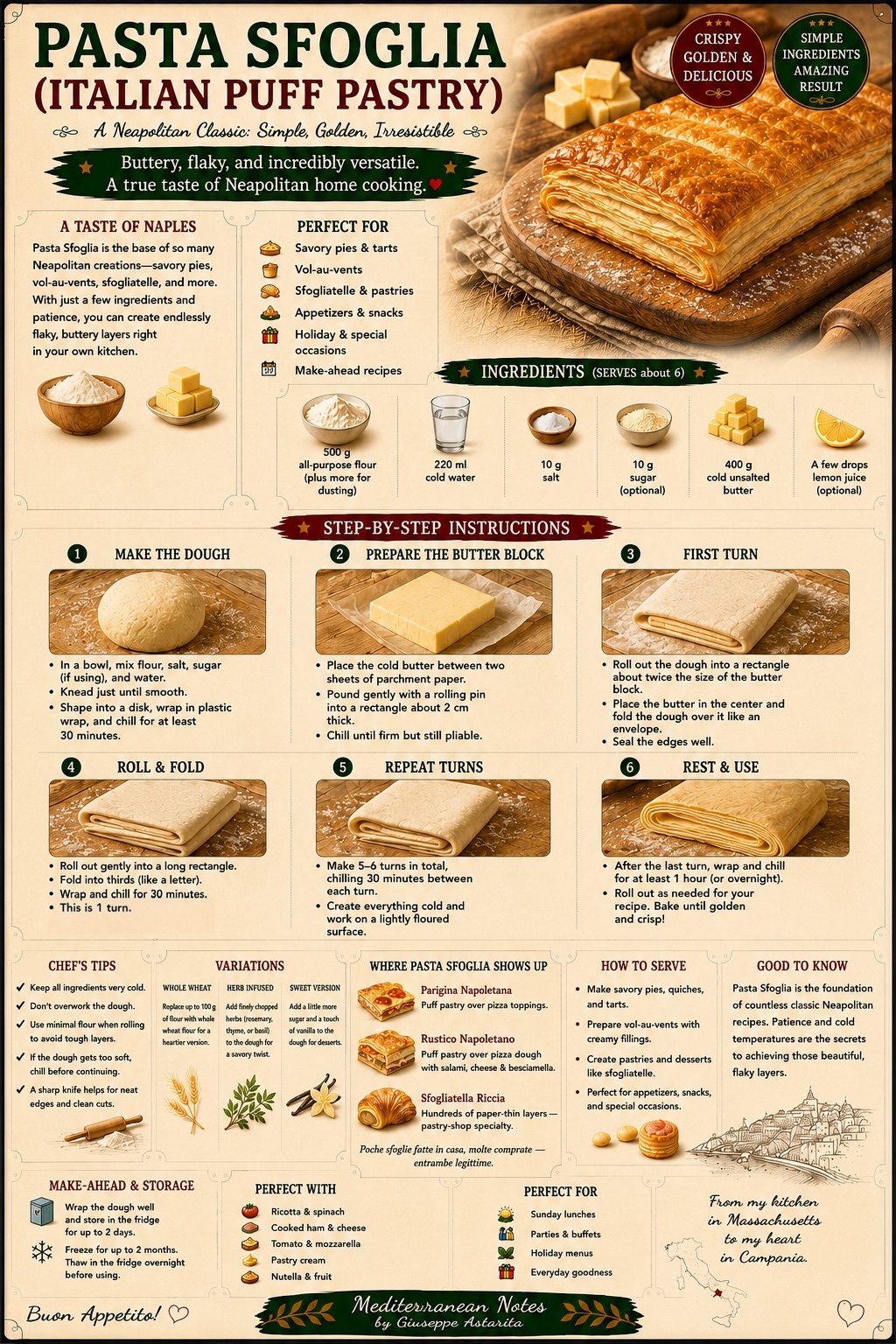
Flour, butter, water, folded and turned again and again until it separates into a hundred thin, airy layers. The pastry underneath the parigina, the rustico, and the sfogliatella riccia — three very different-looking things that all rely on the same lamination.
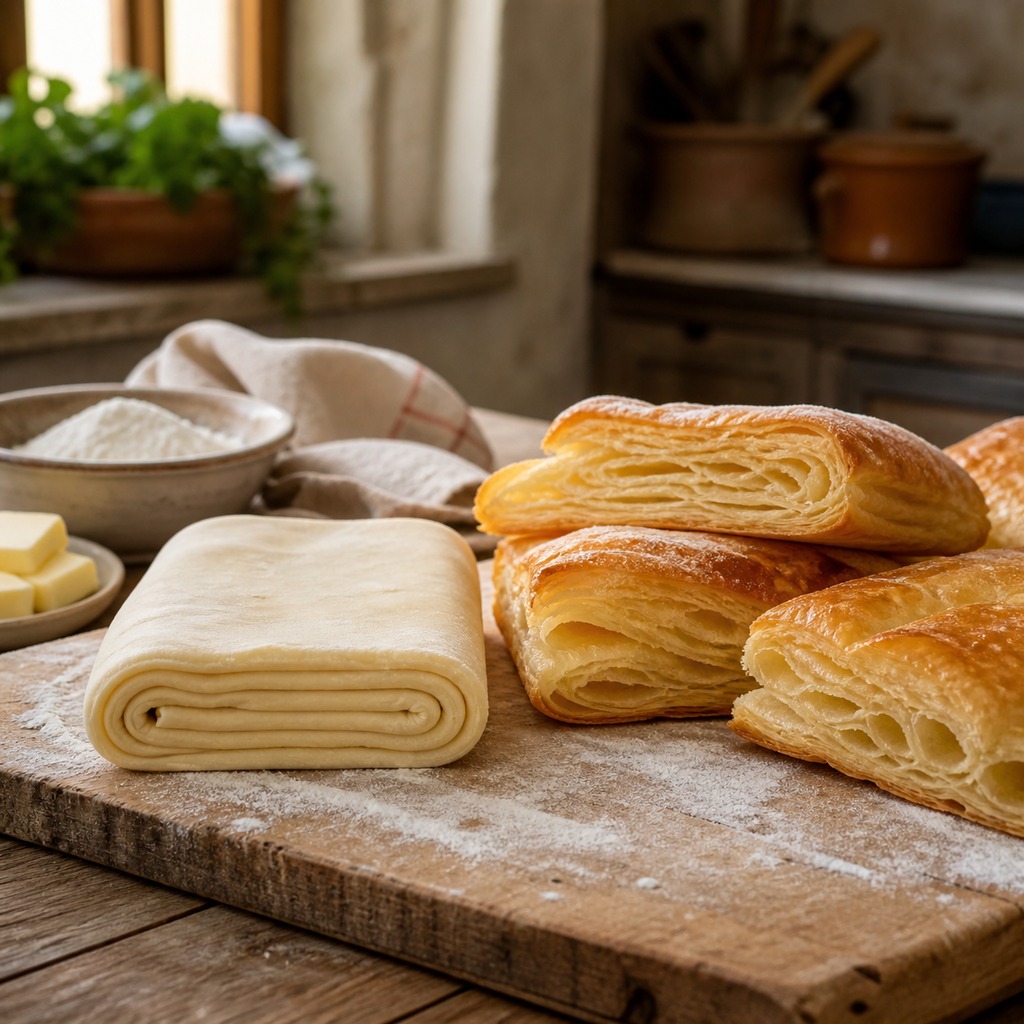
Pasta sfoglia — puff pastry — is the most labor-intensive of the base doughs on this blog, and the one most people buy ready-made rather than build from scratch at home, which is a perfectly reasonable choice. It shares its basic ingredient list with pasta brisée — flour, butter, water — but almost nothing about how those ingredients are handled. Where brisée is mixed quickly and left alone, sfoglia is folded and rolled again and again, in a sequence of turns that builds up dozens or hundreds of alternating layers of dough and butter. The oven does the rest: the water in each layer of butter turns to steam, pushing the layers apart, and the pastry puffs into the light, flaky, shattering thing you recognize on sight.
This is the pastry underneath three very different Neapolitan things: the parigina, a rectangle of puff pastry over pizza toppings; the rustico napoletano, where puff pastry is layered over pizza dough and filled with salami and cheese; and the famous riccia version of the sfogliatella, whose hundreds of visible crisp layers give the pastry its name. Sfogliatella itself is not something you make at home — it belongs to the pasticceria, as that page explains — but understanding what pasta sfoglia is and how it behaves makes the difference between the riccia and the frolla version make sense.
How it differs from the other doughs on this blog
It is easy to confuse pasta sfoglia with the other base doughs on this blog, since several of them share ingredients or a similar look once baked. Here is what actually distinguishes each one.
Puff pastry contains no yeast and no chemical leavener. Its rise comes entirely from lamination: repeated folding and rolling traps a solid layer of butter between many thin layers of dough. In the oven, the water contained in that butter (butter is roughly 16–18% water) turns rapidly to steam, and because each layer of dough is sealed against the layers above and below it, the expanding steam has nowhere to go but to physically push the layers apart. The result is a stack of crisp, separated sheets rather than a single risen mass — the structural opposite of a yeasted dough, where gas produced by fermentation is trapped inside a single continuous gluten network rather than between distinct layers.
This is also why puff pastry must stay cold throughout the folding process: if the butter melts into the dough rather than staying as a distinct solid layer, there is no barrier left to trap steam between, and the dough bakes flat and dense instead of puffing. Chilling between folds is not a matter of convenience — it is the entire mechanism of the pastry.
Where it shows up on this blog
Given the time and precision it demands, most Neapolitan kitchens buy pasta sfoglia ready-made — a perfectly respectable choice, and the one my own family generally made. Understanding the dough is still worth it: it explains why the parigina puffs the way it does, why the rustico has a different texture from the pizza rustica made with frolla, and why the sfogliatella riccia looks nothing like its frolla cousin despite sharing a name.
Poche sfoglie fatte in casa, molte comprate — entrambe legittime.