Fiori di zucca: the golden flower of the Italian summer
They appear in June, sometimes late May if the season has been warm. By August they are everywhere — at the market, in home gardens, piled in golden heaps at the vegetable stalls. By September they are gone. You have to use them the same day you buy them. There is no storing them, no preserving the freshness. The season is the point.
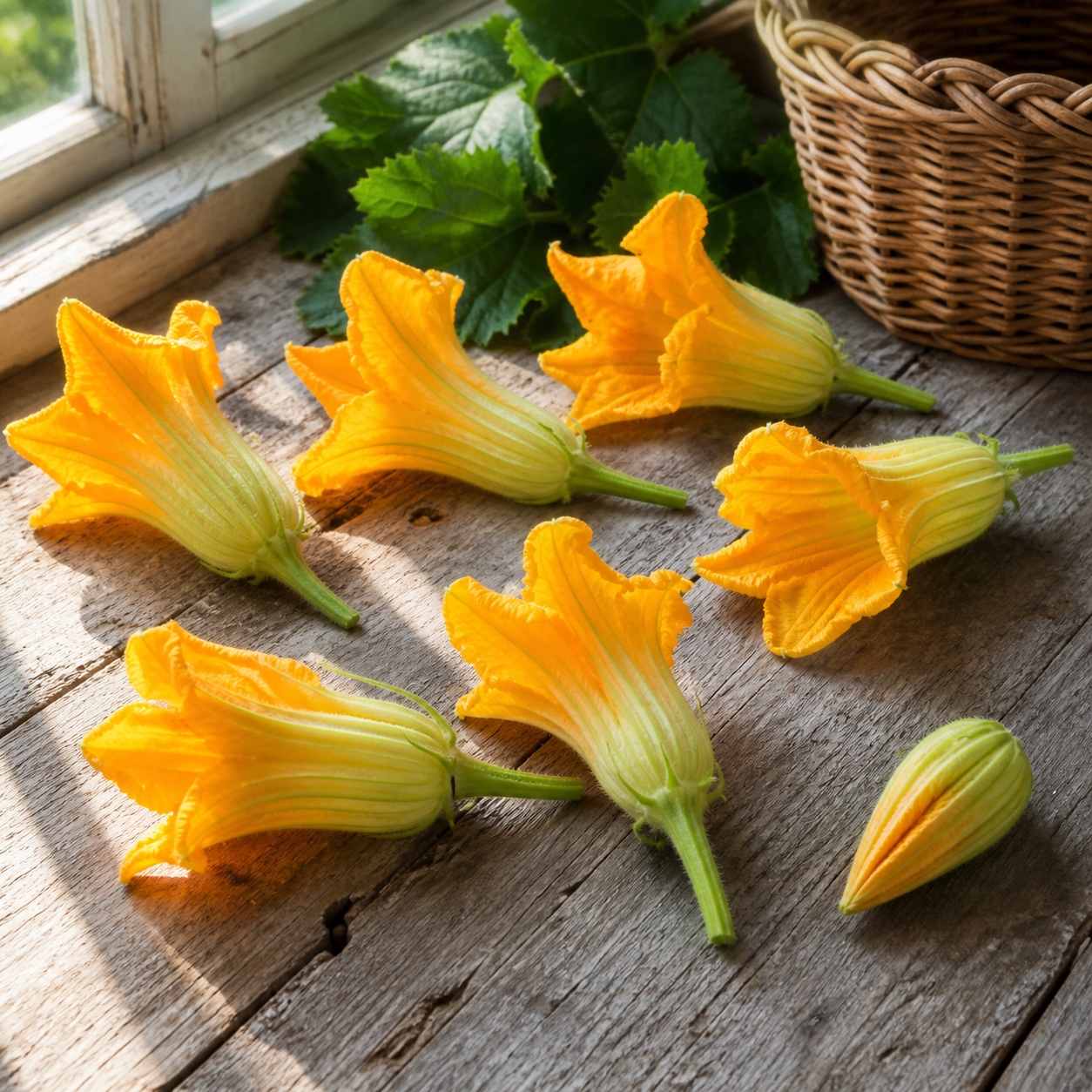
The fiori di zucchina — zucchini blossoms — are one of those ingredients that feel specifically Italian not because they cannot be found elsewhere but because Italian cooking has thought about them the most carefully and built the most coherent set of preparations around them. They are delicate, almost translucent when fresh, with a flavor that is floral and slightly sweet and unmistakably of the vegetable they are attached to. They absorb whatever they are cooked with — the fat of a frying batter, the cream of a risotto, the eggs of a frittata — while contributing their own color and fragrance to the dish in a way that nothing else does.
A note on the name, since this page (like most Italian kitchens) uses "fiori di zucca" and "fiori di zucchina" more or less interchangeably: strictly speaking they're not quite the same flower. Both the pumpkin plant and the zucchini plant are squash, and both produce edible blossoms that look almost alike, but there is a real difference between them. Fiori di zucchina — the ones from the zucchini plant, and the ones actually used in nearly everything on this page — tend to run larger, with pointed petals in a bright yellow leaning toward orange, and very little scent. Fiori di zucca proper, from the pumpkin plant, are smaller, with rounded petals in a paler, softer yellow, and a noticeably stronger fragrance. In everyday speech "fiori di zucca" has become the generic term for both, which is why you'll see it used that way here too — but what actually turns up at the market and in Campanian kitchens, and what fills every recipe below, is almost always the zucchini flower.
In Campania, the relationship with the fiori di zucca is practical and immediate. You buy them at the market in the morning, still slightly closed, and you cook them the same day. The preparations are not elaborate — they do not need to be. The flower does the work. What the cook contributes is the judgment to not overcook them, to add them at the right moment, to give them the heat they need and no more.
Zucchini plants produce two kinds of flower, and it matters which one ends up in the pan. The male flower (fiore maschio) grows on a long, thin stem with nothing at its base — no fruit attached — and it's this flower that carries the pollen-bearing stamen inside. The female flower (fiore femmina) sits directly on top of a small, immature zucchini, and inside it has a pistil rather than a stamen. Picking a female flower means sacrificing the baby zucchini growing beneath it, which is exactly why the male flower is the one sold loose at the market and the one used for frying and stuffing — it costs the plant nothing. Female flowers, when you do find them, still trailing their tiny zucchini, are the ones prized for risotto and pasta, where that little fruit gets sliced in along with the blossom.
Whichever kind you're working with, the same cleanup applies: the stamen (in a male flower) or the pistil (in a female one) turns bitter with cooking and should be pinched out before anything else happens. Do not wash the flowers under running water — they absorb moisture immediately and the water damages both the texture and the batter adhesion if you are frying them. Wipe gently with a damp cloth, open carefully, and remove the stamen or pistil. That's the entire preparation before cooking begins.
Timing matters as much as the flower itself. Zucchini blossoms open at dawn and close again as the day heats up, so they're picked after they've bloomed for the day, not before — a still-closed bud isn't usable yet. For frying and chopping, pick them freshly open, in the early morning if you can. For stuffing, a flower picked a little later, as it's just starting to close back up, actually holds a filling better than one splayed fully open. Either way, same-day cooking matters more than the exact hour — a blossom left overnight is already past its best regardless of when it was picked.
If you're growing your own, the male and female distinction has a second consequence beyond the kitchen. Male flowers can be picked freely and often need thinning anyway — a healthy plant produces far more of them than it needs for pollination, so taking a few for the pan doesn't cost the plant anything, though it's worth leaving several behind to keep the bees working and the female flowers fertilized. Female flowers are the ones to be careful with: every one picked is a zucchini that will never grow. Most home gardeners let the females set fruit and only harvest males for the table, saving a female blossom (with its baby zucchini still attached) as an occasional treat rather than a habit.
Zucchini blossoms and why the flower is more nutritious than the fruit
Zucchini blossoms are compositionally unusual among commonly consumed vegetables. They contain significant concentrations of carotenoids — particularly lutein, zeaxanthin, and beta-carotene — that give them their characteristic deep yellow-orange color. These carotenoids are potent antioxidants and, in the case of lutein and zeaxanthin, are specifically concentrated in the macula of the human eye, where they act as a blue-light filter and reduce the risk of age-related macular degeneration. The fat-soluble nature of these compounds means that their bioavailability is dramatically higher when consumed with dietary fat — a fried blossom, or a blossom cooked in olive oil, delivers far more accessible carotenoid than a raw one, because the frying or sautéing step dissolves the carotenoids out of the plant cell matrix and into the surrounding lipid phase, from which they are directly absorbed in the small intestine. This is one of many cases in Italian cooking where the traditional preparation — frying, sautéing in olive oil, finishing with butter — is the nutritionally optimal one, not despite the added fat but because of it. The blossoms also provide vitamin C, folate, and a modest amount of potassium. Their water content is very high (above 90%), which is why heat must be applied briefly: prolonged cooking collapses the cell structure completely and produces a mushy, flavorless result. The rapid wilt of the petals under heat is the signal that the cooking is done.
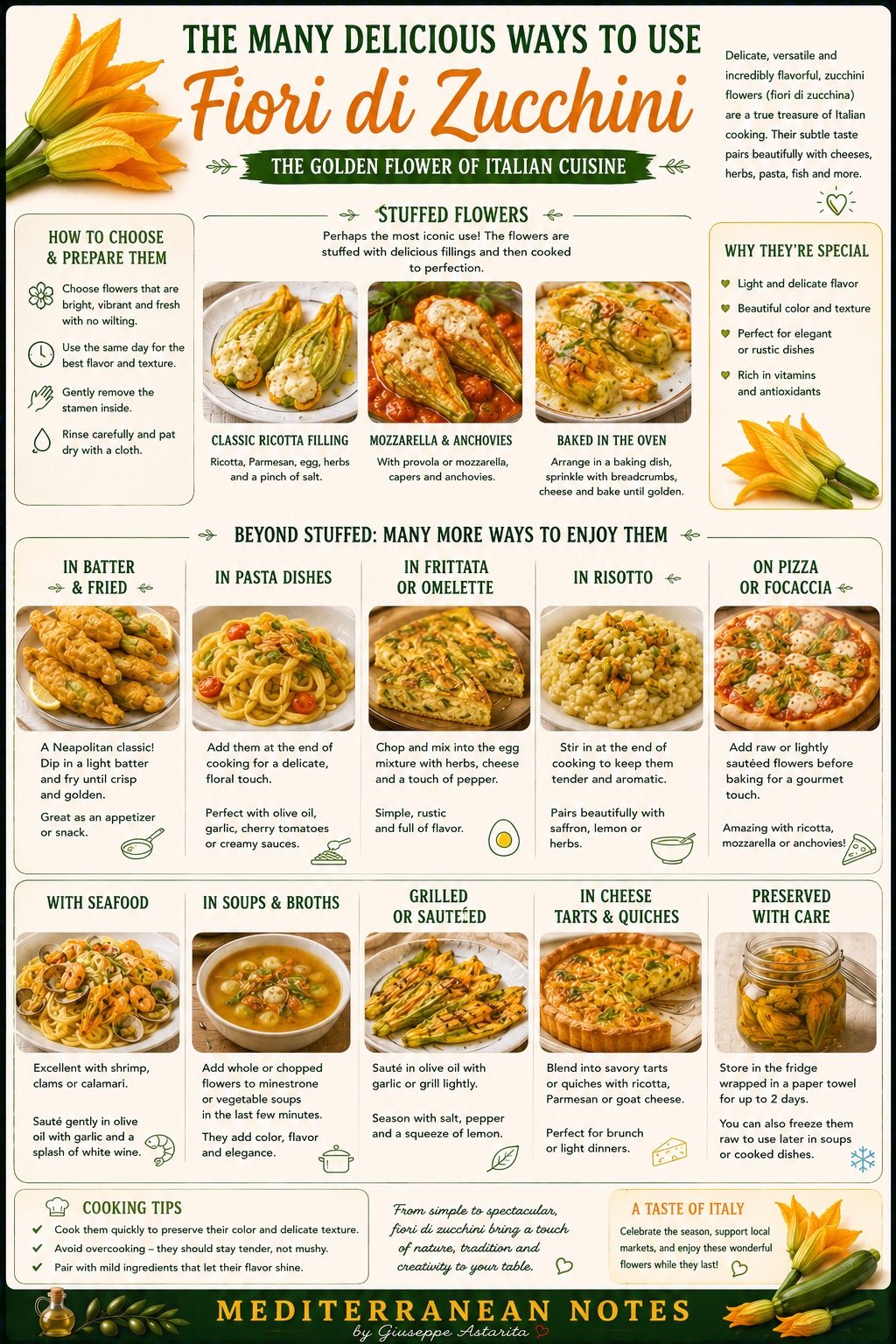
How to use them — an overview
The infographic below covers the full range of uses for fiori di zucca in the Italian kitchen: stuffed and baked, stuffed and fried, in pasta, in frittata, in risotto, in soups, on pizza, with seafood, grilled. The three preparations I grew up with — and the ones that have their own recipes here — are the frittelle, the frittata, and the risotto. Each belongs to a different moment of the day, a different occasion, a different register of cooking.
The three recipes
Street food · Appetizer · Neapolitan friggitoria
Pizzette o frittelle con i fiorilli
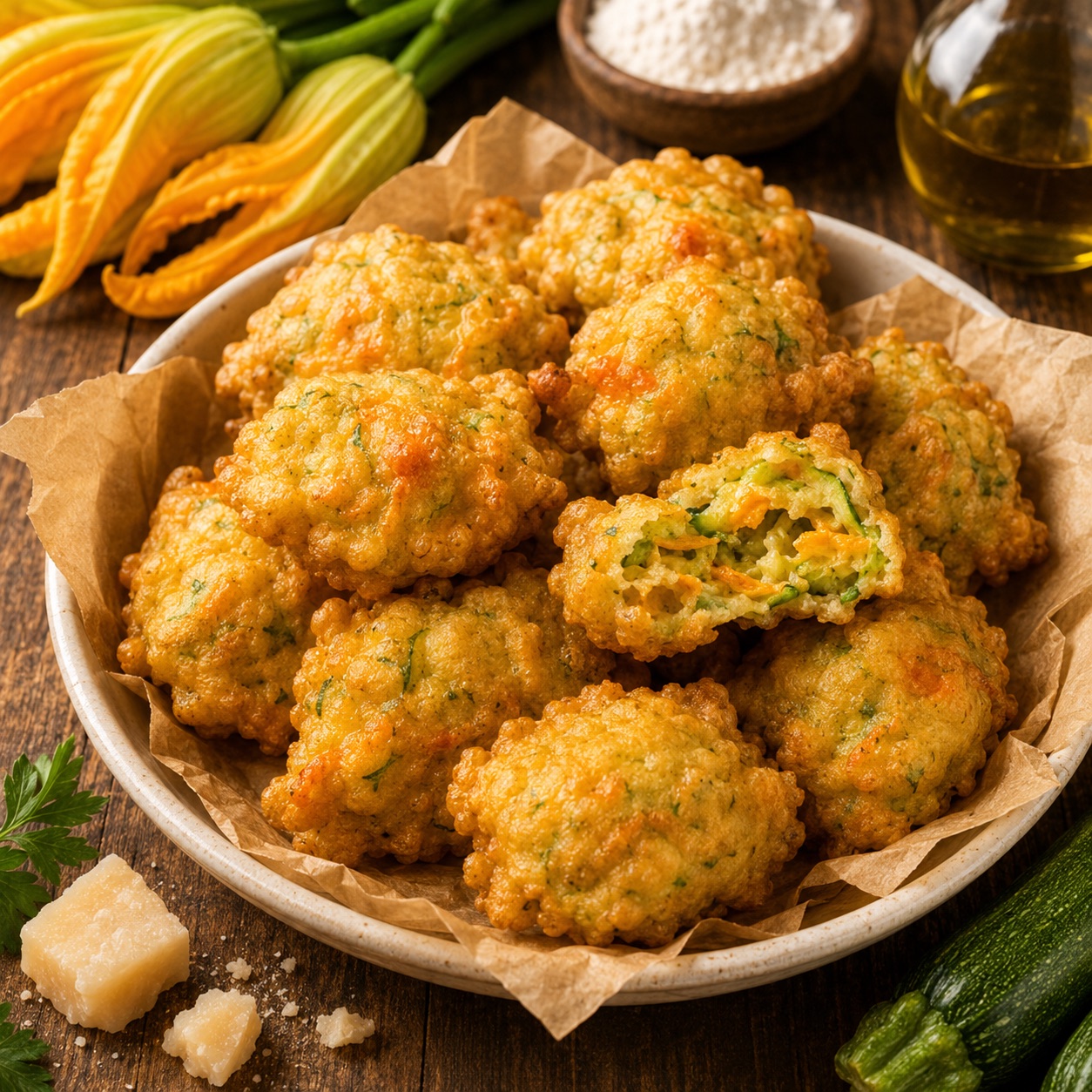
The legendary Neapolitan street fritter. A yeast batter — pasta cresciuta — made cold and dropped into very hot oil. The thermal shock creates the crisp shell. The blossom inside stays tender and aromatic. Sold from the friggitorie of Naples in paper cones, eaten standing on the street. The appetizer version of the same preparation works identically at a table.
Read the recipe →Summer lunch · Simple · Picnic
Frittata ai fiori di zucca
Six eggs, twelve to fifteen blossoms, Parmigiano, basil or mint. The flowers are added at two moments: half sliced into the egg mixture for flavor throughout, half arranged whole on the surface for color and presentation. Cooked slowly under a lid on one side, flipped once onto the other. Simple, seasonal, complete. Eaten warm, at room temperature, or cold the next day in a sandwich.
Read the recipe →Sunday first course · Refined · Spring and summer
Risotto ai fiori di zucchina
The most refined of the three preparations. The flower bases and stems go in early to build the flavor base; the petals go in two minutes before the end to preserve their color and texture. Finished all'onda with cold butter and Parmigiano. A Neapolitan spring and summer first course that requires patience and rewards it entirely.
Read the recipe →Buona stagione — e cogliete i fiori finché ci sono.