La Nutella
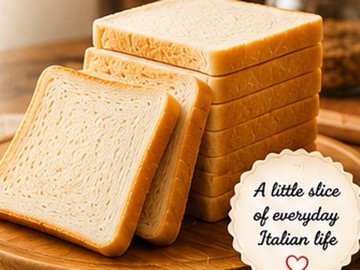
On fresh bread, on pan carrè, stirred into warm milk — the way every Italian child grew up eating it
Nutella exists everywhere now. In Italy in the 1980s, it was simply always there — a jar on the shelf or in the pantry that was restocked without discussion when it ran out. We ate it in every way that made sense and some ways that did not.
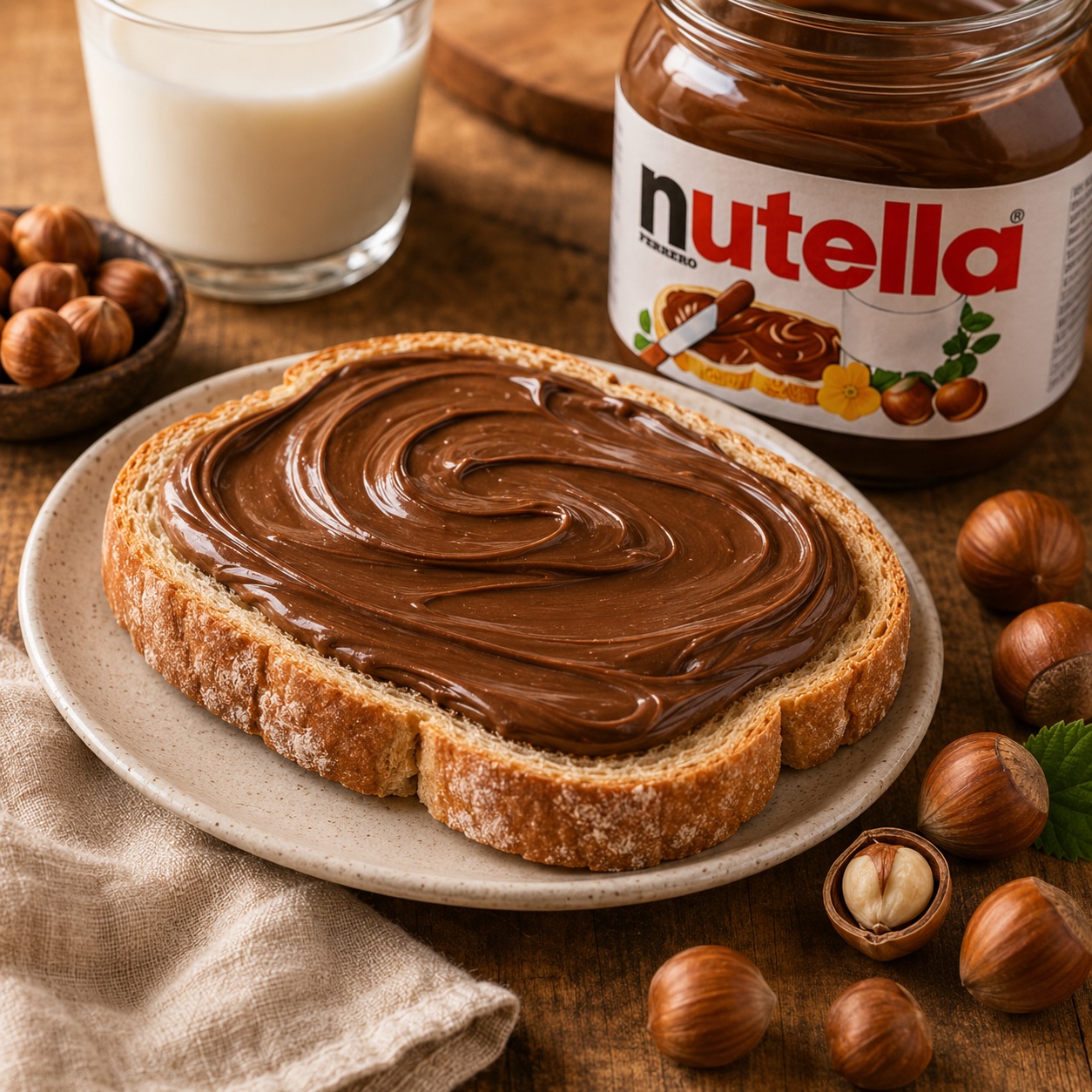
There was a jar of Nutella in our kitchen the way there was bread and milk and a bottle of olive oil. Not as a treat kept for special occasions, not as a reward for anything, just as a standard item that was replenished when it ran out, usually at the supermarket on Saturday. I do not remember the first time I ate it, which means I was too young for the memory to have formed around it. I remember wanting it specifically — on a piece of pane cafone in the afternoon, on the soft interior of a rosetta that had been opened and the crust pushed aside, on pan carrè in the morning before school. The jar sat with its cap slightly loose, the inner layer of Nutella visible at the rim, a knife or spoon laid beside it on the counter, and this was just how the kitchen looked.
The best version was on pane cafone — the thick-crusted Neapolitan bread with its open, slightly chewy crumb. You cut a slice that was a little thick, maybe two centimeters, still slightly warm if you had just bought it, and you spread Nutella on the interior, which absorbed it slightly and then held it without being saturated. The ratio of bread to Nutella was something every person calibrated for themselves. I preferred more Nutella than was probably reasonable, spread all the way to the edges. My mother spread it more sparingly. Neither was wrong. The bread was strong enough in flavor to stand up to the hazelnut chocolate, and the contrast between the slightly bitter crust and the sweet Nutella was the specific thing. Pan carrè worked differently — softer, more neutral, it let the Nutella be the primary flavor rather than a partner. Both were correct and neither substituted for the other.
The warm milk version was something my mother made in the evening sometimes, not for herself but for us. She would heat the milk in a small saucepan until it was just below a simmer, pour it into a ceramic cup, and stir a heaping teaspoon of Nutella into it until it dissolved — mostly. Nutella does not fully dissolve in milk; it breaks into small suspended particles and the milk becomes a warm, slightly dark, hazelnut-chocolate drink with a faint residue at the bottom of the cup. You drank most of it and scraped the bottom with the spoon. This was the evening version, after dinner in winter, when it was cold and we had come home from school or from playing outside. It was warming in a very specific way that had nothing to do with the temperature.
There were people who kept the Nutella in the refrigerator, which produced a very firm, almost grainy texture and made it nearly impossible to spread without tearing the bread. My mother kept it at room temperature, which is correct. At room temperature Nutella has the consistency of a thick but spreadable paste that moves under a knife without resistance. Refrigerated Nutella has the consistency of slightly soft clay. The jar says to keep it at room temperature. This is one of the rare cases where following the manufacturer's instruction and following the correct culinary logic arrive at the same answer.
I buy Nutella here in Massachusetts — the same product, same jar, available in every supermarket. It tastes the same. The difference is that in Caserta you ate it on bread that had been bought fresh that morning a five-minute walk from the house, and the bread was a different kind of bread. In Massachusetts I spread it on whatever bread I have, sometimes on pan carrè imported from Italy when I have it, sometimes on a slice of a decent sourdough. The Nutella is the same. The bread is different. The feeling is approximately the same and not quite the same, which is the condition of eating Italian food outside of Italy in general — you get very close and then you find the specific gap.
Nutella is a fat-continuous emulsion: the continuous phase is hazelnut oil and palm oil (the fats), and the dispersed phase includes sugar crystals, cocoa solids, skim milk powder, and very finely ground hazelnut paste. The ratio is roughly 57% sugar, 31% fat, and the remaining percentage divided between hazelnut, cocoa, milk, and lecithin emulsifier. The texture — spreadable but not runny — depends on the fat being in its semi-solid state at room temperature (around 20–22°C). Palm oil has a melting point of about 35°C, which means at room temperature it is semi-solid, contributing to the firm-but-spreadable consistency. At refrigerator temperatures (around 4°C), both the palm oil and hazelnut oil solidify more completely, which is why refrigerated Nutella is so much harder and less spreadable. The lecithin (soy lecithin) acts as an emulsifier, coating the sugar and cocoa particles and keeping them suspended in the fat phase rather than clumping or settling. When Nutella is stirred into warm milk, the emulsion partially breaks — the fat disperses unevenly, the sugar dissolves, and you get a suspension of cocoa and hazelnut particles rather than a fully homogeneous liquid, which is why there is always sediment at the bottom of the cup. In cold milk, the fat solidifies on the surface of the submerged spoon, which is the mechanism behind the cold-milk-spoon method that every Italian child invented independently.
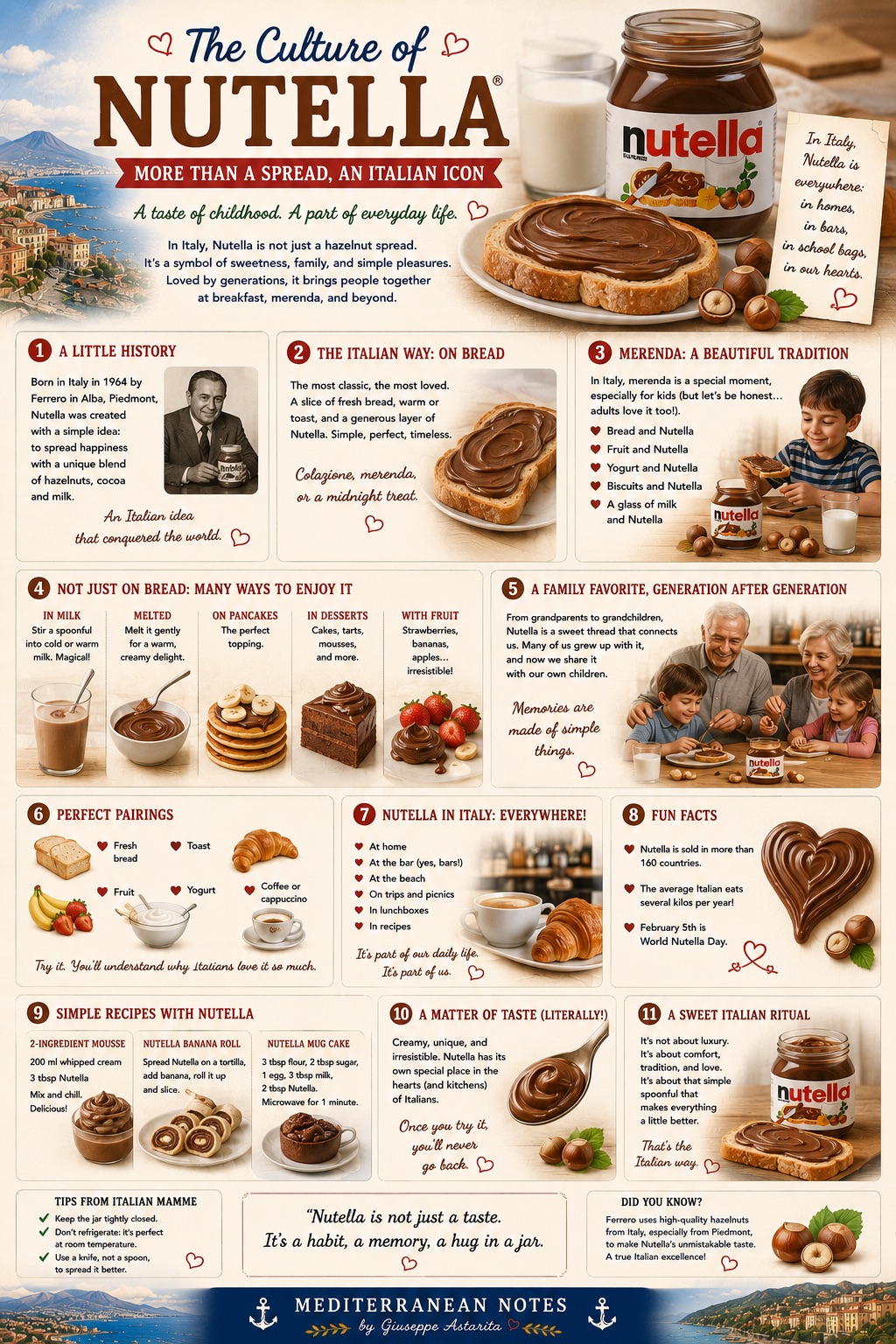
The ways we ate it
My daughters eat Nutella on pan carrè in the morning before school. This is not a tradition I consciously transmitted — it is what happened when they saw the jar on the shelf and tried it. Anna prefers it on pan carrè. Carolina, who is four, prefers to eat it directly from the spoon, which I allow within limits. The jar has been in our kitchen continuously since they were born. Some things do not require explanation or justification. They are just correct, and you keep them around.
Homemade Nutella — a variation from my kitchen
Recently I made this homemade chocolate-hazelnut spread to please my daughter, who loves Nutella and chocolate in general, and to use those wonderful hazelnuts I found at the back of my freezer. I used a blender, with the quantities and blending times below.
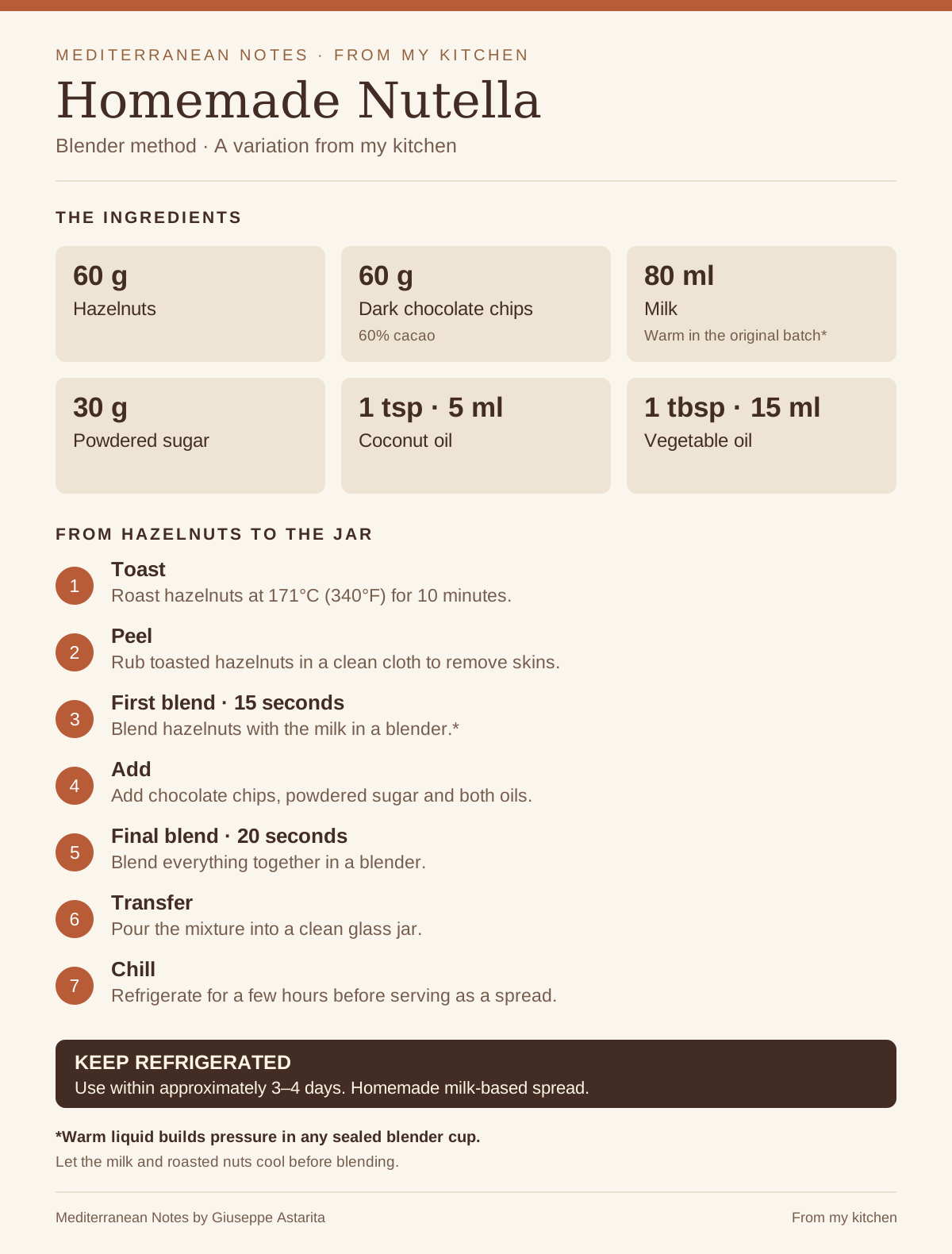
Full recipe — ingredients and preparation
| Ingredient | Quantity |
|---|---|
| Hazelnuts | 60 g |
| Dark chocolate chips (60% cacao) | 60 g |
| Warm milk (as used in this batch) | 80 ml |
| Powdered sugar | 30 g |
| Coconut oil | 1 teaspoon (5 ml) |
| Vegetable oil | 1 tablespoon (15 ml) |
- Toast: Roast hazelnuts at 171°C (340°F) for 10 minutes.
- Peel: Rub the toasted hazelnuts in a clean cloth to remove their skins.
- First blend: Place hazelnuts and milk in a blender. Blend for 15 seconds. In a sealed blender cup, let the milk and toasted hazelnuts cool before blending.
- Add ingredients: Add chocolate chips, powdered sugar, coconut oil, and vegetable oil.
- Final blend: Blend everything in a blender for 20 seconds.
- Transfer: Pour the mixture into a clean glass jar.
- Chill: Refrigerate for a few hours before serving as a chocolate-hazelnut spread.
Storage for this homemade version: Keep refrigerated and use within approximately 3–4 days. The room-temperature storage discussed above applies to commercial Nutella.
Blender note: Hot or warm liquid builds pressure in any sealed blender cup, including bullet-style ones. Let the milk and roasted nuts cool before blending, and never fill the cup past its max line.
Buona colazione.