Sides & Vegetables · Summer · Vegetarian
Melanzane a Scarpone
Stuffed eggplant baked in its own shell — the pulp cooked down with olives, capers, tomatoes and breadcrumbs, filled back in and baked. My mother's verdict: no salad needed.
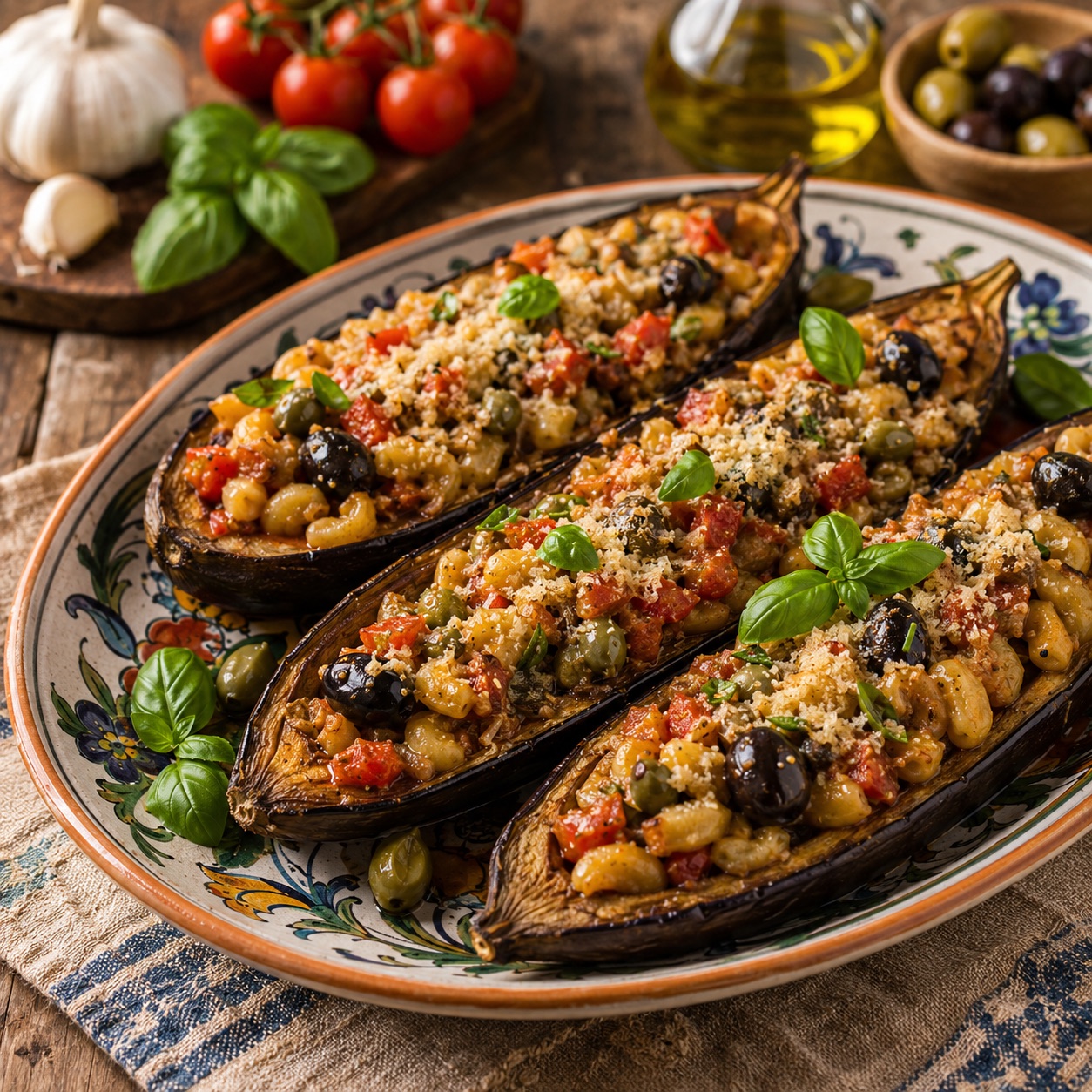
The name comes from the shape. Scarpone means a large, old shoe — and a halved eggplant, hollowed out, does have something of that silhouette: a curved, hollow vessel waiting to be filled. The other name, melanzane a barchetta, says the same thing in a more elegant register: a little boat. Either way, the dish is defined by what happens inside that shell.
I had forgotten this recipe existed until I called my mother to ask what else I was missing. She reminded me without hesitation: le melanzane a scarpone, certo. Of course. And then, anticipating my next question: what did you eat alongside it? A salad? She was dismissive. No, niente insalata. Non c'è bisogno. Le melanzane si mangiano da sole. No salad. No need. The eggplant is eaten alone.
She was right. The filling — eggplant pulp cooked down with cherry tomatoes, Gaeta olives, capers, garlic, basil, and breadcrumbs — is dense, aromatic, and complete. Baked in the shell at high heat until the top colours and the whole thing becomes fragrant, it is a main dish in itself. Not a side, not an accompaniment: the thing you sit down for. Served with bread for the sauce that pools in the shell, and nothing else.
This is a vegetarian dish from a tradition that didn't use the word vegetarian. In Campanian cucina povera, vegetables were the main course on any day that meat was too expensive or absent. The melanzane a scarpone belongs to that tradition — rich enough, filling enough, and fragrant enough to need nothing alongside it. The Gaeta olives are important: small, dark, and briny, they are the Campanian olive of choice, quite different from the milder varieties used elsewhere. If you can't find them, use another small dark olive. The capers should be salt-packed, rinsed — not in vinegar.
Several things happen in the oven that don't happen on the stovetop. At 180–190°C, the surface of the filling and the breadcrumb topping undergo Maillard browning — hundreds of new aromatic compounds form from the interaction of sugars and amino acids. The eggplant shell, acting as a thermal vessel, traps moisture from the filling early in the bake, then allows the surface to dry and crisp once that moisture has evaporated. This gives you a top that is golden and slightly crunchy while the filling below stays soft.
The flavour compounds from the Gaeta olives (phenolic compounds including hydroxytyrosol and oleocanthal), cherry tomatoes (lycopene, which becomes more bioavailable when cooked in oil), and capers (quercetin, a polyphenol with antioxidant properties) are all fat-soluble. The olive oil in the filling ensures their absorption is maximised. Baking also concentrates all of these flavours through evaporation — the same volume of filling, reduced by heat, becomes more intensely flavoured than the raw ingredients would suggest. This is why cucina povera at its best is nutritionally dense: slow cooking and good olive oil extract the best from simple vegetables.
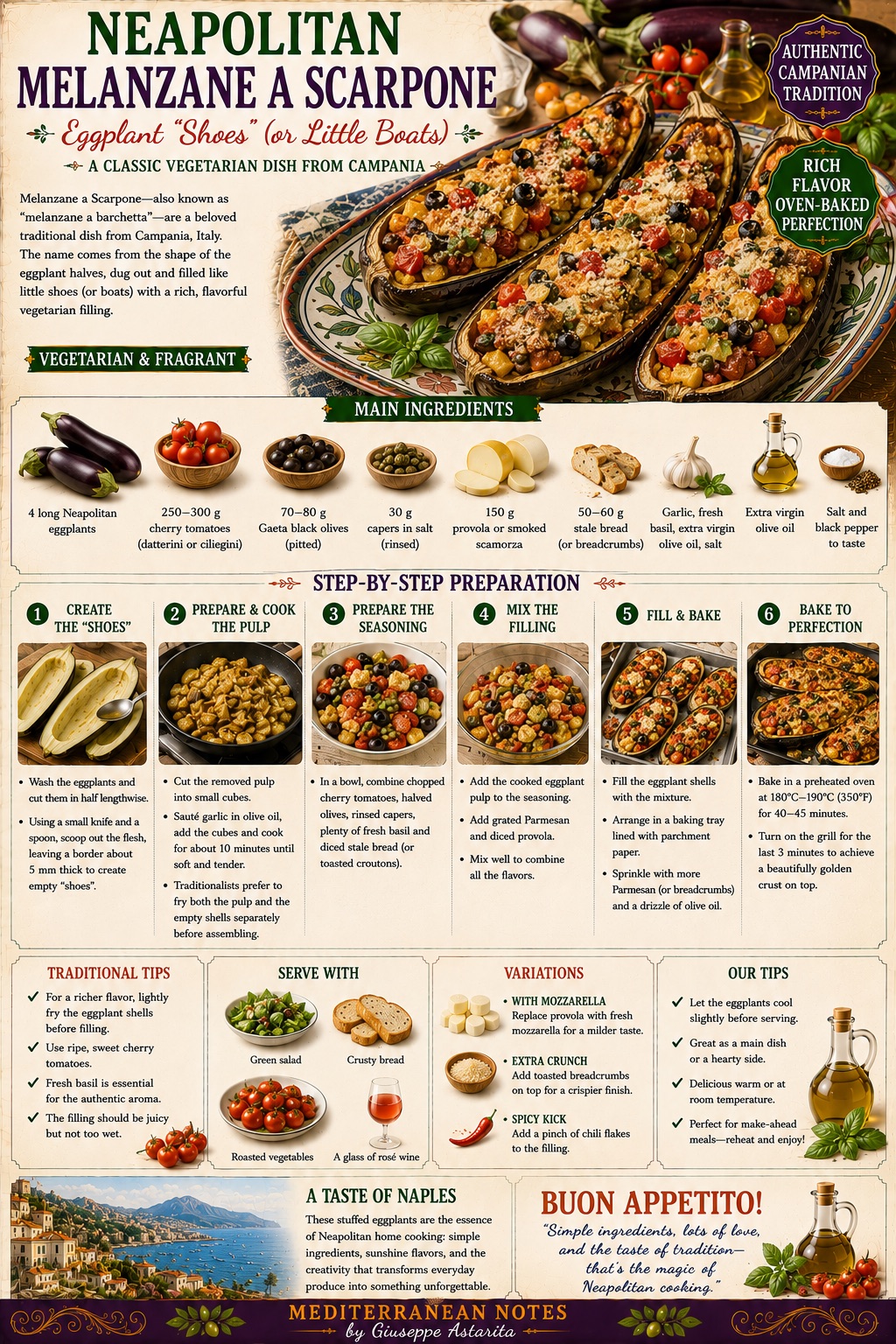
Tap to enlarge — Melanzane a scarpone: ingredienti, metodo, consigli
Recipe — Melanzane a Scarpone
Serves 4 · Ready in 55 minutes
- 4 long Neapolitan eggplants medium-sized, not too wide
- 250–300 g cherry tomatoes halved
- 70–80 g Gaeta black olives pitted and roughly chopped
- 30 g capers in salt rinsed well, then roughly chopped
- 60 g dried breadcrumbs for filling + topping
- 2 garlic cloves finely sliced
- Fresh basil a generous bunch
- Extra virgin olive oil
- Salt and black pepper to taste
- Smoked scamorza or provola optional, sliced thin for extra richness
The melanzane a scarpone is summer food from Campania — made when the long Neapolitan eggplants are in season and the cherry tomatoes are small, sweet, and plentiful. It appears at dinner as its own course, requiring no accompaniment. My mother would not hear of adding a salad. She was right. The eggplant is enough.