Fagiolini al Pomodoro
Green beans slowly stewed in tomato -- humble, satisfying, better the next day
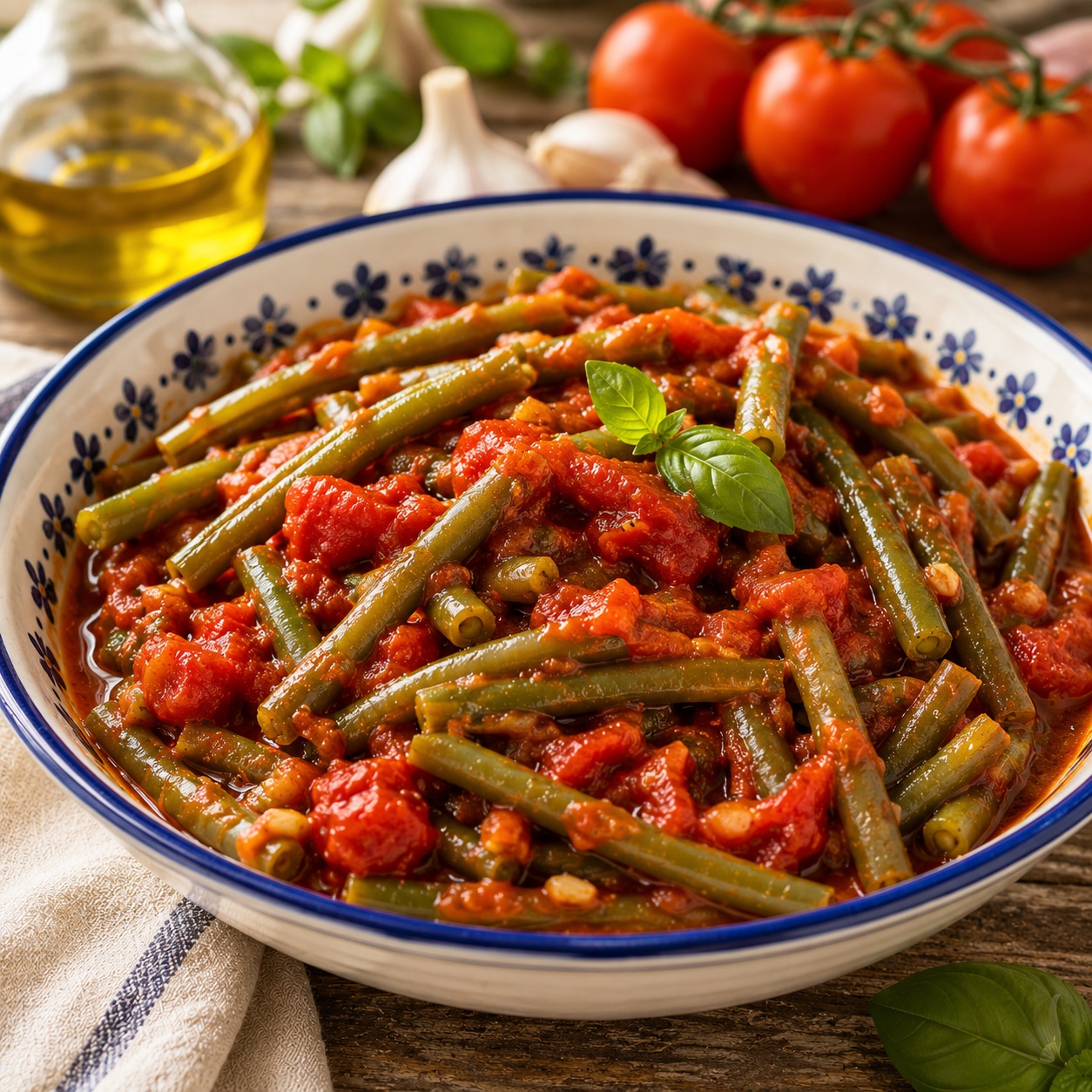
The Neapolitan table has a category of dishes that are not quite a main course and not quite a side dish but something in between -- a pot of something simple made with a few ingredients, cooked slowly, eaten with bread. Fagiolini al pomodoro belongs to this category. Green beans, tomato, garlic, olive oil. That is the complete list. The slow simmer -- twenty to twenty-five minutes covered over low heat -- is what transforms these separate elements into something unified and much better than the sum of its parts. The tomato sauce absorbs into the beans; the beans release their starch into the sauce; the garlic and olive oil provide the savory backdrop. The result is a dish that tastes like it required more effort than it did, and that is even better the next day eaten cold from the container, or at room temperature as part of a summer spread.
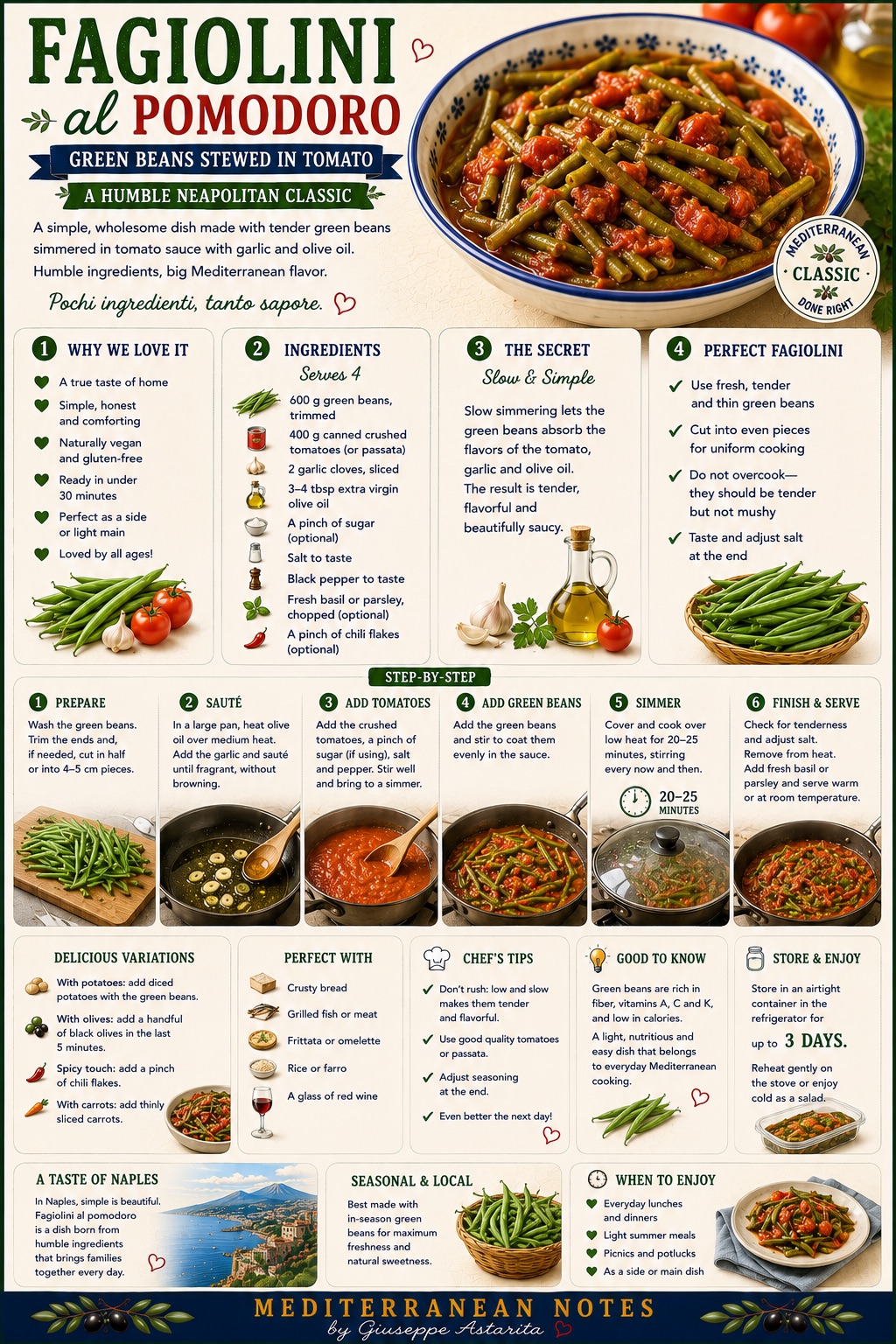
The key instruction is slow and simple. This is not a dish where speed or high heat improves anything. A rushed fagiolini al pomodoro -- cooked too quickly at too high a temperature -- produces beans that are not fully tender and tomato sauce that has not had time to integrate with the bean cooking liquid. Twenty to twenty-five minutes at low heat, the lid on, produces something completely different: the beans become tender throughout, the sauce thickens slightly as it reduces, and the two have spent enough time together to taste of each other. This is not a technical requirement that can be accelerated. It is simply time, and it is worth giving.
Green beans contain pectin in their cell walls -- the structural polysaccharide that holds the cells together and gives raw beans their characteristic snap. At simmering temperatures over 20-25 minutes, the pectin-calcium bonds progressively break down, releasing the cell walls and producing the tender texture of correctly cooked green beans. Simultaneously, a small amount of starch from the beans dissolves into the tomato sauce, acting as a natural thickener that gives the sauce its body. The tomato's glutamic acid -- its umami compound -- concentrates as the sauce reduces, and the olive oil forms a light emulsion with the tomato and bean cooking liquid that produces the characteristic glossy, coating consistency of a good fagiolini al pomodoro. None of this happens in ten minutes at high heat.
The recipe
Buon appetito.