Peperoni Gratinati
Sweet peppers with a golden breadcrumb crust — my mother's summer dish
Sweet bell peppers — red and yellow, the sweetest varieties — blanched briefly to soften, then arranged in a baking dish and covered with a mixture of breadcrumbs, Parmigiano, garlic, parsley, and olive oil. Into the oven until the topping is golden and fragrant and the peppers beneath are completely tender. My mother made this in summer, when peppers were in season and the kitchen did not need complicated food. She used the crisp function on her small oven for the last few minutes, and that is what made the crust.
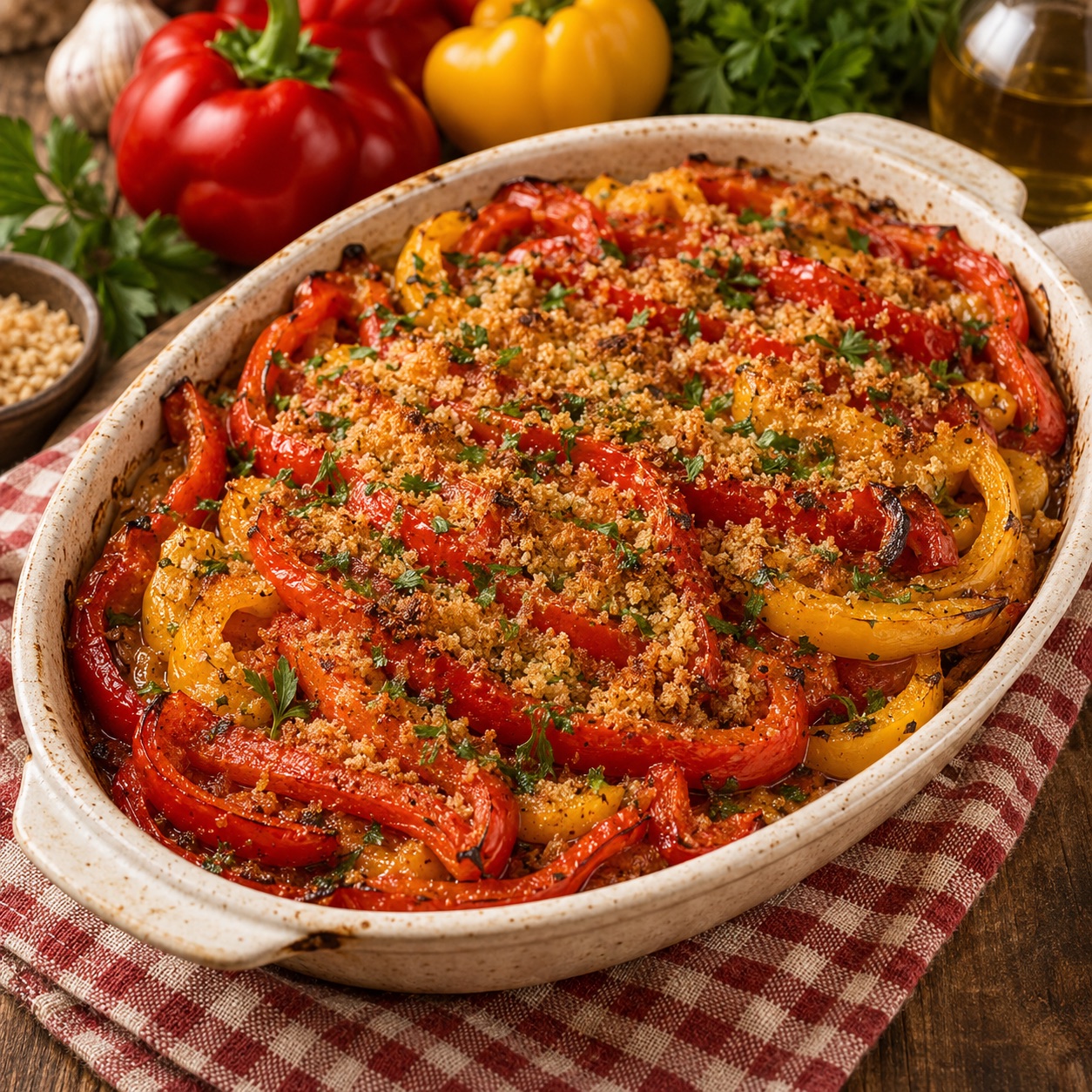
There is a small oven in my memory of my mother's kitchen — a countertop oven, the kind that Italians of her generation often used alongside or in place of a full-size range — that she deployed with specific authority for certain dishes. The gratinati were one of them. The peperoni went in for the main baking and then, at the end, she switched on the crisp function — the grill element at the top, what in Italian is called the grill or gratinatura — and left it for another three or four minutes, watching through the glass, until the breadcrumb surface went from golden to deeply golden with the edges beginning to brown and the Parmigiano forming the slightly crinkled, intensely savory crust that is the whole point of a gratin. This is the step that separates a good peperoni gratinati from an excellent one. The difference is entirely in those last few minutes under direct top heat.
The peppers should be red and yellow, not green. Red and yellow bell peppers are ripe, sweet, and have a concentrated fruit flavor that develops further during baking as their natural sugars caramelize. Green bell peppers are unripe, slightly bitter, and produce a more vegetal result that does not work as well under the breadcrumb topping. Mixed red and yellow also produces a more beautiful dish — the color that shows around the edges of the topping as the peppers cook through. My mother used whatever combination was at the market, but always the ripe colors, never green.
The brief blanching before assembly is important and occasionally skipped with poor results. Two to three minutes in boiling water removes the slight rawness from the pepper strips and ensures that they cook through completely in the oven without the breadcrumb topping burning before the pepper beneath has softened. Without blanching, the topping often reaches its correct color while the pepper is still too firm underneath — a mismatch of textures that the blanching prevents. Drain them well and pat dry before assembling: excess moisture steams rather than bakes and produces a less crisp result.
Bell peppers contain a range of natural sugars — primarily fructose and glucose — at concentrations that vary with ripeness. Red and yellow peppers, which have ripened fully, contain roughly twice the sugar content of green peppers. When heat is applied, two things happen: the cellular structure softens as the pectin in the cell walls breaks down, releasing the sugars into the surrounding tissue; and the sugars begin to caramelize at temperatures above 160°C, producing the characteristic sweetness and depth of roasted or baked peppers that raw peppers do not have. This is why baked red peppers taste substantially sweeter than raw ones of the same variety.
The distinction between oven baking and grill (top element) is a matter of heat direction and intensity. In conventional oven baking, heat circulates from the sides and bottom and the temperature is moderate and even — good for cooking the peppers through but insufficient to produce the rapid surface browning of a gratin. The grill element radiates intense heat directly downward onto the surface of the food, reaching much higher surface temperatures in a short time and producing the Maillard reactions and caramelization that create the golden-brown, crisp, deeply flavored crust. The Parmigiano in the breadcrumb mixture contributes proteins and sugars that participate eagerly in these reactions — which is why Parmigiano gratins brown faster and more evenly than plain breadcrumb ones. Three to four minutes under a hot grill produces what twenty-five minutes of oven baking at 200°C cannot.
The recipe
Serves 4 as a contorno. Use red and yellow peppers — the sweetest, most flavorful varieties. Do not skip the blanching step. Do not skip the grill at the end. Serve warm or at room temperature; both are good.
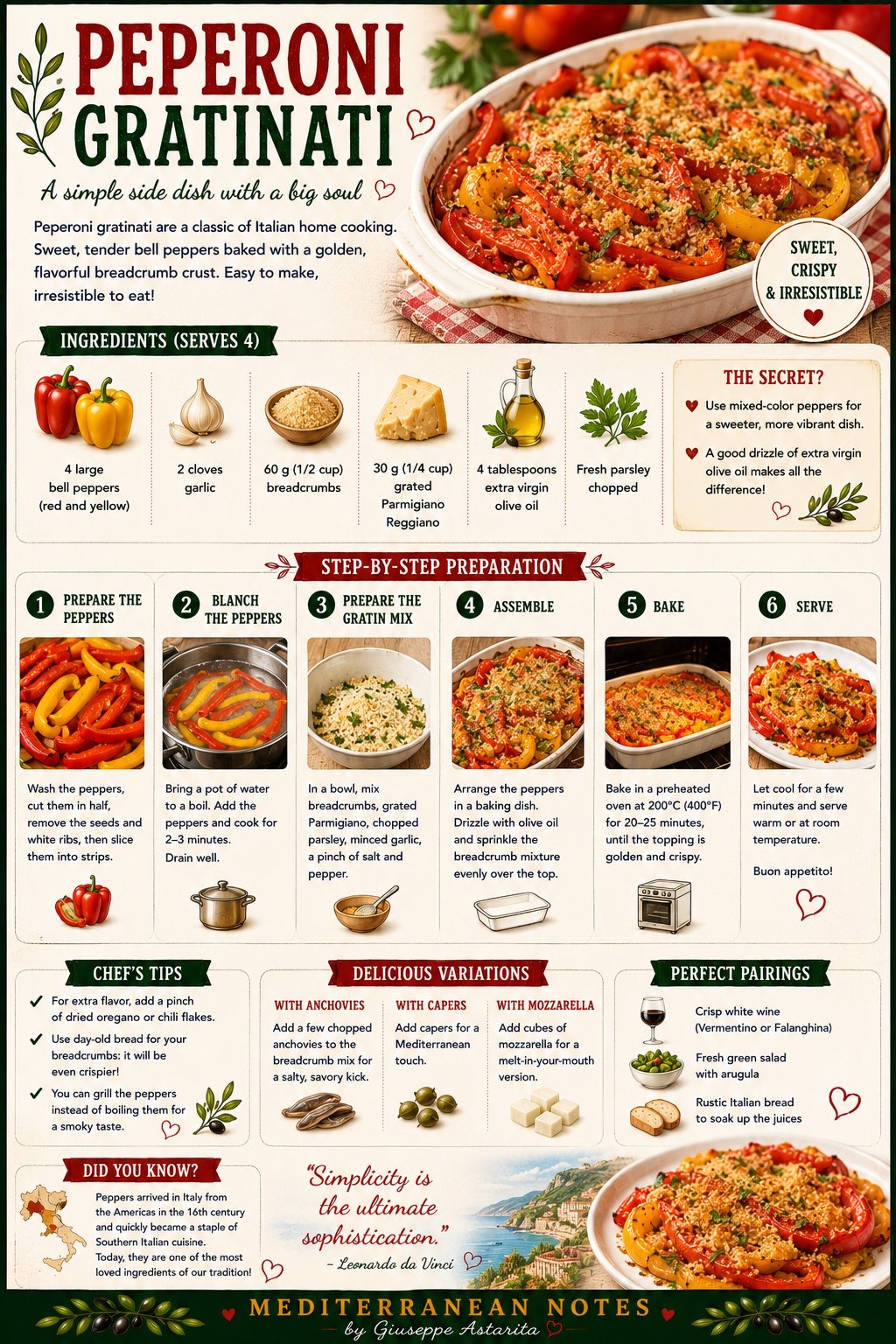
Variations that work well: a few chopped anchovy fillets mixed into the breadcrumb topping add a savory depth without making the dish taste of fish — the same principle as anchovy in the cauliflower salad and the puttanesca. A handful of capers in the breadcrumb mixture. Cubes of mozzarella tucked between the pepper strips before the topping goes on, producing pockets of melted cheese underneath the crust. Each of these is a legitimate direction without changing the essential character, which is sweet pepper and golden breadcrumb.
Buon appetito — e grazie, mamma, per quella funzione crisp.