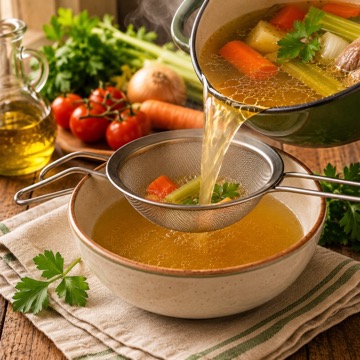
Brodo di Carne alla Napoletana
Il vero comfort di Napoli — the Saturday ritual
Every Saturday without exception the answer to the question of what was for lunch was pasta in brodo. Chiocciole or tubetti in the meat broth my mother had started in the morning, the pot on the stove from early, the kitchen smelling of celery and parsley and the specific warmth of slow-cooked meat by the time we came in from outside.
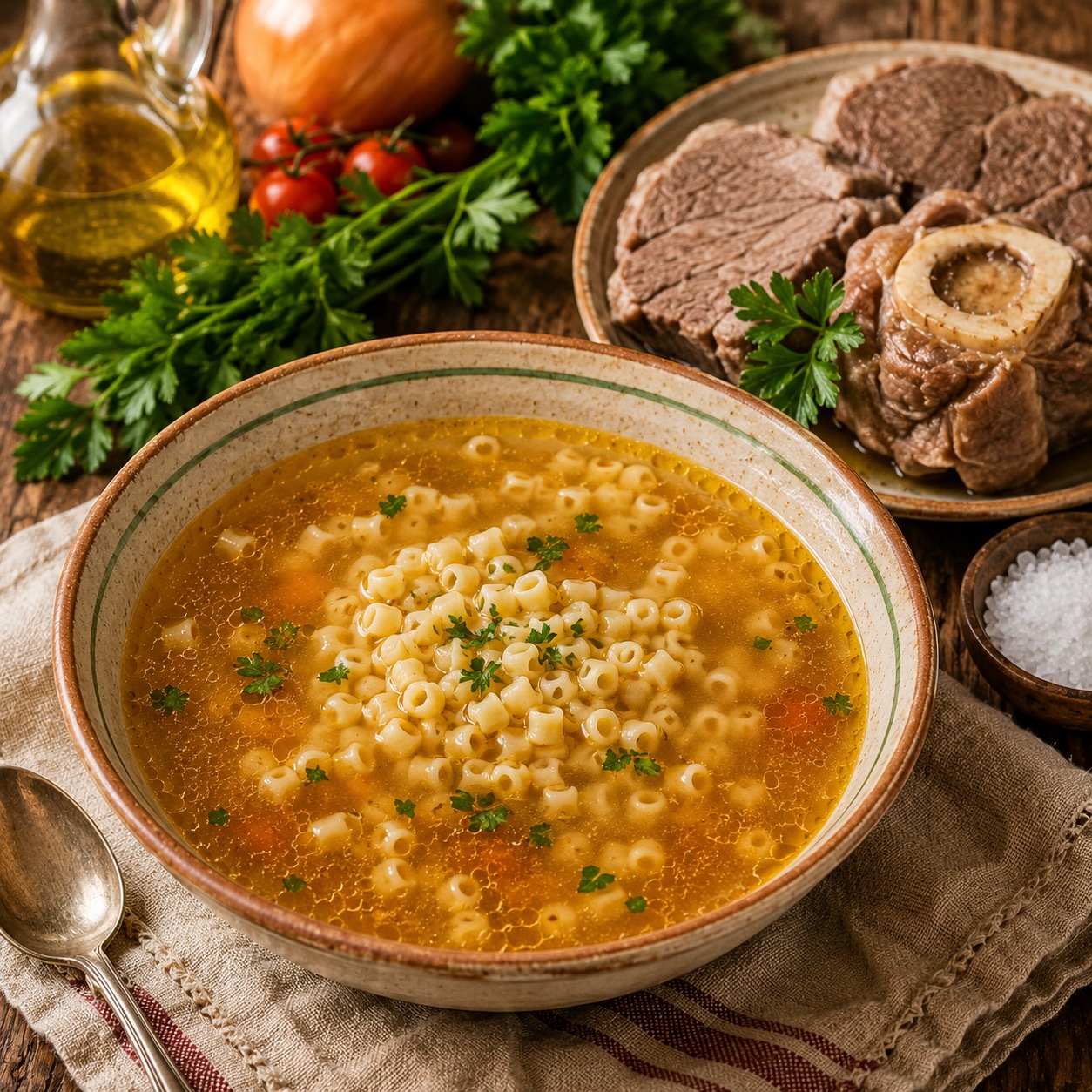
Saturday was brodo day. This was not a decision that was remade each week — it was simply what Saturday was. My mother started the pot in the morning, the same pot, the same cuts of meat, the same vegetables in the same cold water with the same spoonful of tomato passata that gave the Neapolitan meat broth its characteristic color: not the clear pale gold of a French consommé or a northern Italian brodo, but a golden liquid with the faintest rosy quality from the tomato, slightly deeper and warmer in color than any broth without tomato would be. By midday the pot had been simmering for two or three hours and the broth was ready, and the pasta went in and was cooked directly in the broth, and the whole family sat down to the specific pleasure of pasta in brodo on a Saturday in winter.
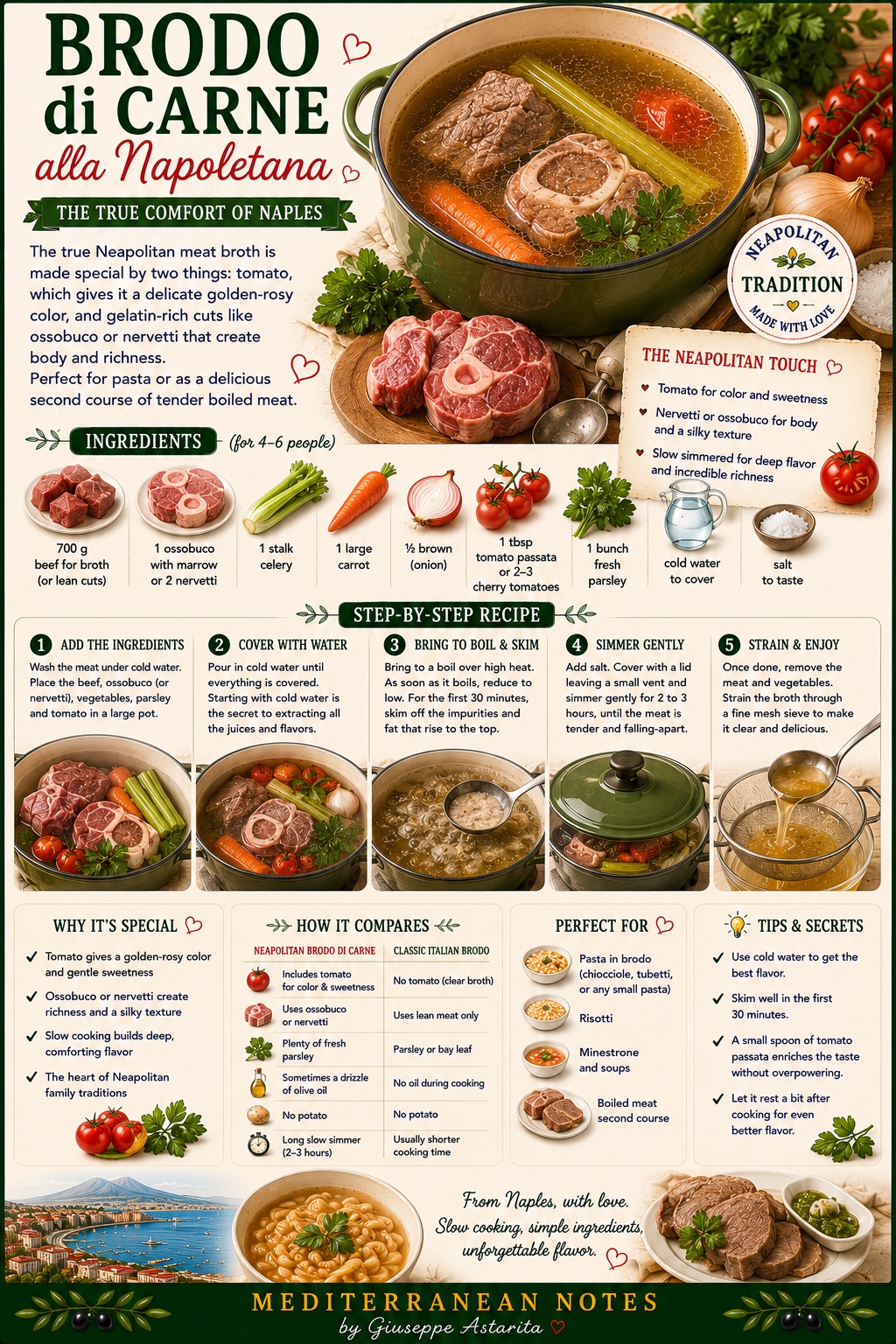
The Neapolitan meat broth differs from the classic Italian brodo in three specific ways, all of which are visible in the color and taste of the finished product. The first is the tomato: a tablespoon of passata or two or three cherry tomatoes added at the beginning, which contributes both the rosy color and a gentle sweetness that balances the savory depth of the meat without being identifiable as a tomato flavor in the finished broth. The second is the use of gelatin-rich cuts — ossobuco with its marrow-filled bone, or nervetti, the cartilaginous cuts of the shank that dissolve slowly over the long simmer and give the broth its body and silky quality. A broth made with only lean beef is technically a broth but lacks the textural richness that makes the Neapolitan version what it is. The third difference is the time: two to three hours at the barest simmer, not the hour or hour and a half that most quick broth recipes suggest. Gelatin does not extract from cartilage and bone quickly. It requires time and patience and a flame so low that the water barely moves.
The meat that had cooked in the broth for two or three hours was the second course. Boiled beef eaten with a drizzle of olive oil and a pinch of coarse salt, or with a spoonful of the broth alongside, or with a green sauce if my mother had made one. This was not a sad consolation for the fact that the meat had given its flavor to the broth — it was a legitimate secondo in its own right, tender in a specific way that only long slow simmering in liquid produces, with a texture that no other cooking method approaches. My father ate the boiled meat. He was not always a seafood person but he was always a brodo person, and the Saturday lunch was one of the fixed points of the week that did not require any adjustment to accommodate his preferences.
La ricetta
Come usarlo
Starting a broth with cold water and bringing it to temperature slowly is not merely tradition — it is the method that produces maximum flavor extraction and clarity simultaneously. When meat is placed in already-boiling water, the surface proteins coagulate immediately, sealing the exterior and reducing the diffusion of flavor compounds, collagen, and minerals into the surrounding liquid. Starting cold allows these compounds to leach out gradually as the temperature rises, producing a more flavorful broth. The gradual heating also means the proteins that coagulate and form the grey foam — primarily myoglobin, albumin, and other water-soluble proteins — do so slowly and can be skimmed before they break into fine particles that would cloud the broth. Rapid boiling after the initial skim breaks these coagulated proteins into tiny fragments that remain suspended and cannot be removed by skimming, which is why a rapidly boiled broth is always cloudy regardless of how long it is cooked. The gelatin contribution of ossobuco and nervetti is the other critical element: these cuts contain cartilage and connective tissue rich in collagen, which hydrolyzes to gelatin over 2–3 hours at gentle heat. Gelatin is a hydrocolloid that increases the viscosity of water, giving the finished broth its characteristic body — the quality that makes it coat the inside of the mouth rather than running like plain water. A meat broth without gelatin-rich cuts is technically a broth but lacks this specific textural richness. The starch argument against potato is straightforward: starch granules that swell and partially dissolve during the long simmer scatter light differently than pure liquid, producing the characteristic cloudiness of starch-containing broths, and the starch also provides a substrate for bacterial growth that accelerates spoilage.
I make this on Saturday mornings in Massachusetts when I have time for it, which is not every Saturday but often enough to maintain the connection. The pot goes on early. The kitchen fills with the smell by mid-morning. My daughters know that when the broth pot is on, lunch will be pasta in brodo, and they know what pasta in brodo means — not just the food but the day, the pace, the kind of Saturday that involves being in the house rather than rushing somewhere. Some rituals travel better than the food they contain. The brodo travels well too, but the Saturday travels with it.
Buon brodo — e buon sabato.