Brioche Salata Napoletana
Babà rustico · Danubio salato — the soft celebration bread
Enriched with eggs, butter, and milk; filled with salami, provolone, and smoked scamorza throughout. Not bread — a soft-crumbed festive loaf you tear apart warm at the table. Known as babà rustico or danubio salato. Not casatiello; not tortano.
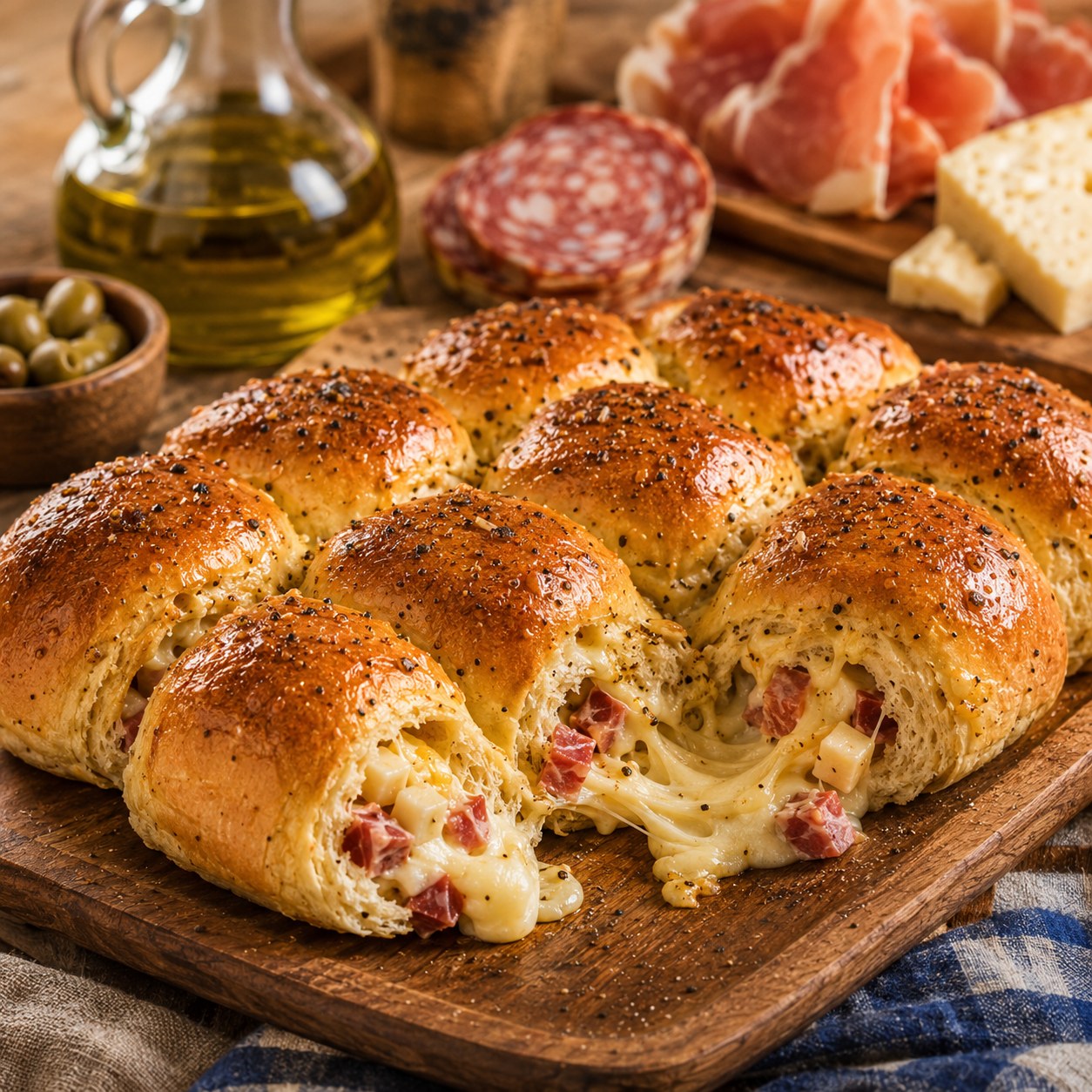
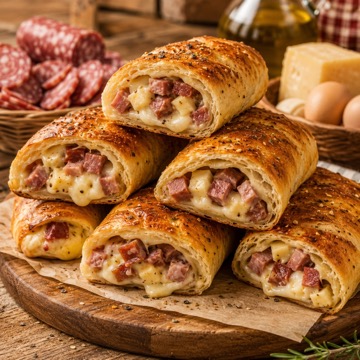
The brioche salata napoletana — known variously as babà rustico or danubio salato — is a celebration bread. Not bread for everyday eating: bread for parties, for holiday tables, for the gathering where people will stand around the kitchen and pull pieces off a loaf that is still faintly warm. The dough is enriched with eggs, butter, and milk, which makes it light and soft and slightly springy in a way that ordinary bread dough is not. The filling — salami, cured ham, provolone, smoked scamorza, Parmigiano — is cubed small and worked directly into the dough before shaping, distributed through every bite rather than concentrated in a seam. When you tear a piece off, the cheese has melted into everything. It is a different thing from a sandwich. The bread and the filling have become one object.
My mother made this for parties and during the holidays sometimes — Christmas gatherings, celebrations where a lot of people were expected and where there had to be something to put out immediately when people arrived, before any hot food was ready. It was not a recipe she made on a weekday. It was a festive-occasion thing, and it had the particular status of something that required effort and time and was therefore a signal that the occasion was serious. She made the dough, she let it rise, she folded in the filling, she shaped it. The loaf came out of the oven golden and fragrant with pepper and provolone. People tore into it while it was still warm.
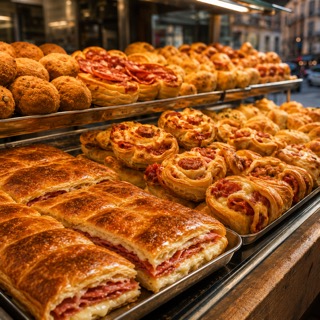
The name shifts depending on who is making it and how it is shaped. Babà rustico usually refers to the version baked in a ring mold — the savory cousin of the sweet babà, same shape, entirely different flavor profile. Danubio salato refers to the pull-apart version: the dough is divided into small balls, each stuffed individually with a cube or two of filling, and the balls are arranged touching each other in a round mold. They bake together and fuse at the sides, so the loaf pulls apart into individual rolls — each one its own sealed package of dough and filling. The danubio format is particularly useful for a buffet, because each ball is already a single-serving portion and no one needs a knife.
How it differs from casatiello and tortano
The three things are often confused because they all involve leavened dough and cured meats and cheese. They are genuinely different objects.
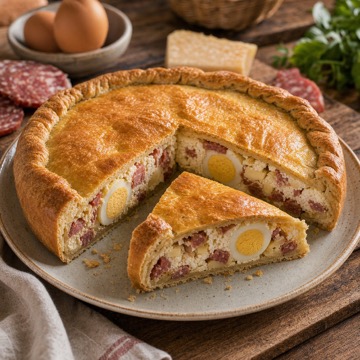
The casatiello and tortano are bread. The brioche salata is a soft-crumbed pastry. The fat in the casatiello/tortano dough is strutto; in the brioche salata it is butter (and sometimes strutto is used in older recipes, but the eggs and milk remain). The filling in casatiello/tortano is layered in during rolling; in brioche salata it is folded into the soft dough. The results are completely different in texture, character, and occasion — though all three serve the same broad function of feeding a crowd something substantial and celebratory.
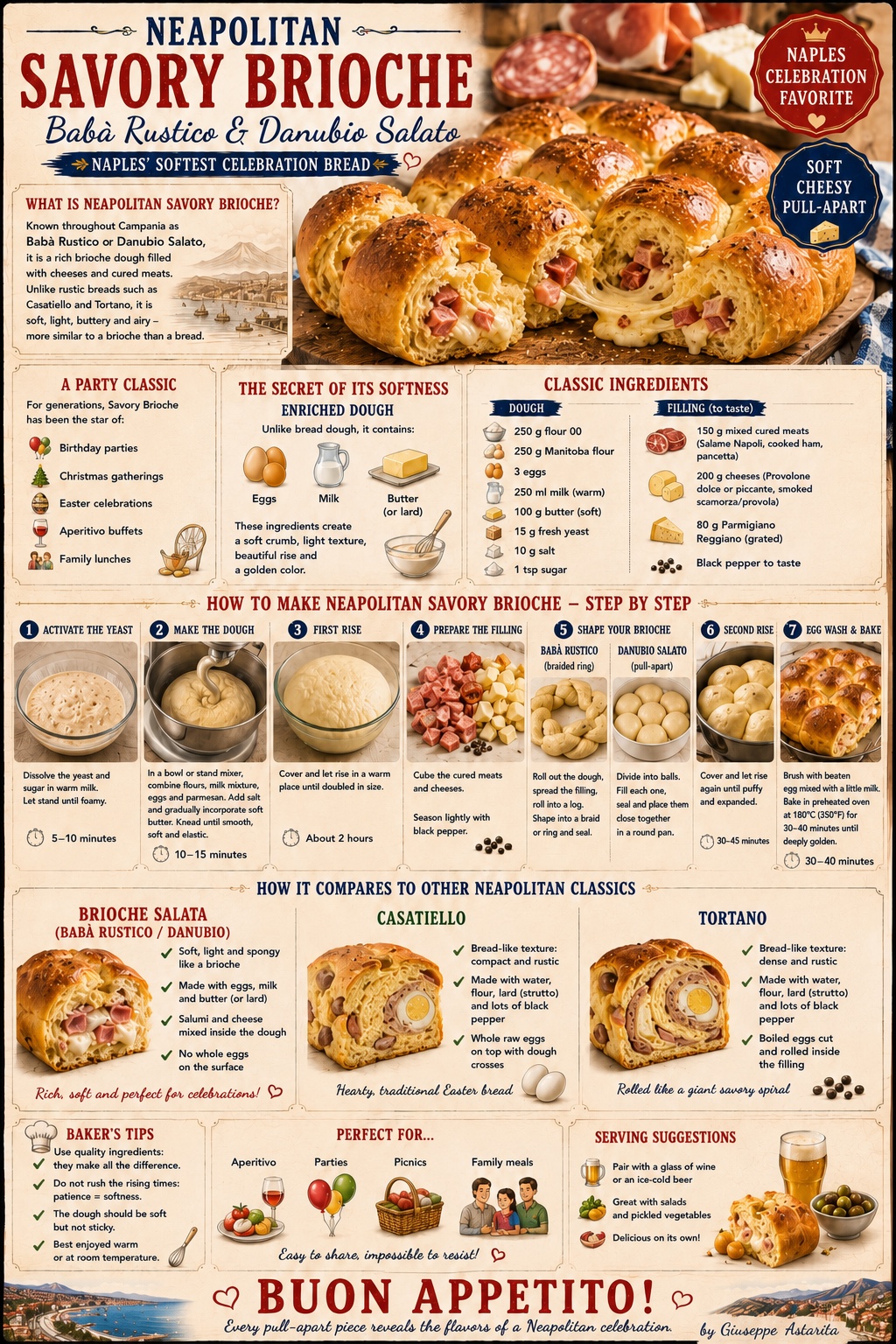
Recipe
Dough
Filling
Method