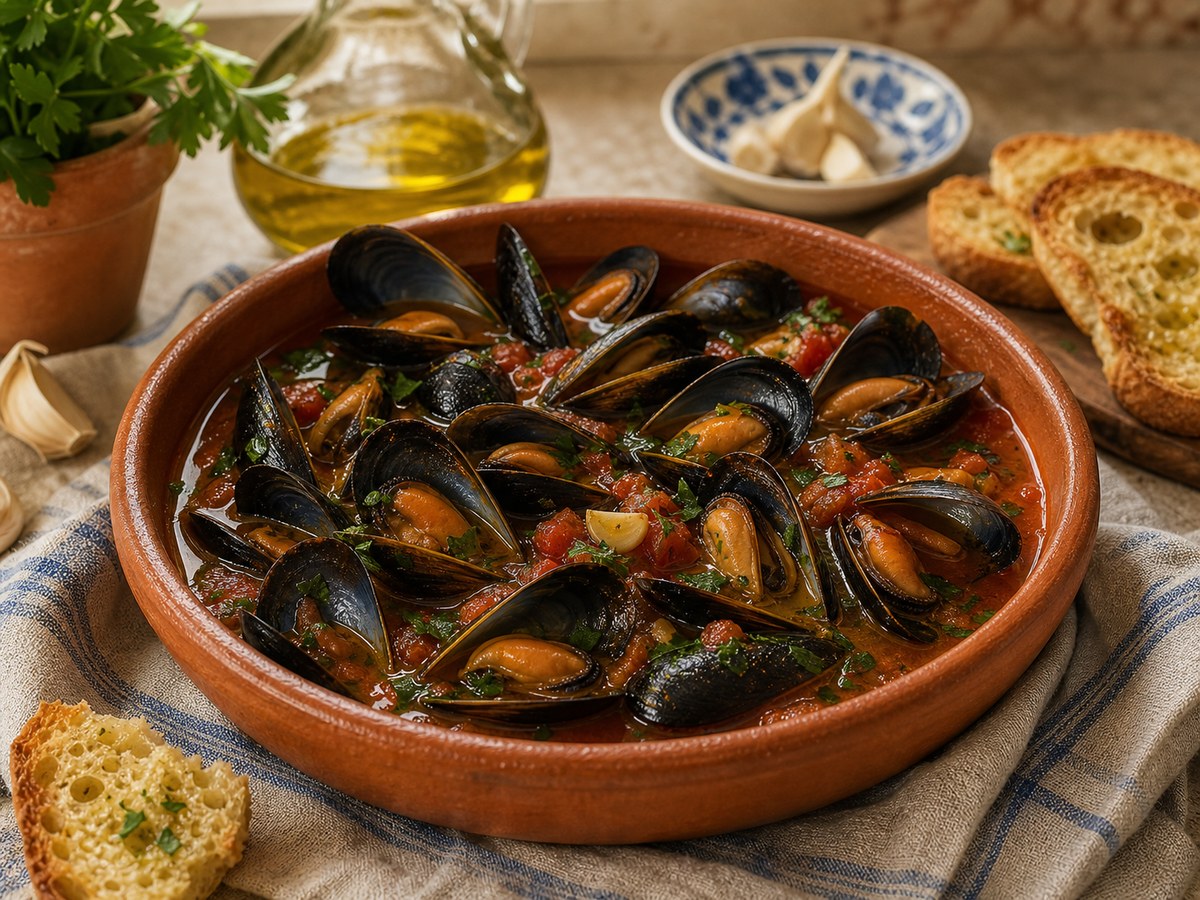
Zuppa di cozze tradizionale
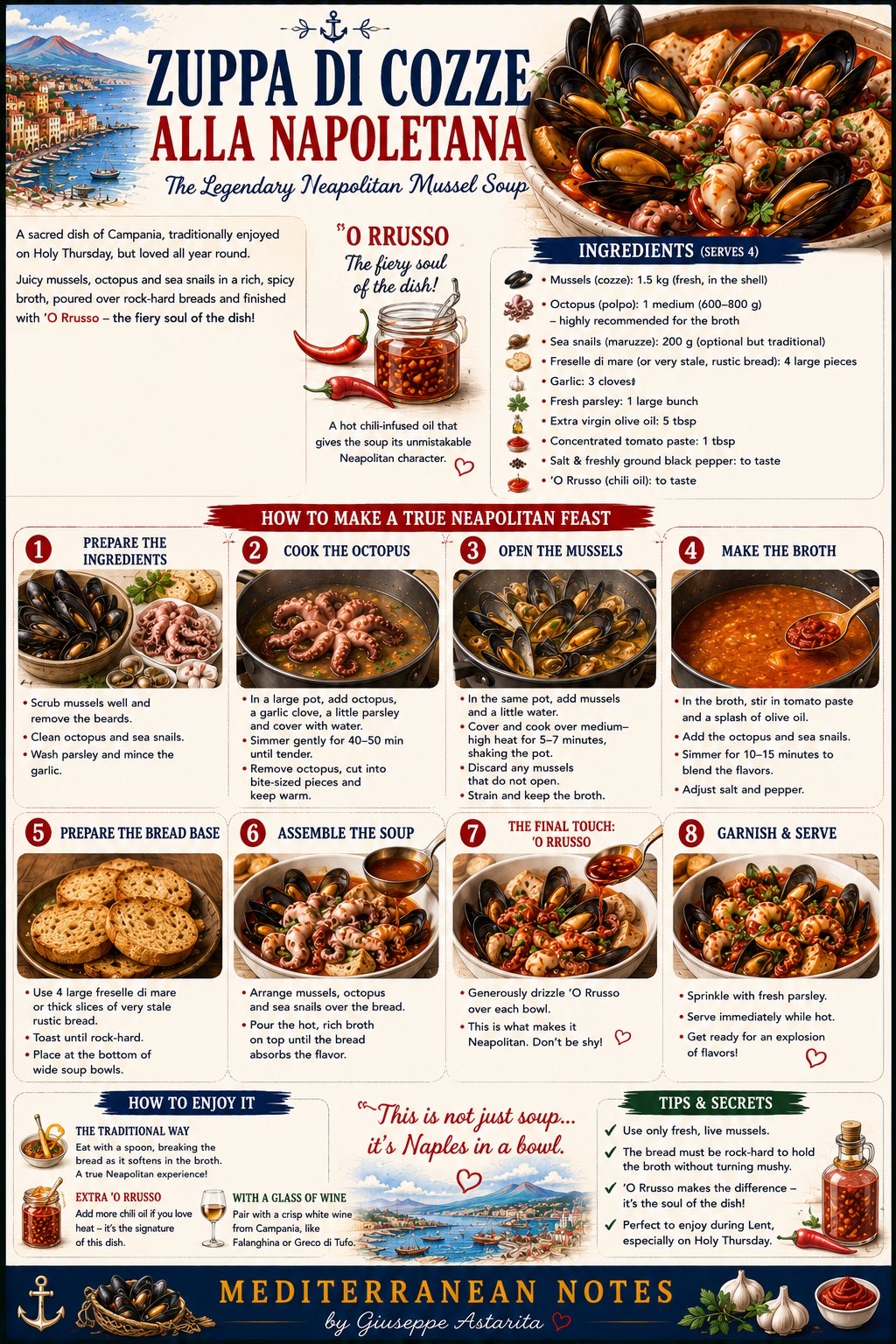
The full preparation — octopus simmered until soft, sea snails, mussels, rock-hard freselle di mare, and 'O Rrusso. The Holy Thursday dish of the Neapolitan coast. This takes most of a morning. It is worth every minute.
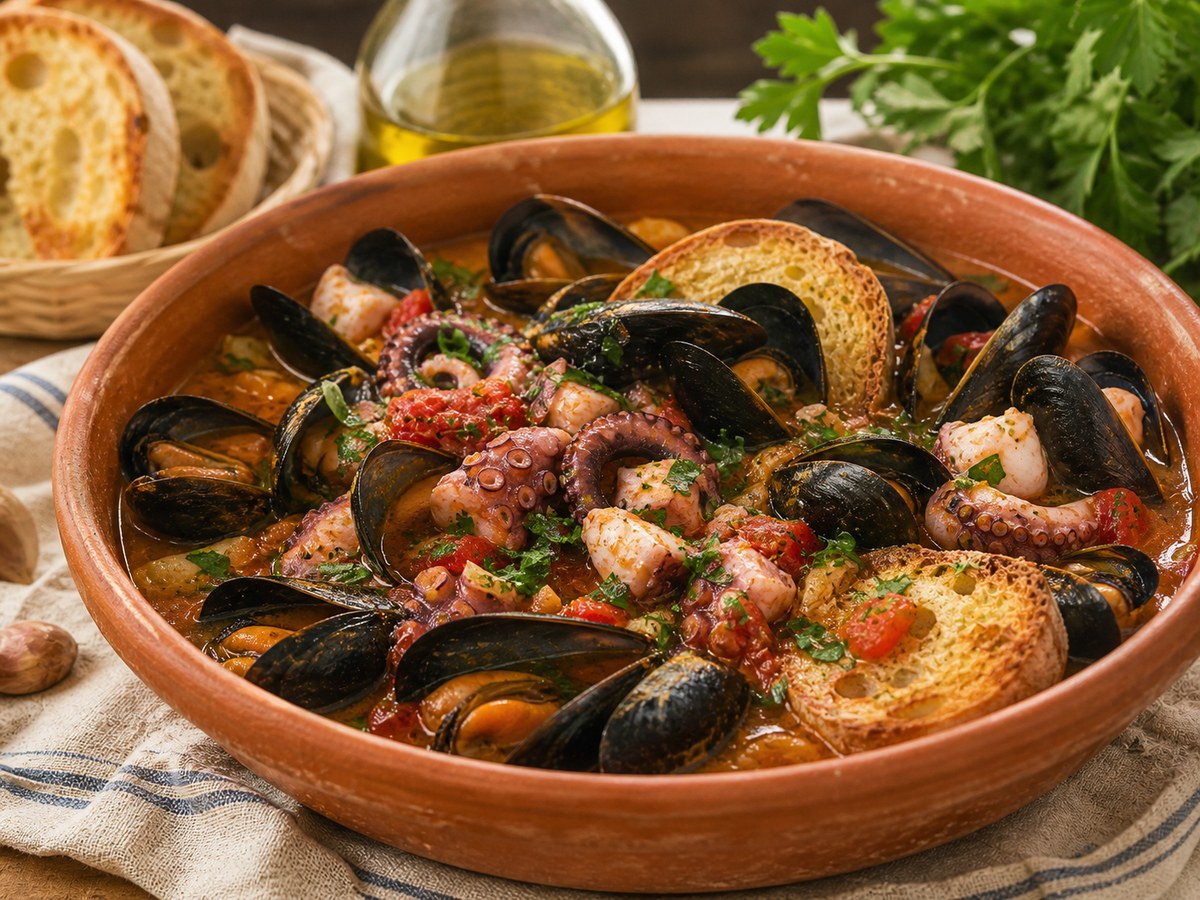
The full zuppa di cozze alla napoletana is a Holy Thursday dish — il Giovedì Santo — and it carries all the weight that implies. Along the Neapolitan coast from Pozzuoli to Torre del Greco, the day before Good Friday has meant this soup for generations: the octopus simmered separately for forty-five minutes until the collagen has converted and the tentacles yield without resistance, the maruzze — sea snails — cooked slowly until they release from their shells, the mussels opened last and returned to a broth that has been building for two hours, the freselle di mare placed at the bottom of the bowl and submerged, the 'O Rrusso poured over everything at the end. It is a meal that takes most of a morning to make and about thirty minutes to eat, and when it is done correctly, the bowl in front of you contains the concentrated flavor of the Tyrrhenian Sea.
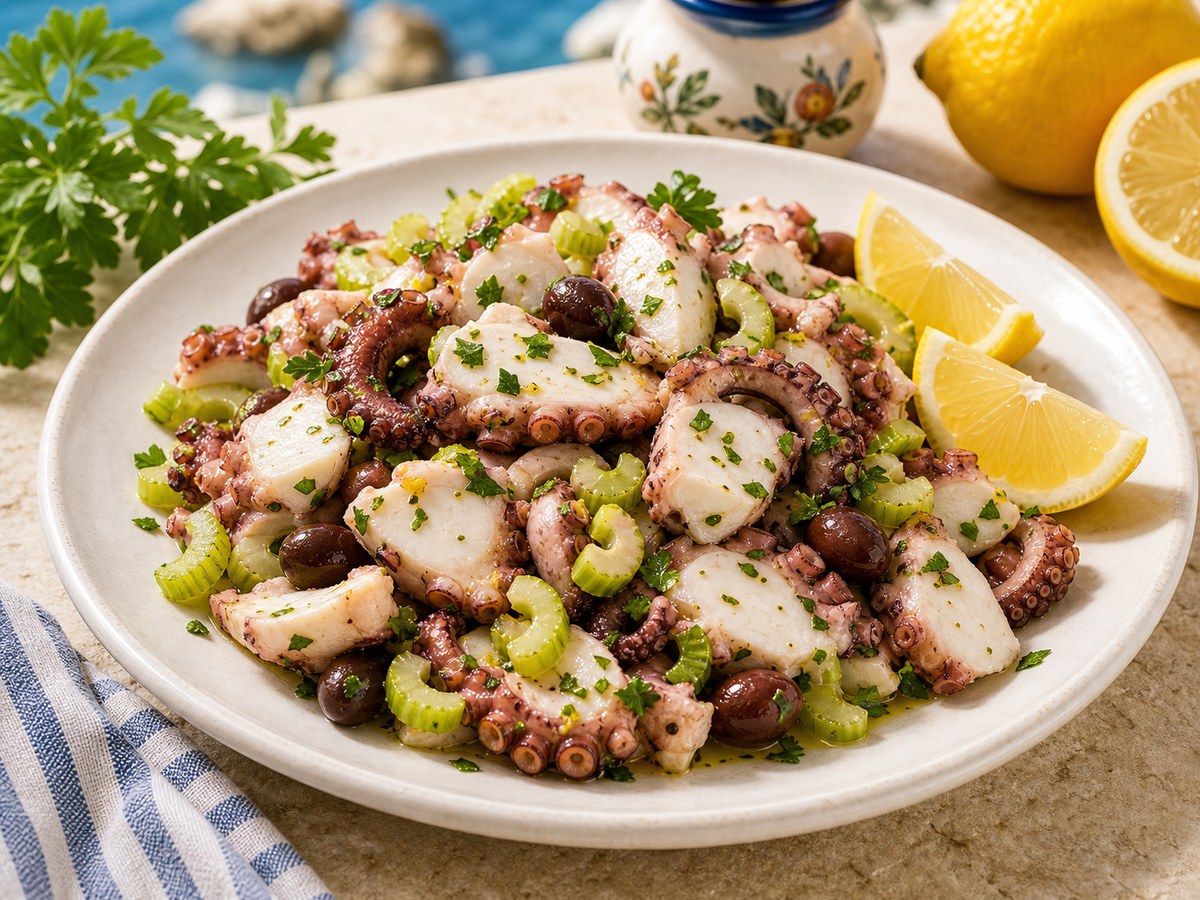
I did not grow up making this myself — my mother made the fast version, which is already very good. The full preparation I first ate at a table near the water in Pozzuoli on a Holy Thursday when I was maybe fourteen, at the house of my father's colleague who was from that part of the coast and whose wife made the soup with the full production. The octopus came to the table separately, dressed with lemon and olive oil, as a first course before the soup. Then the soup arrived in a deep terracotta bowl, the freselle already at the bottom, the broth already deep red from the 'O Rrusso, the mussels piled on top. I ate two bowls and used the shells to scoop up the bread and felt, afterward, entirely satisfied in a way that is specific to eating something that has been made for a long time by someone who knows exactly what they are doing.
The freselle di mare are essential and not interchangeable with ordinary freselle or rustic bread. They are harder — baked three times, not twice — and they hold their structure in a mussel broth for two full minutes before beginning to soften. Regular bread collapses in under thirty seconds. The sea biscuit survives long enough to soak the broth deep into its interior while keeping a firm core, which is the correct texture: soft outside, still slightly resistant at the center, tasting entirely of the broth it has absorbed.
Why the octopus goes in first — and what the broth absorbs from it
Octopus muscle contains a high proportion of collagen relative to most seafood. When simmered at around 85°C for 40–50 minutes, this collagen undergoes hydrolysis: the long triple-helix protein chains break down into shorter gelatin fragments, and the muscle fibers — which tighten dramatically in the first minutes of cooking, producing that rubbery texture — gradually relax as the collagen network dissolves. The result is soft, yielding octopus with a slightly silky texture. What matters for this soup is what the octopus releases into the water it cooks in: gelatin, amino acids (particularly taurine and glycine, the dominant flavor compounds in cephalopod broth), and lipid-soluble aromatic compounds from the skin. When the octopus cooking liquid is combined with the mussel broth, the result has a depth and body that neither liquid has alone. The gelatin from the octopus gives the final broth a slight viscosity — not noticeable as texture, but perceptible as richness. This is the structural reason the traditional recipe uses octopus: not for the meat alone, but for what it contributes to the liquid it swims in.
Timing — plan your morning
Recipe — serves 4–6
Ingredients
Method
Simmer the octopus. In a large pot, heat 3 tbsp olive oil with 1 crushed garlic clove over medium heat. Add the octopus whole. Add 80 ml wine. Cover and simmer over low heat for 40–50 minutes, turning once halfway. The octopus is ready when a skewer enters the thickest part of the tentacle without resistance. Remove the octopus and set aside. Reserve all the cooking liquid — this is flavor.
Do not add water. The octopus releases its own liquid as it cooks. The pot will have 200–300 ml of dark, rich broth by the end.
Cook the sea snails. In a separate small pot, heat 2 tbsp olive oil with 1 garlic clove. Add the maruzze, cover, and cook over medium heat for 25–30 minutes. Add a ladleful of hot water halfway through if the pot dries. They are done when the snail releases cleanly from the shell with a toothpick or skewer. Reserve their liquid too.
Cut the octopus. Once cool enough to handle, cut the octopus into pieces: tentacles in sections of 3–4 cm, body in rough chunks. Set aside.
Open the mussels and build the master broth. In a large pot, heat 3 tbsp olive oil with 2 garlic cloves and parsley stems over high heat. Add mussels, cover, cook 3–4 minutes shaking once. Remove mussels as they open. Strain the mussel liquid through cheesecloth. In the same pot, heat the strained mussel liquid with the octopus liquid and snail liquid over medium heat. Add tomato paste, stir well, and simmer 10 minutes to concentrate slightly. Taste for salt — do not add any unless very underseasoned.
Bring everything together. Add the octopus pieces and sea snails to the master broth. Simmer gently 5 minutes to warm through and meld. Return the mussels to the pot for a final 30 seconds. Add the chopped parsley leaves. Turn off the heat.
Prepare the freselle and assemble. Place one fresella di mare in each deep bowl. Ladle 2–3 tablespoons of hot broth directly over the fresella and leave it to absorb for 90–120 seconds — it should soften slightly on the outside while remaining firm at the center. Then ladle the full soup over it: mussels, octopus, sea snails, and abundant broth. Finish each bowl with a generous spoonful of 'O Rrusso. Serve immediately.
The fresella must be at the bottom before the main ladle, pre-soaked for 90 seconds. If you pour the full broth over a dry fresella it softens unevenly. The two-step approach — broth first, rest, then the full soup — is correct technique.
The other shellfish soups
This is the full production — the once-a-year version. On a weeknight with good mussels and thirty minutes, the faster version without octopus is excellent. For the lighter clam soup, see below.
Buon appetito — e che sia il Giovedì Santo.