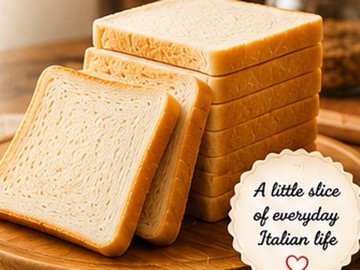
I Tramezzini
The crustless triangle my mother made for every occasion, from childhood parties to graduation lunches
Technically not a Neapolitan invention — Venice and Turin have better claims to the tramezzino. But my mother made them for every gathering from when we were children, and they disappeared from the plate faster than anything else she prepared.
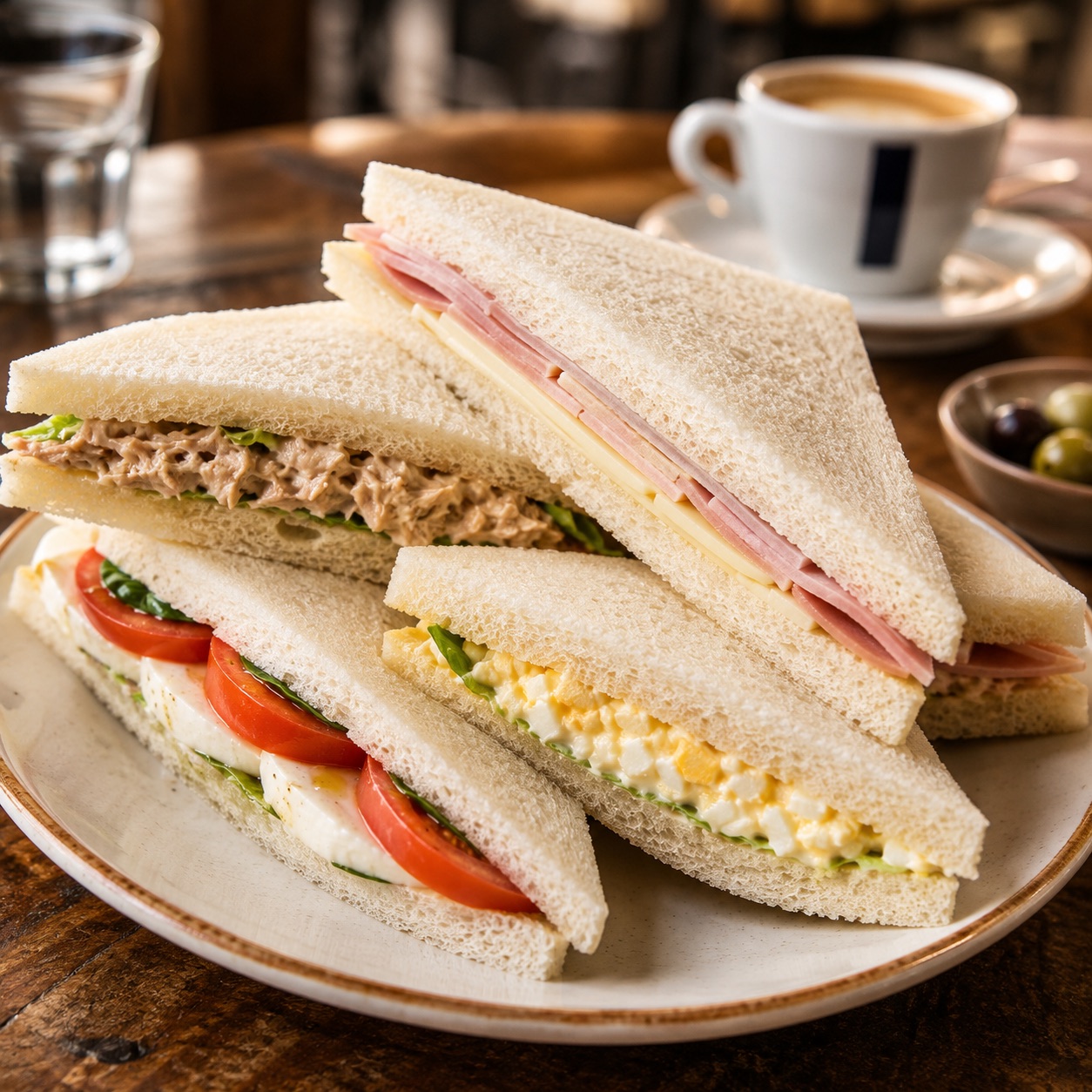
The tramezzino is a product of northern Italy that became genuinely national. Venice has its bar culture built around them; Turin claims the original invention in the 1920s. Naples did not invent the tramezzino, but Naples adopted it completely, and by the time I was growing up in Caserta in the 1980s it was a standard fixture at any gathering that required something to eat with your hands. My mother made them for birthday parties, for Sunday lunches when the family came, for the graduation party in the garden, and occasionally for a quick lunch on a school day when there was not time for something more involved. She made them from pan carrè, trimmed the crusts with a single pass of a knife along each side, filled them, pressed them slightly with her palm, and cut them diagonally once. That was the whole operation, done fast and in quantity.
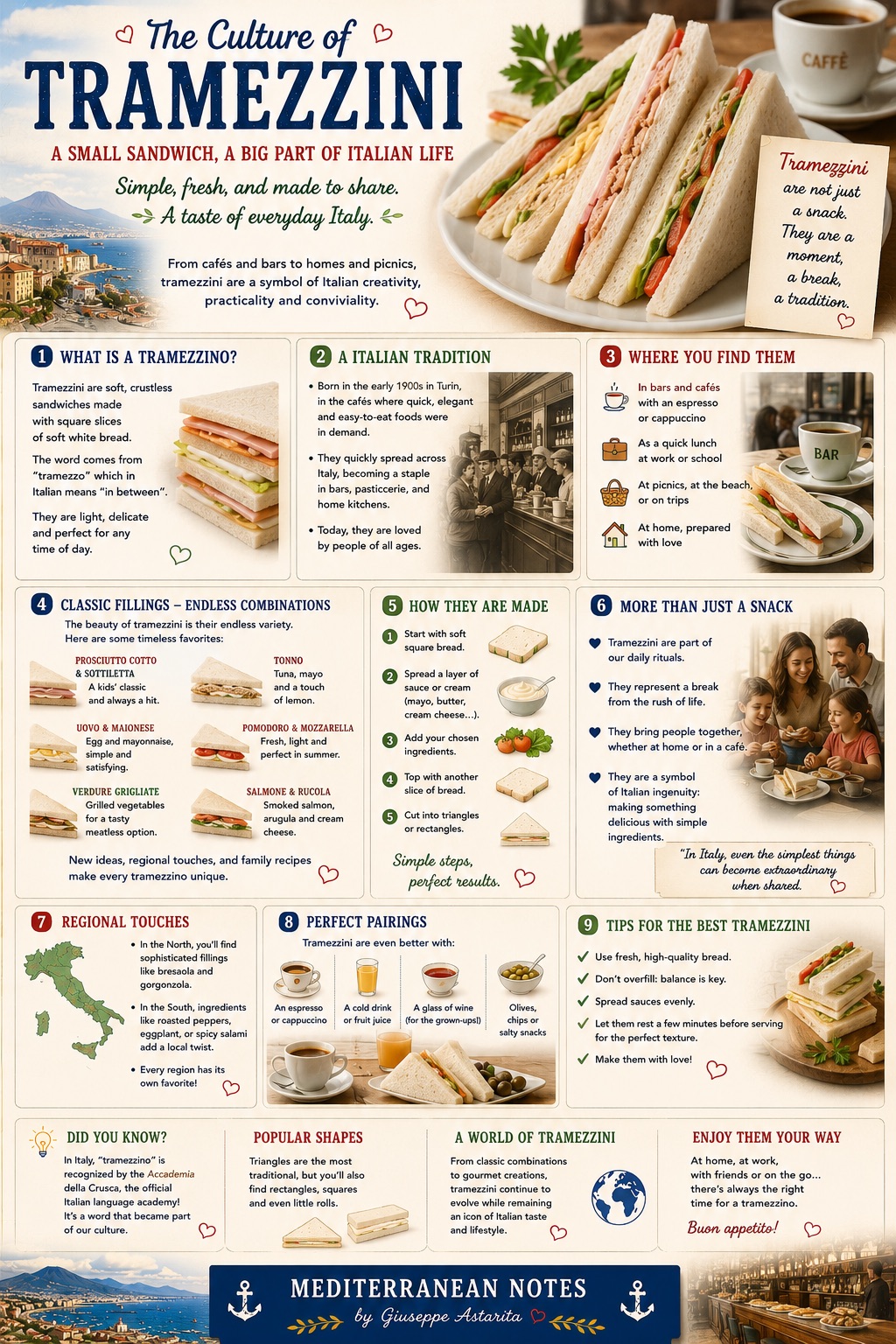
The classic filling at our table was tonno e maionese — canned tuna in olive oil, well drained, mixed with mayonnaise from a jar, sometimes with a few capers or a little lemon juice added, spread generously on both slices of bread. The other standard was prosciutto cotto e burro: cooked ham with a thin layer of softened butter rather than mayonnaise, which produced something cooler and less rich. For parties she would make both kinds, arrange them on a large oval plate, and cover them with cling wrap until it was time to serve. The cling wrap was important — an hour on the counter uncovered and the corners of the bread dried out, which ruined the point of the thing. A good tramezzino is soft all the way to the edge.
The graduation party version was slightly more elaborate. By the time my brother and I graduated — and the same for cousins and family friends in the 1990s and early 2000s — the graduation lunch had become a significant domestic production. My mother would make tramezzini in four or five varieties, sometimes including egg salad with a little chive, or mozzarella and tomato (which required eating quickly, the tomato made the bread wet after thirty minutes). The plates would go out to the garden table and come back empty. Tramezzini are the food that disappears from every Italian party without anyone seeming to eat them.
Recently, the tramezzino has undergone a kind of revival as aperitivo food. In the last ten years in Italy, the early evening standing aperitivo — Spritz or prosecco, a few things to eat — has spread from Venice and Milan to Naples and the south, and the tramezzino arrived with it. I see them now at bars in Naples, displayed in refrigerated cases, in more elaborate versions than my mother made: smoked salmon, artichoke cream, bresaola with rucola. This is a reasonable evolution. The structure is the same — pan carrè, no crust, diagonal — and the logic is unchanged: something soft and filling that does not require plates or cutlery. The tradition my mother practiced in the kitchen on Via Mazzini has arrived at the aperitivo bar forty years later and nobody finds this surprising.
When bread is cut and exposed to air, two processes accelerate simultaneously: moisture evaporation from the cut surface and starch retrogradation — the recrystallization of the starch molecules that were gelatinized during baking, which makes the crumb firm and dry. At the cut edge of a trimmed tramezzino, both processes happen faster than at the crust, because the interior crumb has less structural resistance to moisture loss than the surface crust does. This is why a tramezzino left uncovered for an hour develops dry, slightly stiff corners while the center remains soft. Cling wrap or a damp towel laid over the plate creates a microenvironment of elevated humidity around the bread surface, slowing both moisture loss and starch retrogradation significantly. Refrigeration slows the process further but also accelerates retrogradation slightly (starch recrystallizes faster at cold temperatures than at room temperature, which is why bread kept in the refrigerator goes stale faster than bread kept at room temperature or in the freezer). The correct storage for tramezzini made in advance is covered at room temperature for up to two hours, or covered in the refrigerator for up to a day — but with the understanding that they should come back to room temperature before serving, which restores some of the crumb softness.
The basics
The fillings
I make tramezzini for my daughters' birthday parties. Anna, who is nine, now helps with the cutting, which she finds satisfying — the single diagonal cut, the two triangles appearing from one square. I have explained to her that this is the only cut. You do not cut tramezzini into rectangles or small squares. One diagonal cut, two triangles. This is not a preference. This is how a tramezzino works.
Buon appetito — e coprili con la pellicola.