Seppie e piselli: my mother's dish and the last time she made it
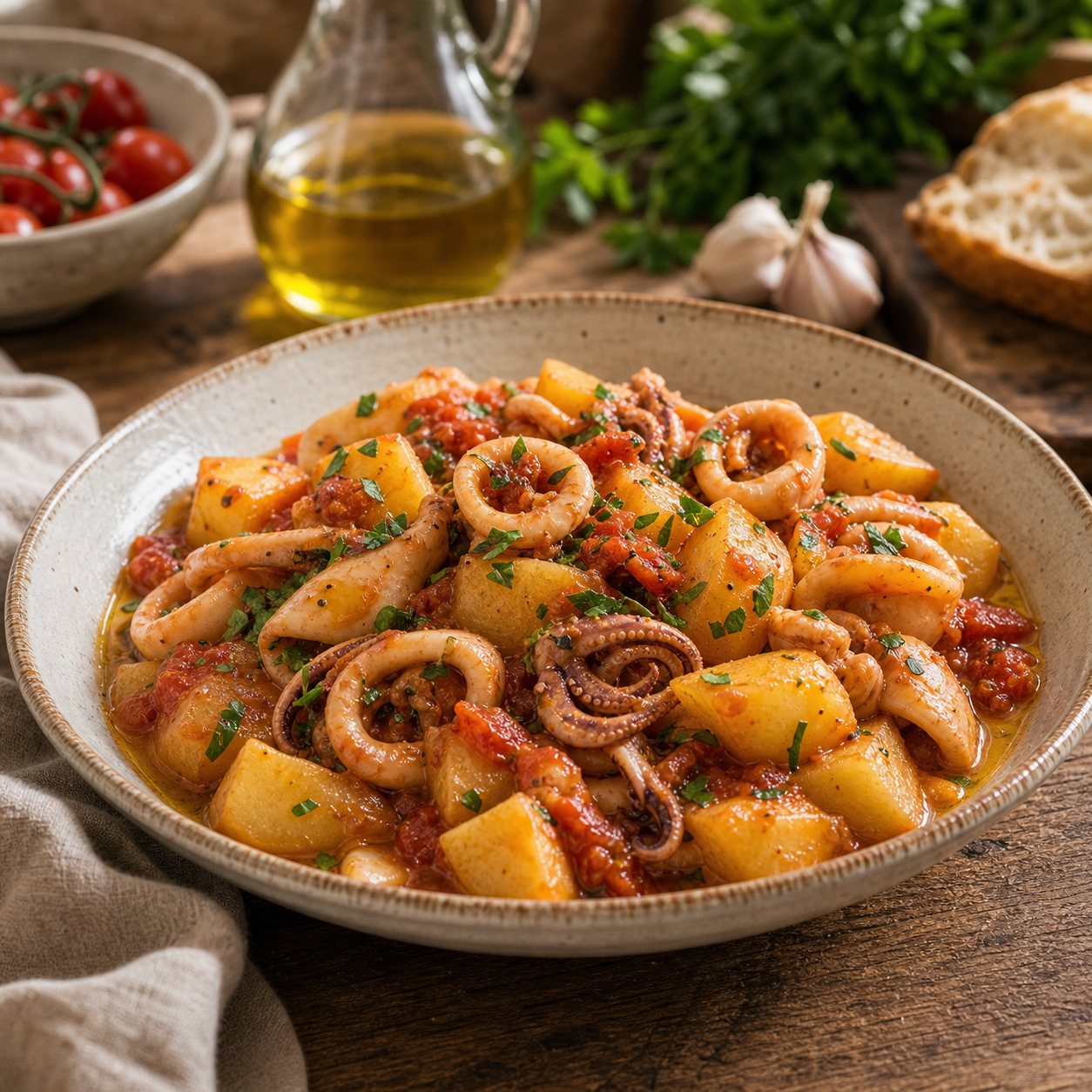
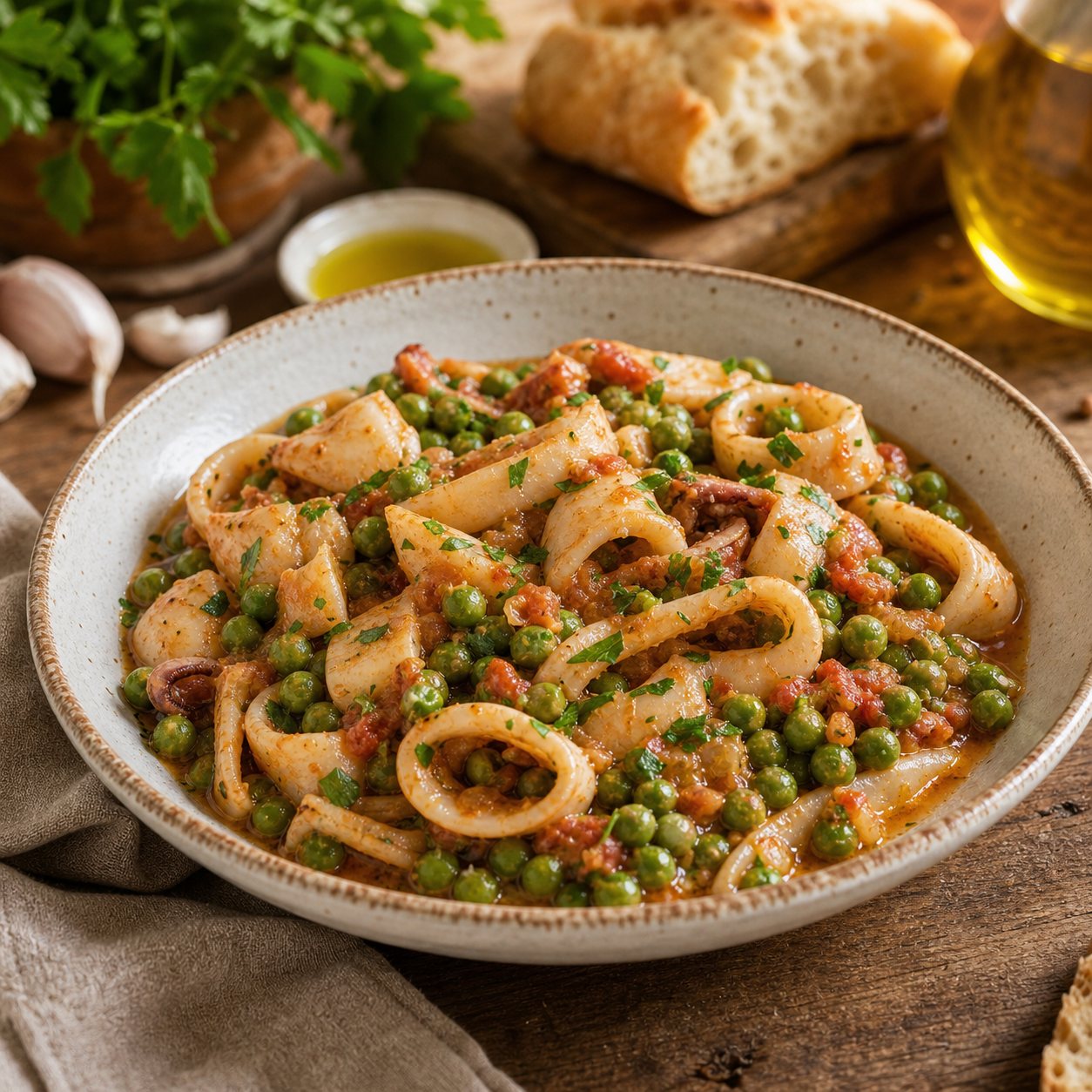
Tender cuttlefish and sweet peas cooked long and slow until the peas dissolve into something almost creamy and the cuttlefish becomes soft enough to cut with a spoon. A dish that requires almost nothing and gives back a great deal. The last time I ate it was the last time my mother made it for me.
My mother made seppie e piselli often when I was growing up, and I ate it without thinking too hard about it, the way children eat food that is always there. It was a spring dish primarily — when the peas were fresh and the cuttlefish was coming in regularly at the market — but she made the frozen-pea version in other months too, and it was nearly as good, because the long simmer equalizes things and what matters in this preparation is the time, not the season. I did not fully understand the dish until I was no longer eating it regularly, which is the usual order of things.
In my early twenties, during a period of graduate research at the Stazione Zoologica Anton Dohrn in Naples, I was working in a laboratory studying bioactive molecules in the defensive ink of Sepia officinalis — the common cuttlefish. We had fresh specimens in the lab regularly. One weekend I brought some home. My mother made the dish the way she always had — slow, with tomato, with the peas going in at the end when the cuttlefish was already nearly done — and we ate it at the kitchen table the way we always had. I did not know at the time that it was one of the last times she would make it for me. I know it now. The cuttlefish that afternoon had come from a research laboratory and ended up in a pan with olive oil and onion and tomato and peas, which seems to me like a correct use of a cuttlefish and a correct use of a Saturday.
There are two versions — in rosso with tomato, and in bianco without — and both are correct. The tomato version is the one my mother made most often, richer and darker, with the peas slightly losing their brightness against the deep sauce. The white version is lighter, cleaner, the sea flavor more present, usually finished with a little lemon zest. The choice depends on the season and the mood. In spring, when peas are fresh and the tomato feels heavy, the bianco is better. In colder months, the rosso is more comforting. Both can become pasta, soup, or risotto from the same base.
Cuttlefish, collagen, and the narrow cooking window between tough and tender
Cuttlefish muscle presents a cooking challenge that the Italian kitchen solves empirically: cooked briefly at high heat, it stays tender; cooked long and slowly, it becomes tender again. The window of toughness is in between — 5 to 15 minutes at moderate heat, where the proteins have denatured and contracted but the collagen has not yet hydrolyzed into gelatin. The recipe's structure — a 2–3 minute sear at high heat, then 20 minutes of low simmering — deliberately skips the tough window. The first stage sears and seals; the second converts the collagen in the cuttlefish's connective tissue to gelatin, which dissolves into the sauce and contributes to its body. This gelatin is why the sauce of a properly made seppie e piselli is silky and slightly thickened without any flour or cream. The peas contribute a second thickening mechanism: their starch and soluble dietary fiber break down during the simmer and integrate into the cooking liquid. Fresh spring peas have higher sugar content and release more flavor; frozen peas have their starch structure partially disrupted by the freezing process and thicken the sauce slightly more efficiently. Nutritionally, cuttlefish is a high-protein, very low-fat seafood — approximately 15–18 g protein per 100 g, less than 2 g fat — with meaningful quantities of selenium, zinc, B12, and omega-3 fatty acids. The ink, which some preparations retain, contains melanin and polysaccharides with documented antioxidant and antimicrobial properties at laboratory concentrations; whether culinary quantities are sufficient to produce measurable effects is an open question, but the ink is nutritionally harmless and adds flavor. The combination of cuttlefish protein with pea protein produces a reasonably complete amino acid profile, making this a well-balanced dish by the standards of the Mediterranean dietary pattern that generated it.
The recipe — in rosso o in bianco
The same base, two directions. Choose at step 4. Serves 4.
Ingredients
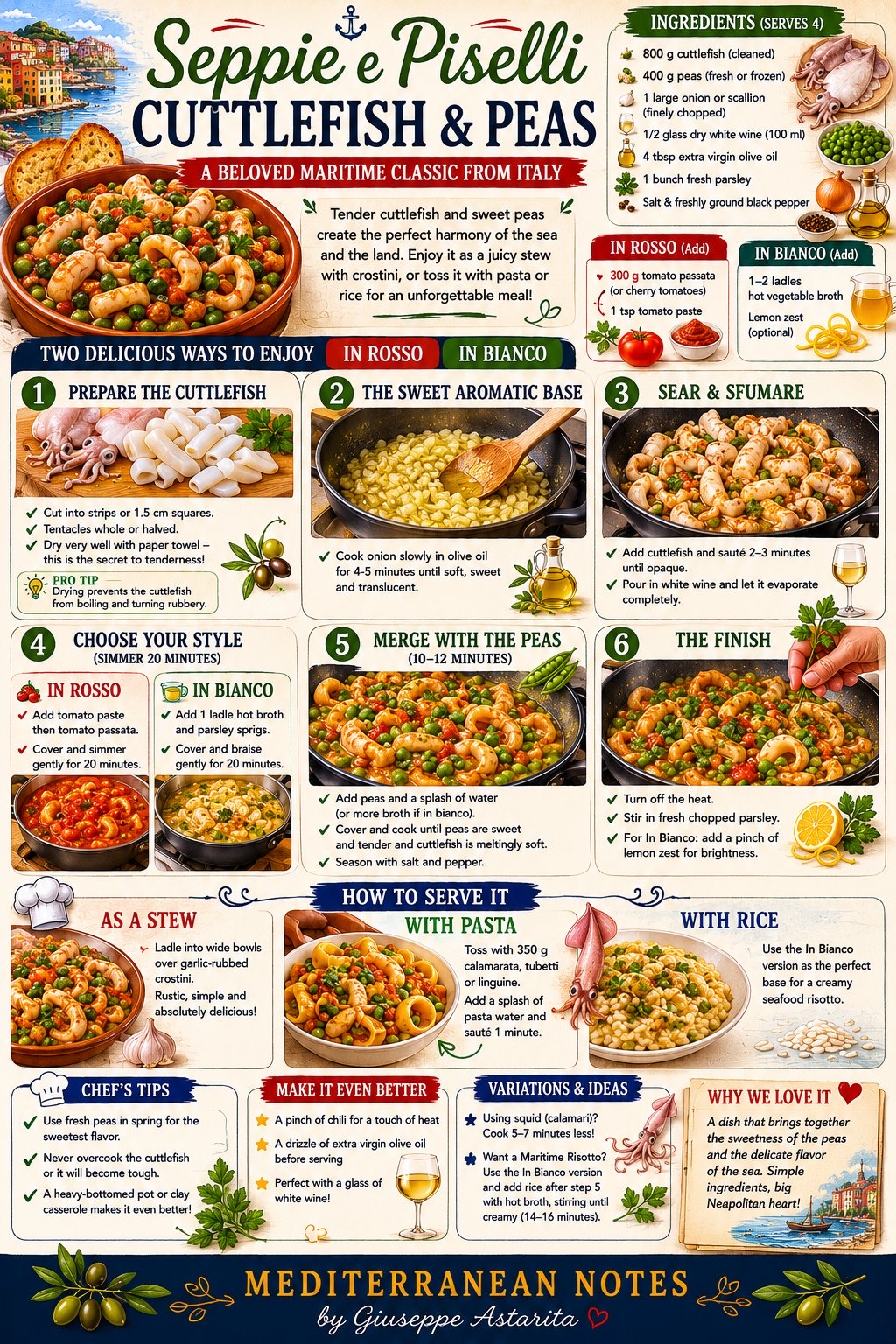
Method
Prepare the cuttlefish. Slice the bodies into strips or 1.5 cm squares, tentacles whole or halved. Dry very well with paper towels — this is the single most important step. Surface moisture causes the cuttlefish to steam rather than sear, which sends it directly into the tough middle zone rather than the quick-tender zone.
Build the base. In a heavy-bottomed pan or clay casserole, warm the olive oil over medium-low heat. Add the chopped onion and cook slowly for 4–5 minutes until soft, sweet, and translucent. Low heat, no hurrying — the sweetness of the onion is the foundation of the dish.
Sear and sfumare. Raise the heat. Add the dried cuttlefish and sauté for 2–3 minutes until opaque on all sides. Pour in the white wine and let it evaporate completely over high heat, stirring and scraping the pan.
Choose your direction.
In Rosso: Stir in the tomato paste, then add the tomato passata. Cover and simmer gently for 20 minutes.
In Bianco: Add a ladle of hot broth and a few parsley sprigs. Cover and braise gently for 20 minutes.
Add the peas. Tip in the peas with a splash of water — or extra broth if cooking in bianco. Cover and cook for another 10–12 minutes until the peas are tender and sweet and the cuttlefish is meltingly soft. Season with salt and pepper.
Finish and serve. Turn off the heat. Stir in a generous handful of chopped fresh parsley. For the in bianco version, add a pinch of fresh lemon zest now — it lifts the whole dish. Serve immediately.
To make this a maritime risotto: use the in bianco version, add the rice directly after step 5, and incorporate hot broth gradually for 14–16 minutes until creamy. The cuttlefish and peas become the risotto's soul.
How to serve it
As a stew it is the simplest and most direct version: ladle it into wide bowls over thick slices of bread rubbed with raw garlic while still warm. The bread absorbs the sauce and the cuttlefish sits on top and that is the meal. With pasta — calamarata, tubetti, or linguine — cook 350 g until very al dente, drop directly into the pan with a splash of starchy pasta water, and toss over high heat for one minute. The in bianco version works as the base of a maritime risotto: add rice directly after step 5 and incorporate hot broth gradually for 14–16 minutes until creamy.
The wine: Greco di Tufo for the in rosso version, which needs something with enough structure to hold against the tomato. Fiano di Avellino for the in bianco, which is more delicate and needs a wine that does not overwhelm it. Either way, a Campanian white. The dish is from Campania and the wine should be too.
Buon appetito — e che la seppia sia tenera.