Il ragù di Peppe: named after me, made by my mother
My favorite sauce. Named after me. Made the way my mother made it, which is the only way it should be made.
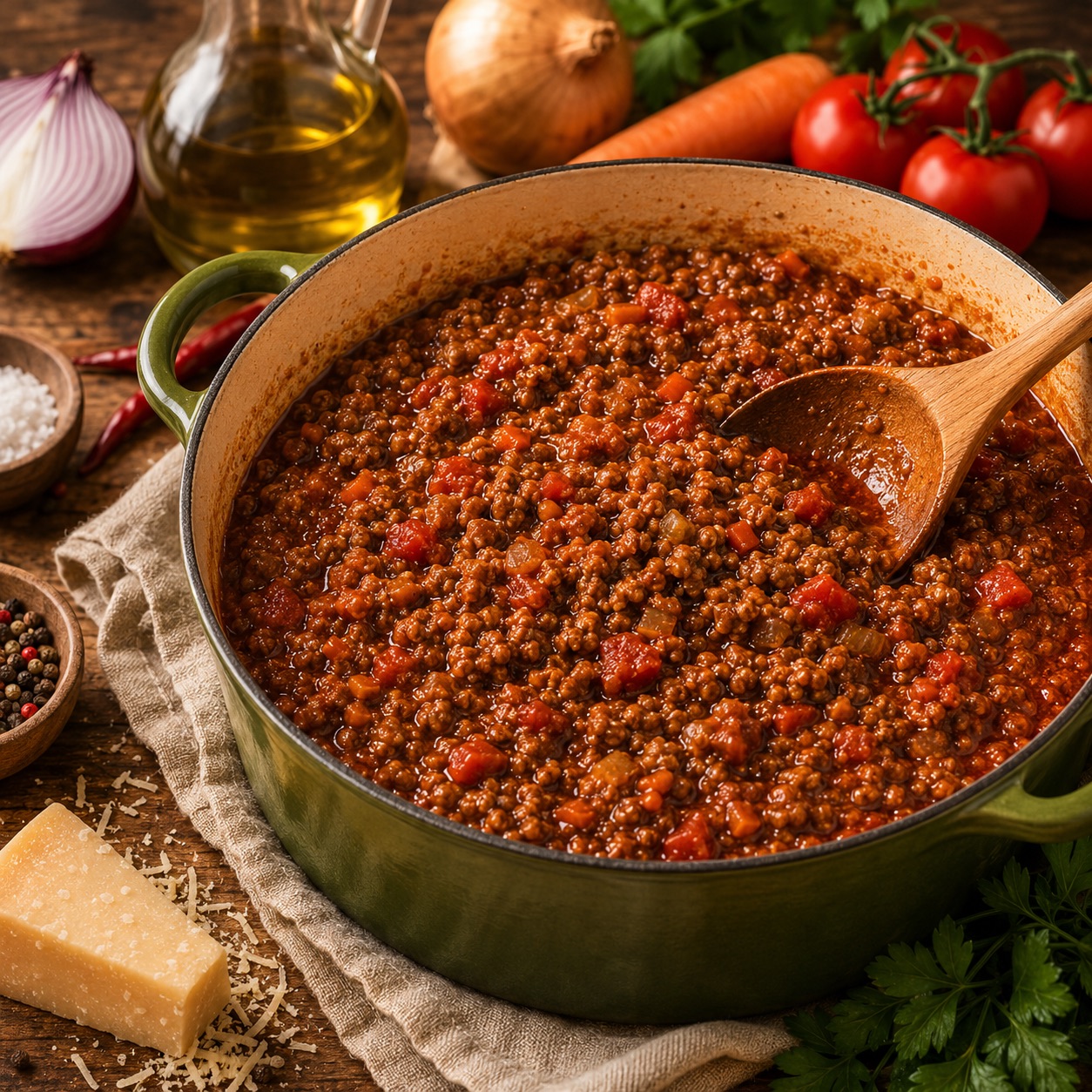
I named this sauce after myself because it is the most honest description I have. This is my sauce. I make it the way my mother made it, which is the way her mother made it, with slight variations introduced over decades that I can no longer trace to their origin.
It is not the Neapolitan Sunday ragù — that dish is a different animal entirely, requiring whole cuts of pork and beef, hours of cooking, meat that falls from the bone into a sauce that turns dark and rich and almost sweet. That is for another day. This is the weeknight version: ground beef, soffritto of onion and carrot, tomato, slow heat. Thirty minutes minimum. An hour is better. Two hours and it is something else again.
The longer it cooks, the better it tastes. I have made this on a Saturday morning and let it go until dinner. It is not the same sauce it was two hours before.
Maillard reactions, caramelization, and why slow cooking builds irreplaceable flavor
The long cooking of this sauce drives Maillard reactions and caramelization simultaneously — the amino acids in the meat interact with sugars from the tomato and the softened onion and carrot, creating hundreds of flavor compounds that accumulate over time. This is why a sauce that cooks longer tastes more complex: not because new ingredients are added, but because existing compounds continue reacting. The tomato lycopene becomes progressively more bioavailable as the sauce cooks with oil — the extended heat and fat-presence maximally extracts and converts the lycopene from its crystalline form in the tomato cell. The carrot is not just flavor: its carotenoids — primarily beta-carotene — are fat-soluble and become accessible in the olive oil.
This is not a quick sauce. If you are in a hurry, make something else. If you have time, this is the answer.
Not Bologna. Caserta.
My daughter asked what the difference is between this and a Bolognese. It is a fair question and the answer is real, not just regional pride. The ragù Bolognese — the one from Bologna, the one with a protected recipe registered with the Bologna Chamber of Commerce since 1982 — is built on a soffritto of onion, celery, and carrot, uses a mixture of beef and pork, adds milk or cream to soften the acidity, uses very little tomato (sometimes none, just a spoonful of paste), and is finished with white wine. It is a rich, pale, unctuous sauce. It goes on tagliatelle. It does not belong on spaghetti, and a Bolognese will tell you this with feeling.
This sauce is from Caserta, in Campania, and it is a different thing. No celery, no milk, no cream. More tomato — a full can, not a spoonful. White or red onion depending on what is at hand — both work, the red onion slightly sweeter, the white more neutral and the one most often used simply because it is always there. Hot pepper is optional and used sparingly when it appears at all — the sauce does not depend on heat, though a small amount in the background does something useful to the tomato. Olive oil throughout, not butter. The result is brighter, more acidic, more assertive. It tastes of the south: of tomato, of olive oil rather than dairy fat, of a kitchen that is several hundred kilometers from the Po Valley and has no interest in pretending otherwise. Both sauces are correct. They are just correct about different places.
Why the fat source changes the sauce — olive oil vs butter and the flavor chemistry of the soffritto
The fat used in the soffritto is not neutral — it carries and transforms the volatile aromatic compounds released by the onion and carrot as they cook. Butter, used in the Bolognese tradition, contains short-chain fatty acids and milk proteins that undergo their own Maillard reactions at soffritto temperature, contributing dairy-derived lactone and diacetyl aromas that round and soften the base. Extra-virgin olive oil, used here, contains polyphenols — primarily oleocanthal and oleuropein — that are heat-stable enough to survive soffritto cooking and contribute a distinct peppery, slightly bitter character to the base. The olive oil also extracts fat-soluble carotenoids from the carrot more efficiently than butter at the same temperature. The addition of hot pepper introduces capsaicin and related capsaicinoids — fat-soluble compounds that dissolve into the olive oil and distribute evenly through the sauce over the long cooking time, producing a warmth that builds gradually rather than hitting immediately. The tomato's acidity, unreduced by milk or cream, remains present throughout, giving the finished sauce its brighter, more assertive character. These are not better or worse choices — they are chemically different choices that produce recognizably different sauces from similar base ingredients.
Ingredients · serves 2–3
Method
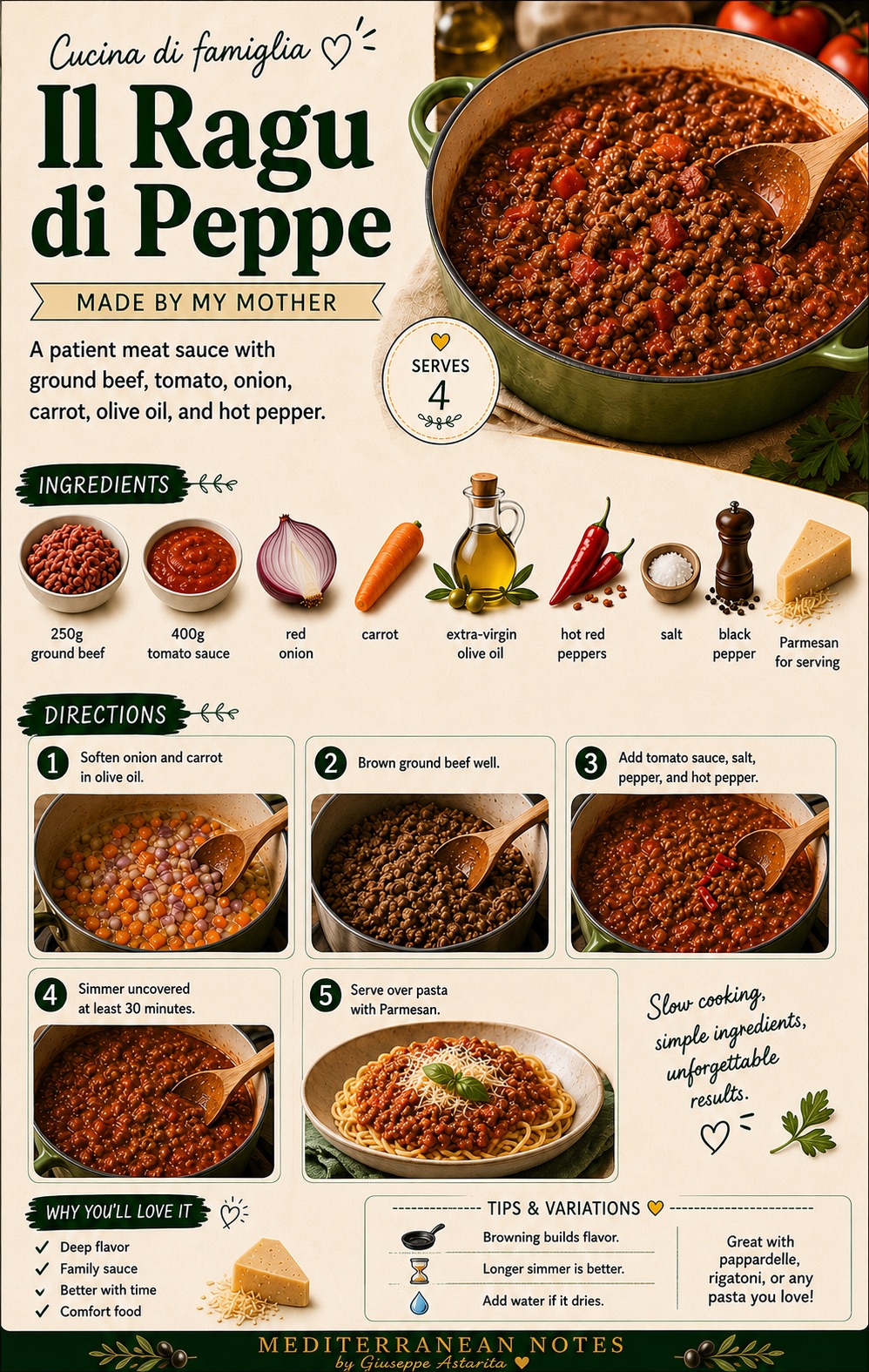
Heat the olive oil in a heavy-bottomed pot over medium heat. Add the chopped onion and carrot. Cook slowly until the onion is translucent and the carrot is soft — about 8 minutes. Do not rush the soffritto.
Add the ground beef. Spread it in the pot and let it brown without disturbing for 2 minutes. Then break it up and brown throughout. Drain any excess fat.
The browning of the meat is where most of the flavor comes from. Take your time. A mix of beef and pork — roughly 60/40 — also works very well: the pork fat adds richness and the mixed proteins produce a slightly more complex Maillard crust. Either way, brown properly before the tomato goes in.
Add the tomato sauce, salt, pepper, and hot peppers. Stir to combine.
Reduce heat to low. Cook uncovered, stirring occasionally, for at least 30 minutes. An hour is better. Two hours is best.
The sauce should reduce and darken. If it dries out, add a splash of water and continue.
Serve over any pasta with Parmesan.
Buon appetito.