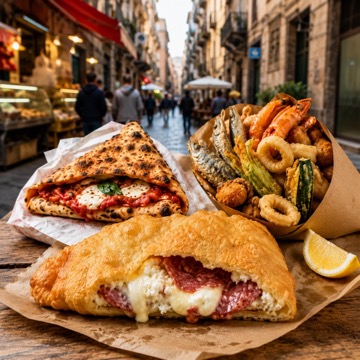
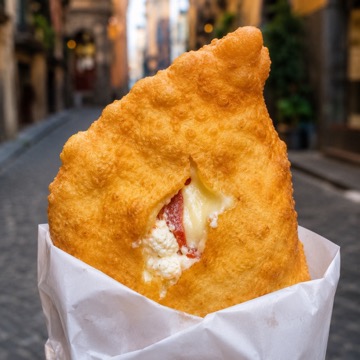
Pizza a Portafoglio
The wallet pizza of Naples. Fresh out of the oven, folded in quarters, eaten in a few morsi while walking the vicoli. How much I miss it.
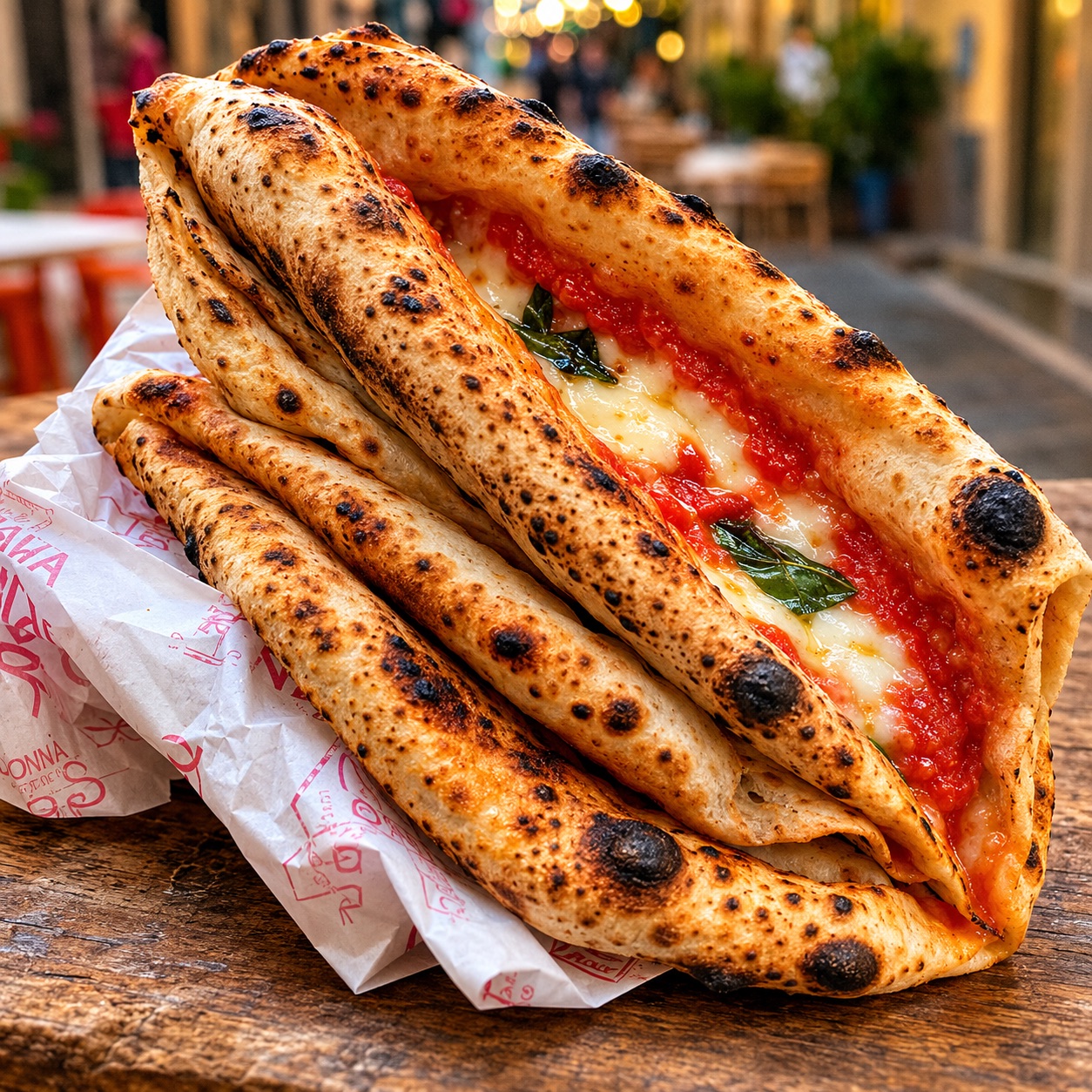
For five years this was my lunch. Between classes, among the vicoli, a few coins at the counter of whichever pizzeria had the oven going — and a whole pizza, fresh out of the fire, folded in half and in half again, wrapped in paper, in my hand. Pizza a portafoglio: the wallet pizza. You eat it in a few morsi, walking, before the steam has finished escaping. Oh, how much I miss it.
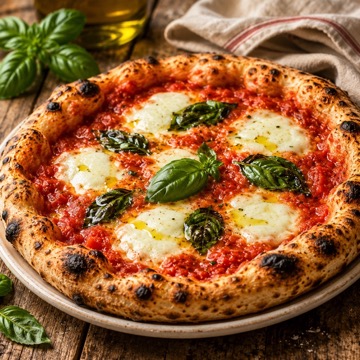
What I want to insist on is that this is not a lesser pizza. It is a real Neapolitan pizza — a slightly smaller margherita or marinara, baked in the same wood oven as the ones that arrive on plates — that happens to be folded. Fresh out of the oven it carries the entire essence of the pizza in your hands: the soft elastic dough that folds without cracking, the molten heart of tomato and mozzarella trapped inside, the leopard-spotted crust against your fingers through the paper. The fold is not a compromise. The fold is the format.
The fold earns its keep twice. Born as the fast food of workers, students, and travelers — I was the student — it makes the pizza one-handed, walkable, affordable. And it traps the steam and the molten toppings inside, so the pizza stays burning hot and nothing drips on your shirt as you thread through the crowd. The first bite at the corner releases a cloud of steam; you learn to bite the corners first and work inward. By the time you reach the molten center you have arrived wherever you were going, and you are sorry the walk was not longer.
We also sat down, of course — a proper pizza on the plate, knife and fork, at a table. Growing up in southern Italy, pizza in one of these two forms and a gelato afterwards were most of what eating out meant. But the portafoglio is the version that belongs to the street itself, and to a particular age: young, hungry, between one place and another, with exactly a few euros in your pocket. Which is to say, the format was invented for precisely who I was.
Why the dough folds instead of cracking
Neapolitan dough is highly hydrated and long-fermented, which builds an extensible gluten network — it stretches rather than breaks. Out of a 450°C oven, the crumb is still full of steam and the gluten is warm and plastic: the pizza folds like fabric. The same pizza cooled would crack at the fold; the portafoglio only exists at oven temperature, which is why it is a street food and not a takeaway food.
The fold also turns the pizza into its own insulation: the trapped steam keeps the interior near serving temperature for the length of a Neapolitan block, and the double layer of crust protects your hand. Function, in Naples, always tastes like tradition.
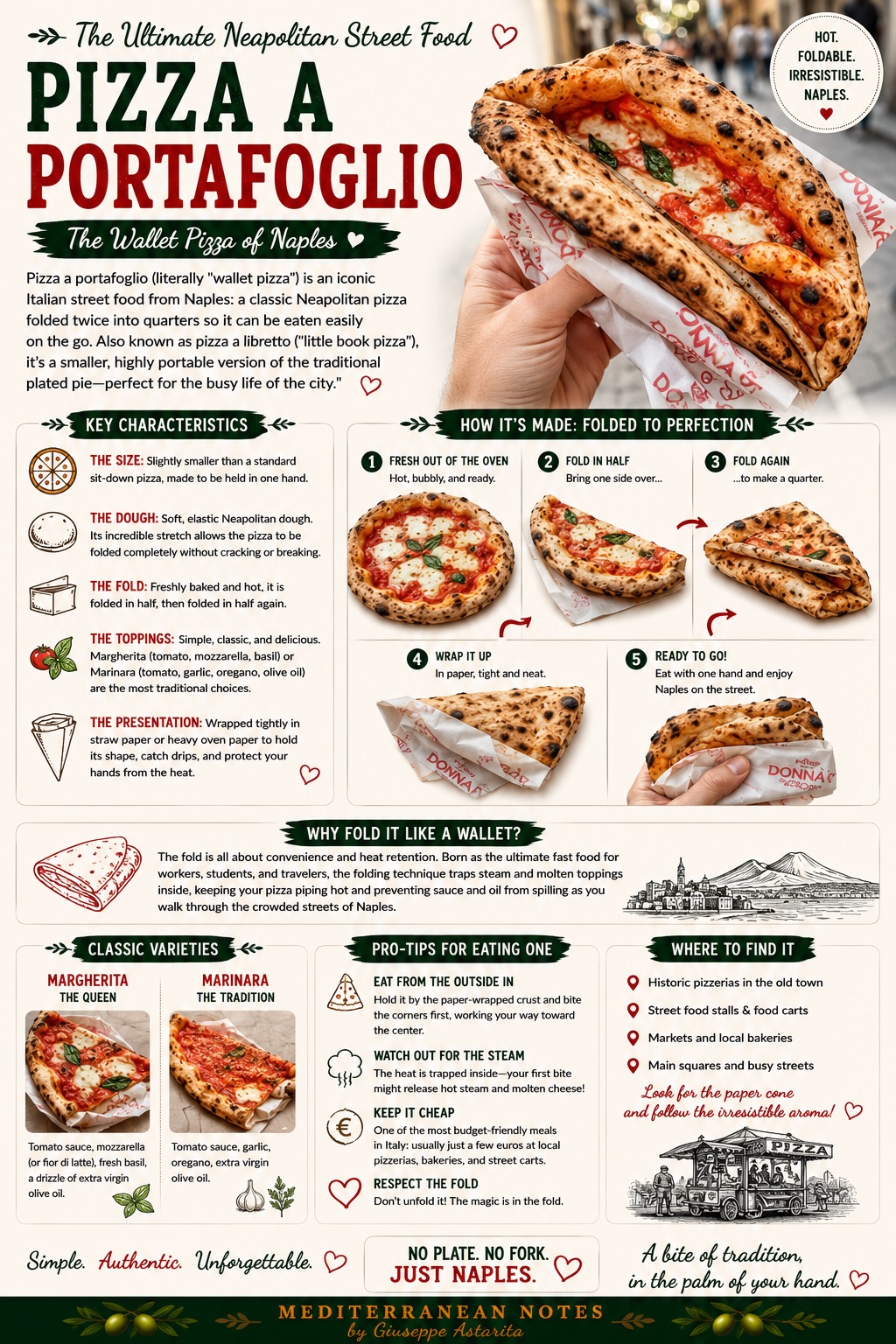
Tap to enlarge — Pizza a portafoglio: the fold, the varieties, the rules
The portafoglio is the only street food I bought with any loyalty in my five years among the vicoli — the rest of the street canon I mostly admired through the smell. Loyalty to one thing, in a city that offers a hundred, is also a way of loving it.