Il Gelato Artigianale
Every day in summer, eaten fast, with the people you love
In Campania in summer you eat gelato almost every day. Not as a treat reserved for special occasions — as a daily thing, as natural as coffee in the morning. You go with your mother or your grandmother or whoever is there, and you eat it quickly because the heat is serious and gelato does not wait.

The gelateria in Caserta was not a destination. It was part of the afternoon routine in the same way that the bar for coffee was part of the morning routine — a stop, a pause, something that punctuated the day rather than interrupted it. In summer my mother would take us in the late afternoon, sometimes with my grandmother, and we would sit outside if there were chairs or stand at the counter and eat our gelato before it could do what gelato in Campanian July always threatens to do: melt faster than you can eat it. The heat was not incidental. It was the condition under which the gelato existed. You learned to eat with a certain pace, tilting the cone slightly, catching the edge of the first scoop before it reached your hand. This is a skill that no Italian child is taught and every Italian child acquires.
The social dimension of the gelateria in Italy is something that takes time to understand from the outside but is obvious from inside. It functions like a coffee break in the sense that it is genuinely about being with someone. The gelato is the occasion, not really the point. You go to the gelateria with your family or your friends the way you go for a coffee — not primarily because you need gelato at that moment but because going together is the thing, and gelato is the shared object around which the being-together organizes itself. In Caserta this happened across generations without anyone coordinating it: grandmothers and children at the same gelateria counter, each choosing what they had always chosen, and the hour spent there was a complete thing that needed no justification beyond itself.
The gelateria had a specific way of being. The counter with the metal pozzetti — the covered containers sunk into the counter at an angle — and the gelataio with the flat paddle who scooped and shaped and handed you the cone or the coppetta. The flavors written on small signs above each container, though after a while you did not need to read them because you already knew your order. The question of one flavor or two. Two was permissible; three was generally too many, though children pushed on this point. My grandmother always chose nocciola. My mother varied. I went through periods of absolute loyalty to stracciatella followed by periods of pistacchio, which still seem to me the two most serious flavors available at any gelateria that does them well.
What distinguishes artisan gelato from industrial ice cream is not primarily the flavor — though the flavor difference is real and significant — but the texture and the density. Artisan gelato is churned with less air than industrial ice cream, a technical difference with a direct sensory consequence: the gelato is denser, heavier on the spoon, more concentrated in flavor per volume. A small coppetta of good artisan gelato is more satisfying than a large portion of the industrial equivalent, not despite being smaller but because of the density. The gelataio makes it fresh every day in small batches with local seasonal ingredients — strawberry when strawberries are good, no strawberry when they are not. This seasonal discipline is not marketing language. It is what produces the difference you taste.
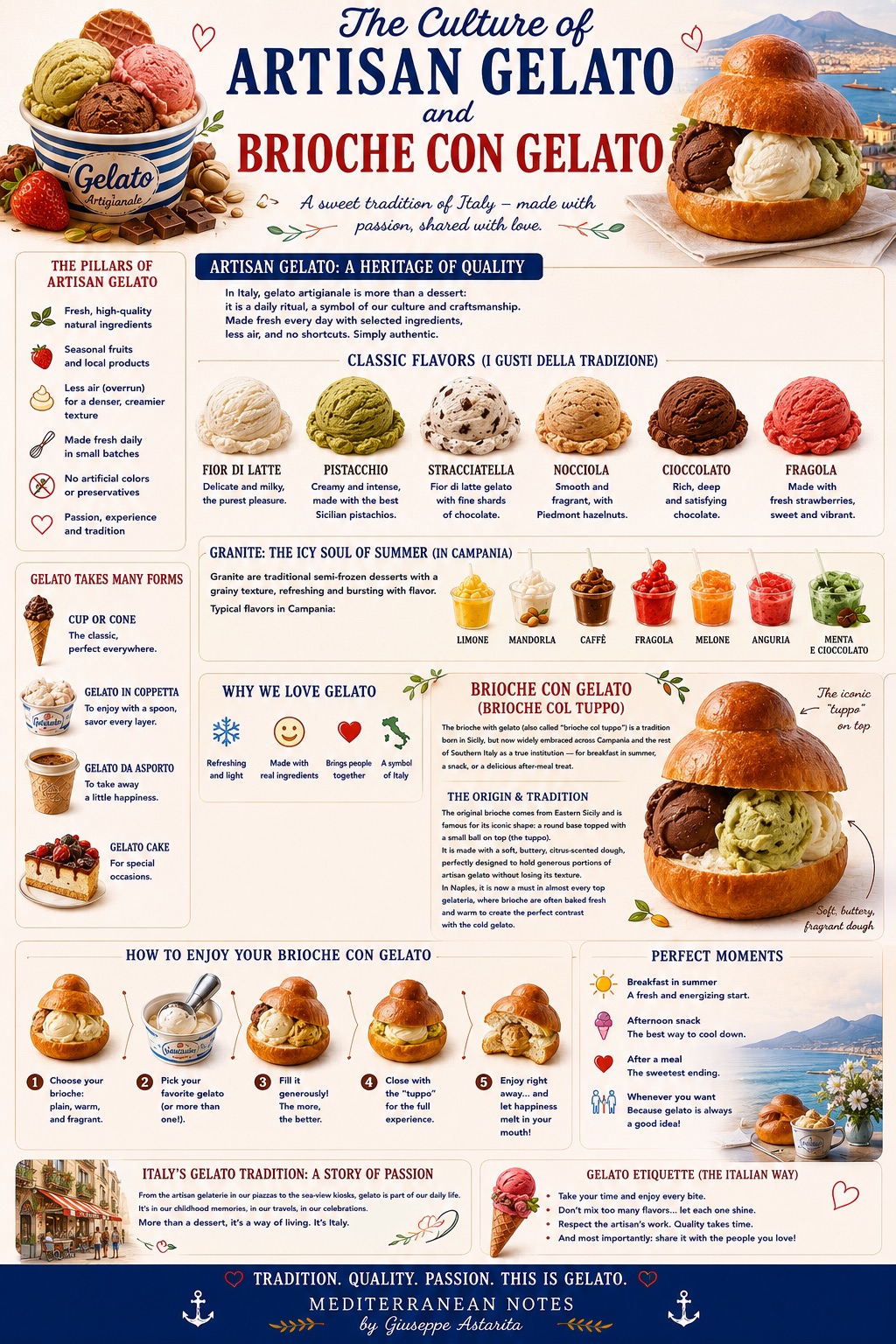
I gusti della tradizione
La granita — the icy soul of Campanian summer
The granita is not gelato. It is a semi-frozen preparation with a deliberately grainy texture — smaller ice crystals than a sorbet, stirred rather than churned, served in a cup with a spoon. In Campania the granita is a summer institution in its own right, sometimes eaten for breakfast with a brioche, sometimes in the afternoon as an alternative to gelato when the heat calls for something even colder and lighter. The mandorla granita — almond — is one of the great flavors of the Campanian summer, pale and subtly sweet, with none of the heaviness of a cream gelato. The caffè granita is the other essential: intensely coffee-flavored, slightly bitter, the best possible response to a hot afternoon in July.
Artisan gelato melts faster than industrial ice cream for the same reason it tastes better: lower overrun and fewer stabilizers. Overrun is the percentage of air incorporated during churning — industrial ice cream can reach 50–100% overrun, meaning up to half its volume is air, which acts as insulation and slows melting. Artisan gelato is typically churned at 20–30% overrun, producing a denser product with less insulating air. It also contains fewer hydrocolloid stabilizers — guar gum, carrageenan, locust bean gum — which in industrial products bind water and slow ice crystal growth, extending both shelf life and melt time. The result of these absences is a product that melts quickly in heat, which is the direct sensory evidence of its authenticity. The rapid melting is not a flaw — it is the consequence of making gelato with fresh ingredients, minimal air, and no industrial binding agents. It is also why artisan gelato must be kept at a specific temperature range (typically -11 to -14°C, warmer than industrial ice cream at -18°C) and consumed fresh. A gelato that never melts is a gelato that has been made to last, which is a different set of priorities from a gelato made to be eaten immediately. In Campania in July, immediacy is the only relevant category.
In Massachusetts in 2026 a good artisan gelato is still genuinely difficult to find. There are places in Boston that do a reasonable approximation — lower overrun than American ice cream, fresh ingredients, a proper pozzetto counter — but the specific flavor profile of a Neapolitan gelateria in summer, made with local milk and local fruit and the particular confidence of someone who has been doing the same thing every day for thirty years, is not something that travels easily. My daughters know this from the two times they have been to Italy. Anna, who is nine, has a specific opinion about stracciatella that she formed at a gelateria in Naples at age six and has not revised since. Carolina, who is four, has not yet developed the same certainty but is working on it. We go back to Italy every summer when we can, and the gelateria is on the list of things to do on the first day, before anything else.
The etiquette of the Italian gelateria is worth stating plainly because it is real even if unwritten. You take your time and enjoy every bite — the gelateria is not a fast-food stop even when you are standing at the counter. You do not mix too many flavors: two is the standard maximum, chosen because they complement each other, not because you could not decide. Three flavors in one cone is the choice of someone who has not thought about it. You respect the work — a gelateria that makes its gelato fresh every day from quality ingredients has earned a moment of attention. And you share it with the people you are with, which is the actual point of going in the first place.
Buona estate — e mangiatelo veloce, che si scioglie.