La Conserva di Pomodoro
The Taste of Summer, All Winter Long
Every September, the crates of San Marzano tomatoes arrived. My father took time off work so we could all do it together as a family — parents, children, sometimes grandparents. We made passata and pelati, enough to last the whole winter. I remember waking up excited for it. Sometimes it lasted days. Once we went to my aunt's house and even more people joined. It was a family and community ritual.
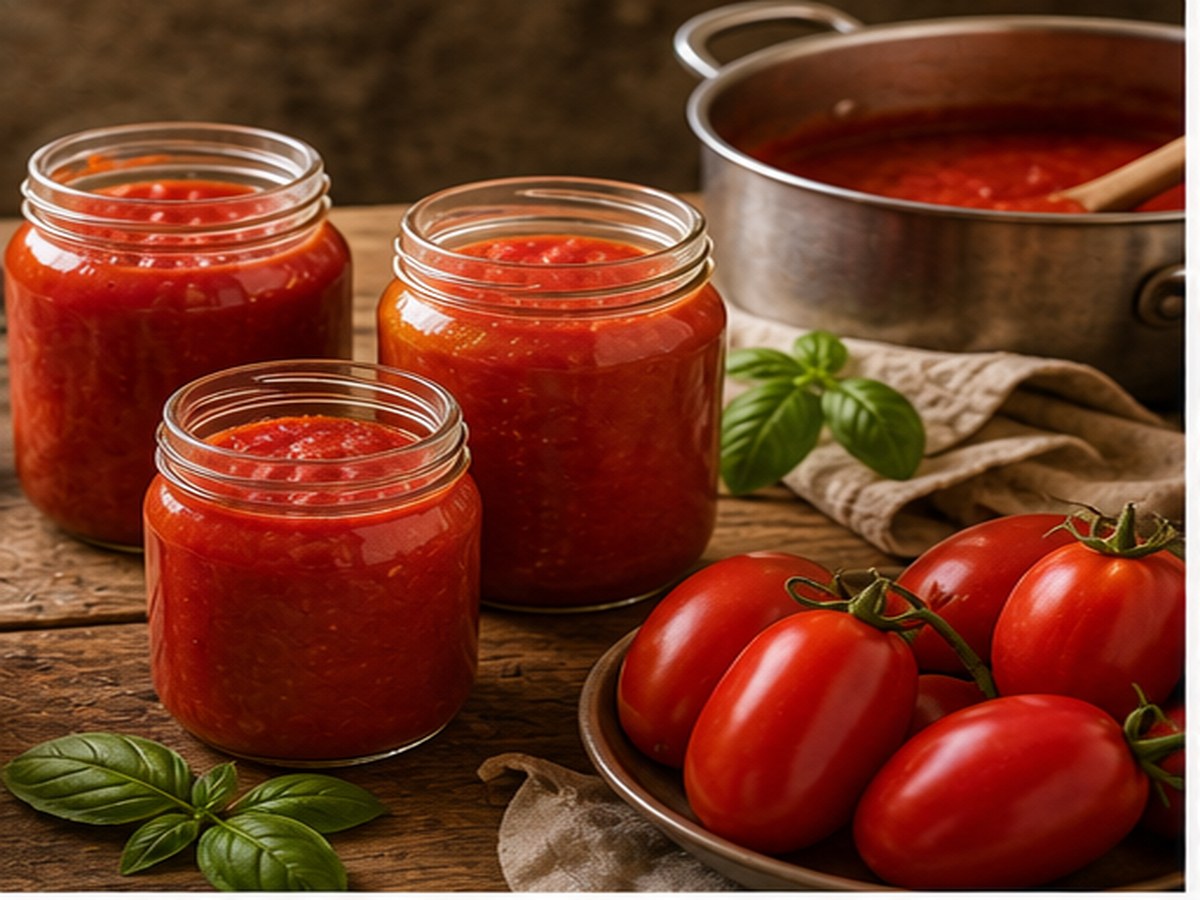
The work lasted a full day, sometimes two or three. There was the washing, the blanching, the peeling for the pelati, the cooking and passing through the mill for the passata, the filling of the sterilized jars, the basil leaf added to each one before sealing — always the basil, a leaf in each bottle — the pasteurization in the large pot, the labeling, and finally the carrying down to the basement garage where the jars were stored in the dark and the cool, in rows, labeled with the year. That was the winter supply. We went downstairs to get it whenever we needed it — all year long, until the next September brought more.
Once we did it at my aunt's house and even more people joined — neighbors, relatives, a whole network of people who helped and who had their own jars at the end of the day. This is what a community ritual looks like. Not organized, not announced formally, just understood: when the tomatoes arrive in September, everyone comes. Every jar opened in winter was like opening a memory of summer, of home, of love.
Tradition. Family. Flavor. That's the real secret.
The San Marzano tomato is the correct variety for this preparation and the reason it is specified is not snobbery — it is practicality. The San Marzano has more flesh and less water than most round tomatoes, fewer seeds, and a thin skin that slides off easily after blanching. These properties make it ideal for both pelati and passata: the pelato holds its shape in the jar without dissolving; the passata produced from San Marzano has a density and sweetness that rounder, more watery tomatoes cannot match. The volcanic soil of the Agro Nocerino-Sarnese plain — fertilized by centuries of Vesuvius eruptions — concentrates the flavors and produces a tomato that is genuinely different from varieties grown elsewhere in different soil. This is why San Marzano tomatoes have a DOP designation. It is also why every jar of passata produced in September in a Caserta kitchen smelled and tasted like a specific place at a specific time of year.
Nowadays you buy cans and bottles from the store. The commercial product is good — some of it is very good — and it is certainly safer in terms of consistent pasteurization and food safety regulation. But it has lost the specific thing that made the September ritual what it was: the participation of many people in a shared physical task, the smell of the tomatoes cooking for hours, the rows of filled jars cooling on the table, the specific knowledge of whose land the tomatoes came from, and the pleasure of going to the basement in January to retrieve a bottle you had filled in September with your own hands. These are not things that a supermarket shelf provides.
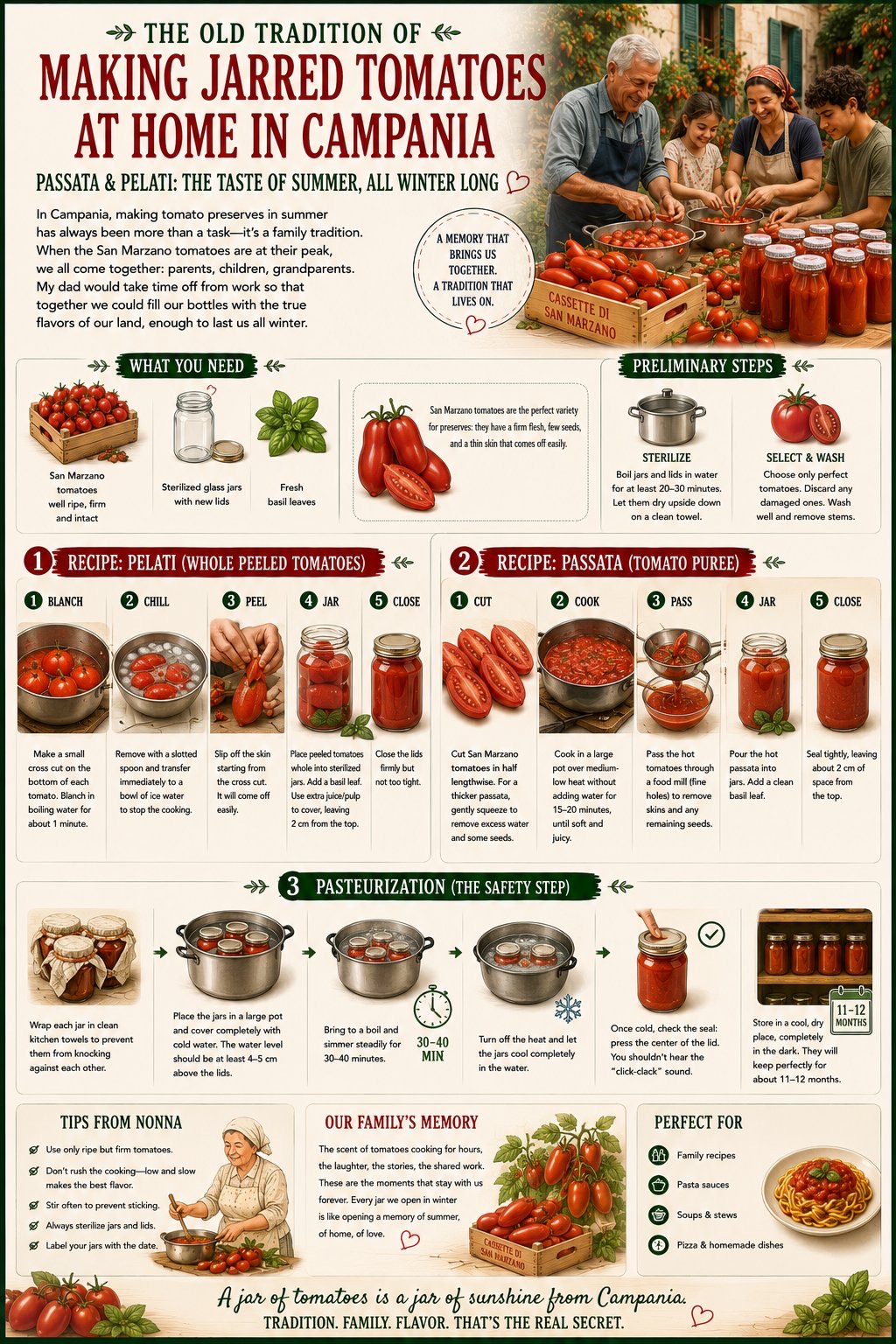
The two preparations
The San Marzano tomato's suitability for preserving comes from its specific fruit composition. Compared to round tomatoes, San Marzano has a higher ratio of dry matter (flesh) to water content — approximately 6–7% compared to 4–5% in standard varieties — fewer locular cells (the chambers containing seeds and gel), and a thinner, more easily removed skin. The higher dry matter means less water in the final preserve, producing a denser passata and pelati that hold their texture through storage. The DOP designation restricts certified San Marzano cultivation to the volcanic plains between Naples and Salerno, where the soil composition — high in minerals and organic matter from volcanic deposits — produces the flavor profile that distinguishes the authentic tomato from commercially grown imitations elsewhere.
The pasteurization step in a boiling water bath achieves two things: it destroys pathogenic microorganisms (primarily Listeria, Salmonella, and the spores of Clostridium botulinum, which can survive in low-acid environments) and it creates a vacuum seal as the contents cool and contract, pulling the lid inward and preventing recontamination. Tomatoes are sufficiently acidic (pH 4.0–4.5) that botulism is not a significant risk with proper technique, but the pasteurization also extends shelf life by destroying yeasts, molds, and spoilage bacteria. The family method described here — boiling water bath, proper headspace, verified seal — is the same method used by commercial canners, just at kitchen scale.
The basement garage where we stored the jars was cool and dark — exactly the correct environment for long-term storage. Going down in January or February to retrieve a jar of passata, seeing the rows of labeled bottles in the dim light, picking one up and carrying it upstairs: this was an act that compressed the distance between summer and winter, between the September morning when the crates arrived and the February Sunday when the sauce went on the stove. The jar contained both the tomato and the memory of making it. You could not open one without knowing where it came from.
This tradition is documented here not as a recipe to replicate exactly — commercial canned San Marzano tomatoes are genuinely excellent and the safety standards of industrial production are higher than most home operations — but as a record of what it was. The September days with the whole family organized around the tomatoes. My father's annual leave from work, allocated to this purpose. The smell of the tomatoes cooking in the large pot. The basil leaf in each bottle. The rows of jars in the basement. The joy of a child waking up early because something real and shared was happening in the kitchen and you wanted to be part of it.
Un barattolo di pomodori è un barattolo di sole campano.
A jar of tomatoes is a jar of sunshine from Campania.