Babà Napoletano
Naples' most iconic pastry — light yeast cake, rum syrup, whipped cream
The babà has one of the more remarkable itineraries in the history of European pastry. It began in Poland as the baba, a yeast cake flavored with saffron and raisins made in the court of the Polish king Stanisław Leszczyński, who reportedly found the local brioche too dry and soaked it in sweet Tokaji wine. When Stanisław went into exile in Lorraine and became its Duke, he brought the recipe with him, and from Lorraine it traveled to Paris where a Polish pastry chef introduced it to the French courts — replacing the Tokaji with Jamaican rum, which had become fashionable at Versailles, and developing the mushroom shape that French pâtisseries still make today. From Paris it came to Naples in the nineteenth century, brought by the monsù — the French-trained cooks who worked in aristocratic Neapolitan households — and Naples made it into something that is now so deeply Neapolitan that the city considers it its own.
In our family the babà made one more journey — from the pasticceria into my mother's oven. My father loved it so much that for his birthday she used to make one large babà as the cake: a single great golden dome, soaked through, in place of anything more ceremonial. I think what he loved most was the rum. Nobody ever asked for a different cake.
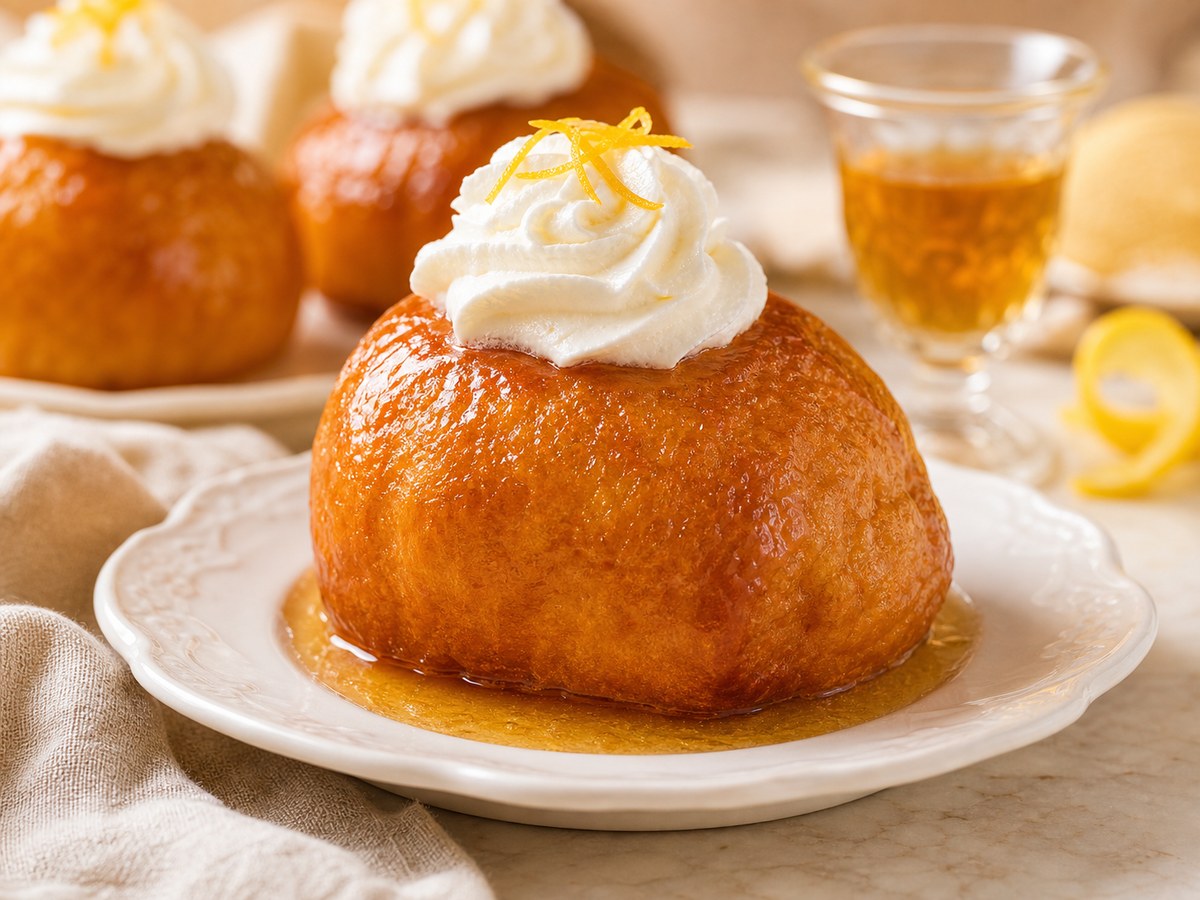
The Neapolitan babà is rounder than the French version, often baked in individual domed molds, and it is soaked more aggressively — the rum syrup penetrates all the way through, so that each bite releases rum and sugar and lemon zest. It is served with a cloud of fresh whipped cream and a candied cherry. It is found in every pasticceria in Naples and bought from street carts and eaten standing up, or taken home in a box and eaten at the table with coffee. It is one of the few things about which Neapolitans make no concession to moderation.
The babà dough is enriched with eggs and butter, which inhibit gluten development and require extended kneading to build the protein network that can support the fermentation gases produced by the yeast. Under-kneaded babà dough does not trap these gases effectively; the resulting cake is dense and the rum syrup cannot penetrate properly because the internal structure has no open pores to absorb it. Well-kneaded dough develops a tight, elastic gluten network that expands significantly during the two rises — the first at room temperature for 2–3 hours, the second in the molds — producing the open, airy crumb structure that makes the babà feel light despite being soaked in sugar syrup. The butter, added a little at a time after the gluten is established, lubricates the protein network and gives the crumb its characteristic tenderness. The rum in the syrup is not only flavor — the ethanol lowers the surface tension of the syrup and helps it penetrate the crumb more efficiently than a water-based syrup would.
The recipe
For the dough (6–8 babà)
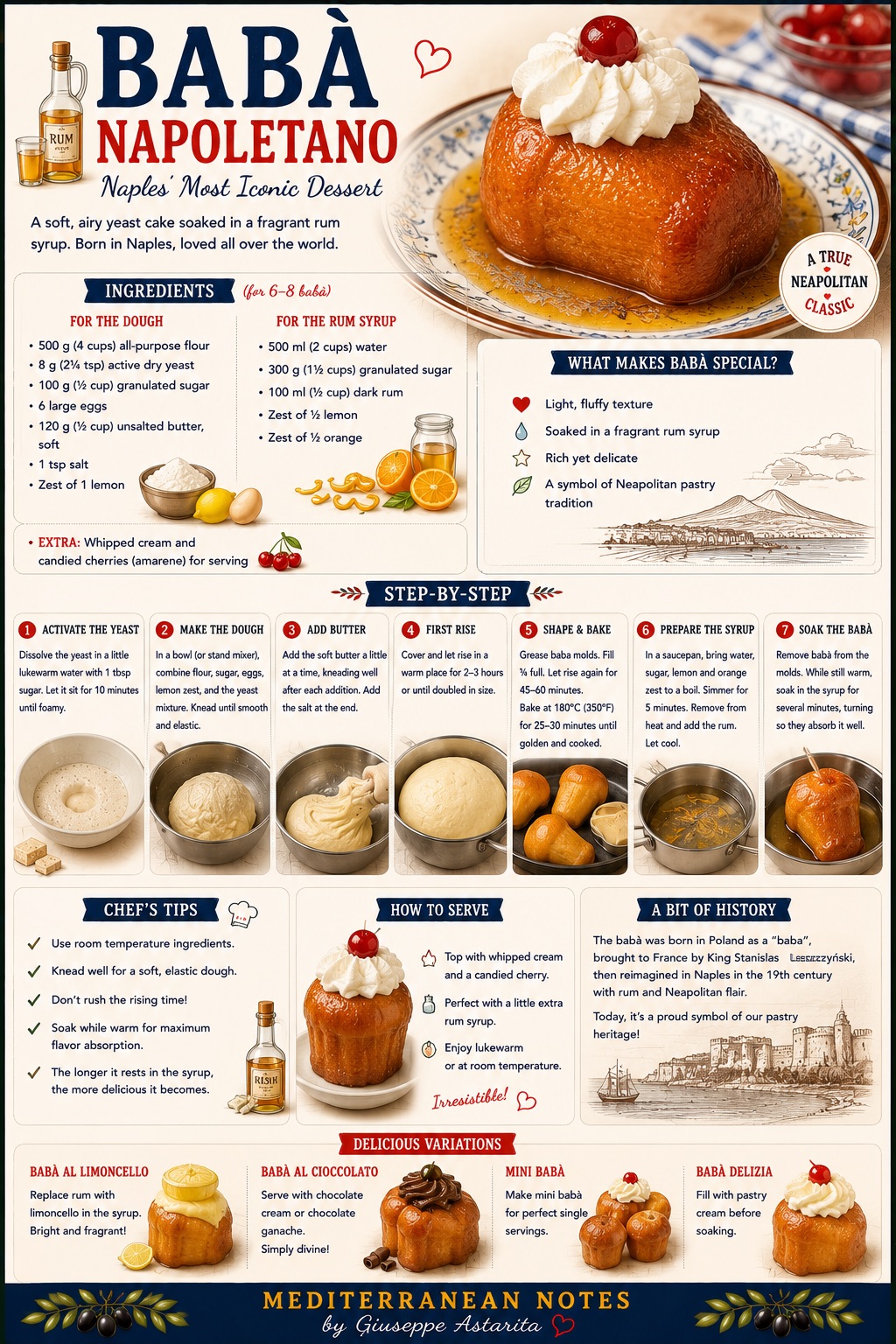
For the rum syrup
Buon appetito — e buon rum.